Arminius: The Germanic Warrior Who Defied Rome
Trained by Rome and trusted by its commanders, Arminius used the empire’s own military knowledge to destroy three legions in the forests of Germania.
Introduction
In the autumn of 9 CE, a Roman army disappeared into the wet forests and narrow passes of northern Germania. It included three experienced legions, auxiliary troops, cavalry, servants, families, and a heavy baggage train. Few returned. The man responsible was Arminius—a Germanic noble who had served Rome, gained Roman citizenship, and learned how its army marched, fought, and trusted its allies.
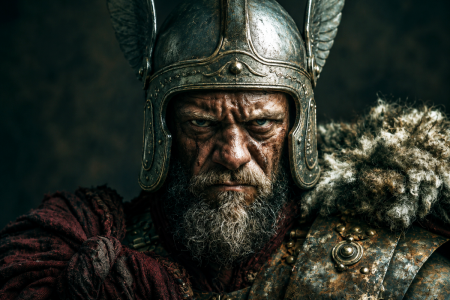
The Battle of the Teutoburg Forest became one of the most devastating defeats in Roman history. Arminius united elements of several Germanic tribes, deceived the Roman commander Publius Quinctilius Varus, and attacked where the legions could not form their usual battle lines. The destruction of legions XVII, XVIII, and XIX shocked Emperor Augustus and transformed Rome’s struggle for control east of the Rhine.
Yet the full Arminius biography is more complicated than a simple tale of national liberation. He was shaped by both Roman and Germanic worlds, fought rival tribal leaders as well as Roman armies, and died not at Roman hands but in an internal political struggle. His life reveals how Rome ruled through local elites—and how dangerous those alliances became when loyalty collapsed.
Rome and Germania: An Unfinished Conquest
By Arminius’s lifetime, Rome controlled Gaul and had pushed its armies toward the Rhine, Elbe, and Danube. The empire built forts, roads, supply bases, and political alliances while seeking to turn parts of Germania into governable territory. This expansion continued the military momentum created by earlier commanders such as Julius Caesar, whose conquest of Gaul had brought Roman power to the Rhine.
Roman expansion did not always mean direct occupation. Commanders frequently relied on treaties, tribute, hostages, auxiliary service, and cooperation with local aristocrats. Germanic society was not a single nation or unified kingdom. It consisted of many communities with shifting rivalries, family alliances, and competing leaders. Some benefited from Rome. Others feared taxation, legal interference, military demands, and the growing authority of Roman officials.
This divided landscape gave Rome influence, but it also gave Arminius an opportunity. He did not command all Germanic peoples. Instead, he assembled a temporary coalition strong enough to strike a vulnerable Roman army.
Arminius’s Early Life and Service in the Roman Army
Was Arminius a Roman Soldier?
Arminius was born around 18 BCE into an influential family of the Cherusci tribe. His father, Segimer, belonged to the tribal elite. The name “Arminius” is the Roman form preserved by ancient writers; his original Germanic name is unknown. The familiar name “Hermann” was attached to him many centuries later and was not used during his lifetime.
Roman sources clearly indicate that Arminius served in Rome’s auxiliary forces, received Roman citizenship, and achieved equestrian standing. Those honors suggest that Rome regarded him as a valuable allied commander. He spoke Latin, understood Roman expectations, and gained practical knowledge of imperial military organization.
Popular retellings often describe him as a childhood hostage raised in Rome. That is possible, since Rome commonly used elite hostages to secure alliances, but surviving ancient accounts do not firmly establish the details of such an upbringing. What is certain is that Arminius knew Roman warfare from the inside.
Arminius’s greatest advantage was not superior numbers. It was that Rome believed he was one of its own trusted allies.
Arminius and Rome: The Key Figures
| Figure | Position | Role in the Conflict |
|---|---|---|
| Arminius | Cheruscan noble and former Roman auxiliary officer | Organized the coalition that defeated Varus and resisted Germanicus. |
| Publius Quinctilius Varus | Roman commander and administrator | Led the three legions destroyed in the Varus Disaster of 9 CE. |
| Segestes | Pro-Roman Cheruscan noble | Warned Varus about Arminius and later surrendered Thusnelda to Germanicus. |
| Thusnelda | Wife of Arminius and daughter of Segestes | Her capture exposed the bitter divisions within the Cheruscan elite. |
| Germanicus | Roman prince and military commander | Led Rome’s major retaliatory campaigns from 14 to 16 CE. |
Why Did Arminius Rebel Against Rome?
Arminius left no written explanation of his motives. Every surviving narrative was composed by Roman authors, some years after the battle. Historians therefore have to reconstruct his decisions from hostile or politically shaped sources.
Roman administration under Varus appears to have increased resentment. Varus had experience governing wealthy eastern provinces, but Germania was not a settled Roman province with long traditions of taxation and imperial law. Attempts to impose Roman courts, financial demands, and administrative control may have convinced some tribal leaders that alliance was becoming subordination.
- Political independence: Roman administration threatened the authority of local nobles and tribal assemblies.
- Personal ambition: Victory over Rome could make Arminius the leading figure among the Cherusci and their allies.
- Military opportunity: Arminius knew Varus, Roman marching routines, and the limitations of heavily equipped troops in broken terrain.
- Tribal resentment: Taxes, legal judgments, and military demands may have helped him attract support from several communities.
The revolt was therefore both resistance and a struggle for power. Like Boudica’s later rebellion in Roman Britain, it grew from the interaction of imperial pressure, local grievances, and ambitious leadership.
The Battle of the Teutoburg Forest
How Did Arminius Defeat the Romans?
In September 9 CE, Varus was moving his army from its summer position toward winter quarters. Arminius reportedly brought news of a local uprising and persuaded the commander to change course. Segestes, a rival Cheruscan noble, warned Varus of the conspiracy, but the warning was ignored.
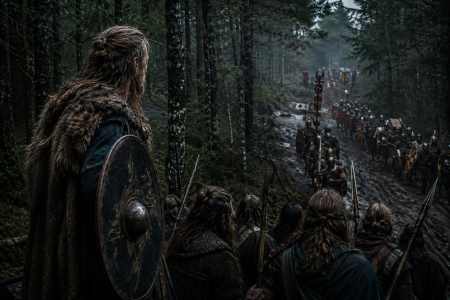
Varus’s column included legions XVII, XVIII, and XIX, auxiliary cohorts, cavalry units, civilians, animals, wagons, and supplies. Stretched across difficult ground, it was an army on the march rather than one arranged for battle. Heavy rain, forests, marshy areas, narrow routes, and broken terrain made coordinated movement increasingly difficult.
Arminius and his allies attacked repeatedly over several days. They avoided the type of open, organized battle in which Roman discipline was strongest. Instead, warriors struck exposed sections of the column, withdrew, and attacked again. As the weather worsened and casualties mounted, the Roman formation disintegrated.
The final destruction probably occurred across more than one location. Archaeological discoveries at Kalkriese, north of modern Osnabrück, include Roman coins, weapons, equipment fragments, human and animal remains, and evidence of intense fighting. Kalkriese is widely regarded as the strongest candidate for a major battlefield zone, although debate continues over the exact route and sequence of the disaster.
Varus took his own life when defeat became unavoidable. Many officers followed him. The three legions were effectively annihilated, and their numbered designations—XVII, XVIII, and XIX—were never restored to the regular Roman army.
The Varus Disaster and Rome’s Response
News of the defeat caused alarm throughout the empire. Augustus feared that the Rhine frontier might collapse or that Germanic forces might invade Gaul. According to Suetonius, the emperor later cried out for Varus to return his legions. The famous line may have been dramatized, but it reflects the scale of the psychological shock.
Rome did not abandon the region immediately. Tiberius stabilized the frontier, strengthened the Rhine armies, and conducted further operations. The empire retained forts and influence east of the Rhine in some areas, while major bases on the western bank supported future campaigns.
The battle nevertheless altered strategic calculations. Conquering and permanently administering the lands between the Rhine and Elbe would require more campaigns, larger garrisons, secure roads, and reliable local allies. Teutoburg demonstrated that apparent submission could hide organized resistance.
Arminius and Germanicus: Rome Returns to Germania
After Augustus died in 14 CE, the Roman commander Germanicus launched major expeditions across the Rhine. His goals included punishing the tribes involved in the Varus Disaster, recovering lost legionary standards, restoring Roman prestige, and weakening Arminius’s coalition.
Germanicus’s armies revisited the battlefield and buried remains of the Roman dead. Roman forces recovered two of the lost legionary eagles during the wider campaigns and defeated Germanic armies in several engagements. At the Battle of Idistaviso in 16 CE, Arminius was wounded but escaped. A later clash near the Angrivarian Wall also ended with Roman claims of victory.
Yet Germanicus did not capture Arminius or establish permanent Roman government across the region. Emperor Tiberius recalled him after the 16 CE campaign season, arguing that diplomacy and internal tribal rivalry could accomplish more at lower cost.
Germanicus later became one of Rome’s most admired princes. His son would eventually rule as Emperor Caligula, linking Arminius’s frontier war to the political history of the imperial court.
Thusnelda, Segestes, and a Divided Cheruscan Elite
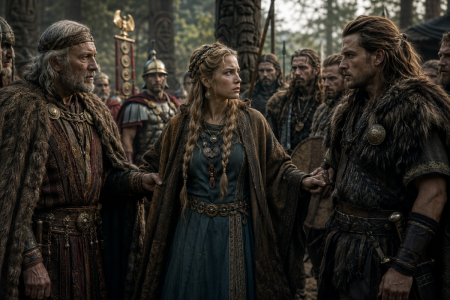
Arminius’s struggle was also a family conflict. His wife, Thusnelda, was the daughter of Segestes, a Cheruscan leader who supported cooperation with Rome. Ancient accounts state that Arminius took and married her against her father’s wishes.
In 15 CE, Segestes appealed to Germanicus for help and surrendered the pregnant Thusnelda to the Romans. She later appeared with her young son, Thumelicus, in Germanicus’s triumphal procession in Rome in 17 CE. Segestes reportedly watched as members of his own family were displayed as captives.
The episode reveals that Arminius did not lead a united Germanic nation. Even within the Cherusci, powerful families disagreed over Rome, marriage alliances, leadership, and the future of the tribe.
What Happened to Arminius After Teutoburg?
Once Rome reduced its major offensive operations, old rivalries among the Germanic peoples returned. Arminius fought Maroboduus, the powerful leader of the Marcomanni, in a wider contest for influence. Neither man created a lasting political union.
Arminius’s prestige after Teutoburg made him powerful, but it also made other nobles fear him. Tacitus reports that he faced accusations of seeking kingship—a form of authority many tribal elites resisted because it threatened their own independence.
How Did Arminius Die?
In 21 CE, Arminius was murdered by members of his own extended family or political circle. He was approximately 37 years old. Rome had failed to kill or capture him, but the rivalries within the Cherusci achieved what Roman campaigns had not.
His death emphasizes the limits of his achievement. Arminius defeated a Roman army and resisted later invasions, but he did not create a permanent Germanic state. The coalition that fought Varus depended on temporary agreement among groups whose interests soon divided again.
Arminius: Myth Versus History
Ancient Roman writers transformed Arminius into several different figures: traitor, barbarian, brilliant commander, and defender of freedom. Tacitus, despite writing from a Roman viewpoint, offered him unusual praise as a leader who challenged Rome at the height of its power.
Centuries later, German humanists rediscovered the ancient accounts and associated Arminius with the name “Hermann.” During the 18th and 19th centuries, writers and political movements increasingly portrayed him as a founding hero of German independence. The enormous Hermannsdenkmal, completed near Detmold in 1875, embodied that nationalist interpretation.
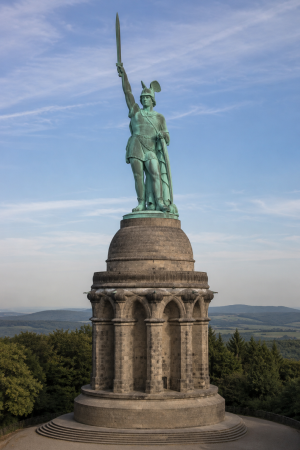
Modern historians treat such claims cautiously. The peoples of early 1st-century Germania did not form a modern German nation, and Arminius did not fight for nationalism in the later sense. He operated within a world of tribal alliances, aristocratic competition, Roman patronage, and personal power.
-
Myth: Arminius united all Germans against Rome.
History: He led a coalition of several groups, while other Germanic leaders remained neutral or supported Rome. -
Myth: He was known as Hermann during his lifetime.
History: Ancient sources call him Arminius; the Hermann identity was created much later. -
Myth: Rome permanently abandoned Germania immediately after Teutoburg.
History: Roman armies returned repeatedly and fought major campaigns through 16 CE. -
Myth: Kalkriese explains every phase of the battle.
History: It is the strongest archaeological battlefield candidate, but questions remain about the wider route and sequence.
Why Was the Battle of Teutoburg Forest Important?
Teutoburg was not the end of Roman military power in northern Europe. Rome remained capable of crossing the Rhine, winning battles, and devastating hostile territory. The more important result was strategic: the defeat exposed the enormous cost of turning Germania into a stable province.
Over time, the Rhine became one of the empire’s principal frontiers. Roman influence, trade, diplomacy, and warfare continued beyond it, but direct rule did not advance permanently to the Elbe. Arminius therefore helped shape the geography of Roman power, even if the battle alone did not determine every later imperial decision.
His resistance also belongs to a broader history of leaders who learned Roman methods and then used them against Rome. Centuries later, Decebalus and the Dacians would similarly exploit terrain, alliances, and military adaptation while defending a frontier kingdom from imperial expansion.
Timeline: Arminius, Germania, and Rome
- c. 18 BCE: Arminius is born into an elite Cheruscan family.
- Early 1st century CE: He serves in Rome’s auxiliary forces and receives citizenship and equestrian status.
- 7 CE: Varus takes command in Germania and works to consolidate Roman administration.
- September 9 CE: Arminius leads the coalition that destroys three Roman legions in the Teutoburg Forest campaign.
- 10–13 CE: Tiberius restores security along the Rhine and conducts operations in Germania.
- 14–16 CE: Germanicus leads major Roman retaliatory campaigns.
- 15 CE: Thusnelda is captured and taken into Roman custody.
- 16 CE: Arminius survives the battles of Idistaviso and the Angrivarian Wall.
- 17 CE: Thusnelda and Thumelicus appear in Germanicus’s triumph in Rome.
- 21 CE: Arminius is killed by relatives amid disputes over political power.
Fast Facts About Arminius
-
His original name is unknown:
“Arminius” is the name preserved in Roman sources. The later name “Hermann” was not used during his lifetime.
-
He held Roman citizenship:
Arminius was not an outsider unfamiliar with Rome. He received citizenship and equestrian rank after serving in Roman auxiliary forces.
-
Three legions were lost:
Legions XVII, XVIII, and XIX were destroyed in 9 CE. Rome did not reuse their numbers for new permanent legions.
-
His coalition was temporary:
Arminius brought several groups together against Varus, but Germania remained divided by political and family rivalries.
-
Rome returned after Teutoburg:
Tiberius and Germanicus conducted further campaigns. Teutoburg was a turning point, not an immediate end to all Roman operations east of the Rhine.
-
His own relatives killed him:
Arminius survived Rome’s attempts to defeat him but was assassinated in 21 CE during internal disputes over leadership.
Conclusion: The Warrior Between Two Worlds
Arminius changed Roman history because he understood both sides of the frontier. Rome gave him military training, status, and access to its system of alliances. He then used that knowledge to identify the empire’s vulnerability: its confidence in local partners and its dependence on disciplined formations moving through unfamiliar territory.
His victory in the Teutoburg Forest did not create a German nation, destroy Roman power, or end every imperial campaign in Germania. It did, however, expose the limits of conquest. Rome could defeat tribal armies and cross the Rhine, but permanent control required political cooperation that military force alone could not guarantee.
Arminius remains compelling because he cannot be reduced to one identity. He was a Roman citizen and Rome’s enemy, a coalition builder and a divisive noble, a defender of independence and an ambitious contender for power. His life stands at the meeting point of biography, military strategy, archaeology, and national myth—a story in which one of Rome’s trusted allies became the architect of one of its greatest defeats.
Arminius & Teutoburg Forest — Frequently Asked Questions
Who was Arminius?
Arminius was a noble of the Cherusci tribe, a former Roman auxiliary officer, and the leader of the Germanic coalition that destroyed three Roman legions in 9 CE.
Was Arminius a Roman soldier?
Yes. Arminius served in Rome’s auxiliary forces, received Roman citizenship, and attained equestrian standing before leading the revolt against Varus.
Why did Arminius rebel against Rome?
His exact motives are unknown, but they probably included resistance to Roman administration, protection of local authority, personal ambition, and opposition to taxation and legal control imposed by Varus.
How did Arminius defeat the Romans?
He deceived Varus, drew the Roman army into difficult terrain, and launched repeated attacks against a long marching column that could not form its usual battle lines.
How many Roman legions were lost at Teutoburg Forest?
Three legions—XVII, XVIII, and XIX—were effectively annihilated, along with auxiliary units and many members of the army’s baggage train.
Where was the Battle of Teutoburg Forest fought?
Archaeological evidence strongly identifies Kalkriese, near Osnabrück in modern Germany, as a major battle zone. The full route and exact locations of every stage remain debated.
Did Arminius stop Rome from conquering Germania?
His victory was a major reason Roman expansion became more cautious, but Rome continued campaigning east of the Rhine through 16 CE. The eventual frontier resulted from the battle, military costs, political priorities, and persistent Germanic resistance.
What happened to Arminius after Teutoburg?
He resisted Germanicus, fought rival Germanic leaders, and remained influential among the Cherusci. His growing power eventually alarmed other nobles.
How did Arminius die?
Arminius was murdered by members of his own extended family in 21 CE, reportedly because they feared that he intended to establish kingship.
Sources & References
- Tacitus, Annals, Books I–II, especially sections concerning Germanicus, Thusnelda, and the death of Arminius.
- Velleius Paterculus, Roman History, Book II, sections 117–120.
- Cassius Dio, Roman History, Book 56, sections 18–24.
- Suetonius, The Twelve Caesars: Augustus.
- Peter S. Wells, The Battle That Stopped Rome (W. W. Norton, 2003).
- Adrian Murdoch, Rome’s Greatest Defeat: Massacre in the Teutoburg Forest (Sutton Publishing, 2006).
- Martin M. Winkler, Arminius the Liberator: Myth and Ideology (Oxford University Press, 2016).
- Reinhard Wolters, Die Schlacht im Teutoburger Wald: Arminius, Varus und das römische Germanien (C. H. Beck, updated edition, 2017).
- Museum und Park Kalkriese, archaeological research and museum materials concerning the Varus Battle site.
- Oxford Classical Dictionary and Brill’s New Pauly, reference entries on Arminius, Varus, and Roman Germania.
More Articles