Caligula: A Biography of Rome’s Most Notorious Ruler
From the beloved child of Germanicus to an emperor murdered by his own guards, Caligula’s four-year reign remains one of ancient Rome’s most disputed stories.
Who Was Caligula?
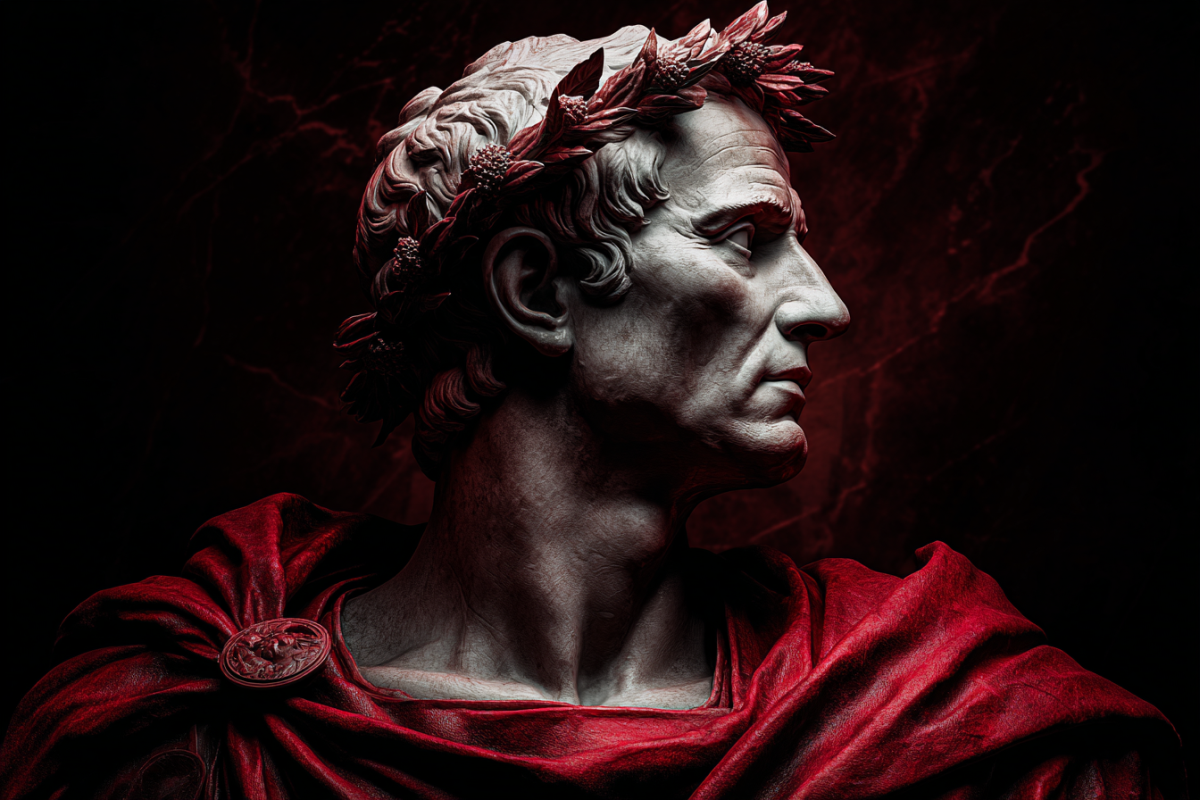
Caligula was the third emperor of Rome, ruling from 37 to 41 CE. Born Gaius Julius Caesar Germanicus, he belonged to the powerful Julio-Claudian dynasty and was the son of Germanicus, one of the most popular generals in the Roman Empire. Romans initially greeted the young emperor with extraordinary enthusiasm. He represented a famous military family, the memory of Augustus, and an apparent break from the secretive final years of Tiberius.
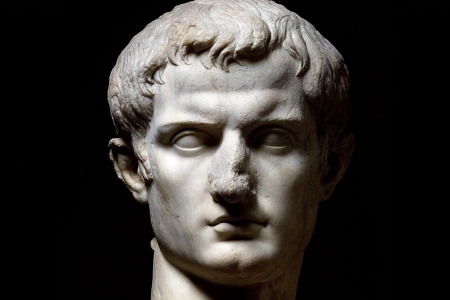
His reputation soon changed. Ancient writers accused him of cruelty, sexual scandal, financial excess, divine pretensions, military farce, and contempt for the Senate. Those stories made Caligula the model of the “mad Roman emperor.” Yet much of the surviving narrative was written by senators and elite authors who disliked his style of government or wrote long after his assassination.
A responsible Caligula biography must therefore do two things at once: reconstruct what can reasonably be known about his life and reign, while explaining why so many famous details remain uncertain. Caligula was neither the harmless victim of every hostile rumor nor the one-dimensional monster of popular culture. He was a young ruler operating inside an unstable political system in which the emperor held overwhelming power but was still expected to pretend that Rome’s old republican traditions mattered.
Caligula’s Early Life and Imperial Family
Caligula was born on 31 August 12 CE. Suetonius acknowledged competing ancient traditions about his birthplace but concluded that the public record identified Antium, a coastal town south of Rome. His father, Germanicus, was the adopted son and intended successor of Emperor Tiberius. His mother, Agrippina the Elder, was a granddaughter of Augustus.
This ancestry placed the young Gaius close to the center of Roman power. Germanicus commanded armies along the Rhine and led campaigns in Germania after the devastating defeat of Varus in 9 CE. For more on that frontier struggle, see Arminius: The Germanic Warrior Who Defied Rome.
What Does the Name Caligula Mean?
“Caligula” was not the emperor’s formal name. As a small child, Gaius accompanied his parents among the Rhine legions and wore a miniature soldier’s uniform. The troops nicknamed him after the caliga, the heavy military sandal worn by Roman soldiers. Caligula therefore meant “little boot.”
The name was affectionate when attached to the army’s child mascot, but Gaius reportedly disliked it as an adult. Ancient Romans normally referred to him as Gaius. The childhood nickname became dominant only because later historians and popular culture used it to distinguish him from other members of the imperial family.
Germanicus’s Death and the Destruction of the Family
Germanicus died in Antioch in 19 CE under suspicious and politically explosive circumstances. Agrippina returned to Rome carrying his ashes, while public grief increased tension between her family and Tiberius. Over the following decade, the imperial court turned against Agrippina and her elder sons.
Caligula watched his family disintegrate. His mother was exiled and died in confinement. His brothers Nero and Drusus were imprisoned or exiled and also died. Gaius first lived with his great-grandmother Livia and later with his grandmother Antonia. In 31 CE he was summoned to join Tiberius on Capri.
Surviving Capri required restraint. Caligula could not openly protest the deaths of his relatives or challenge the emperor who controlled his future. Ancient authors later portrayed him as concealing hatred behind obedience. Whatever his private feelings, he demonstrated the ability to survive a court in which suspicion, accusations of treason, and sudden political reversals could be fatal.
How Did Caligula Become Emperor?
When Tiberius died on 16 March 37 CE, his will named Caligula and the emperor’s teenage grandson, Tiberius Gemellus, as joint heirs to his private estate. That arrangement did not create a practical system of shared imperial rule. Caligula had dynastic prestige, popular support, and the assistance of the Praetorian prefect Naevius Sutorius Macro.
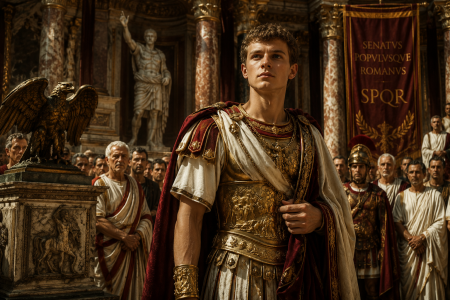
Members of the Praetorian Guard hailed Gaius, and the Senate quickly confirmed his position. The senators set aside Tiberius’s will, allowing Caligula to inherit the political position and household of Caesar without sharing power with Gemellus. He received the principal imperial powers together rather than accumulating them gradually, as Augustus had done.
Caligula was only twenty-four years old. His accession was welcomed throughout Rome because he was the son of Germanicus and the surviving representative of a family that many Romans believed Tiberius had persecuted. Crowds greeted him as he entered the capital, and contemporary enthusiasm was so strong that the beginning of his reign was presented as a rebirth of the Roman state.
How Long Did Caligula Rule Rome?
Caligula ruled for approximately three years and ten months, from March 37 CE until his assassination on 24 January 41 CE. His reign was brief, but it was not the shortest in Roman history. Several emperors during later civil wars ruled for only weeks or months.
The Popular Beginning of Caligula’s Reign
Caligula’s first public measures presented him as a generous and accessible ruler. He arranged an elaborate funeral for Tiberius, recovered the remains of his mother and brother from exile, and placed them in the Mausoleum of Augustus. These ceremonies restored the reputation of Germanicus’s family and reminded Romans of Caligula’s dynastic legitimacy.
- He recalled some political exiles and abandoned unresolved accusations inherited from the previous reign.
- He publicly burned documents connected to cases against his mother and brothers.
- He paid legacies included in the wills of Tiberius and Livia.
- He published accounts of imperial income and expenditure.
- He attempted to restore popular participation in the election of magistrates.
- He remitted the half-percent tax on auction sales in Italy.
- He distributed money, sponsored games, and held public banquets.
These measures answer an important question often obscured by the later scandals: what did Caligula actually do as emperor? His government was not composed only of theatrical gestures. It handled finance, courts, provincial affairs, public works, elections, the army, and imperial succession.
The Illness of 37 CE
Several months after his accession, Caligula suffered a serious illness. Rome reacted with intense anxiety, and some citizens publicly offered their lives or promised to fight as gladiators if the emperor recovered. Ancient biographers later treated the illness as the moment when a good young ruler suddenly became a monster.
Modern historians are more cautious. Illness may have affected Caligula physically or emotionally, but the neat story of a medical event instantly causing insanity is impossible to prove. The period after his recovery also coincided with political consolidation. Gemellus was executed, and Caligula’s relationships with Macro and other early supporters ended violently. What ancient authors described as a change in personality may partly reflect a change in politics.
Caligula’s Reign at a Glance
| Period | Major Developments | Historical Significance |
|---|---|---|
| March–autumn 37 CE | Popular accession, recalls from exile, financial measures, games, public accounts. | Caligula presents himself as the generous son of Germanicus. |
| Late 37–38 CE | Serious illness, execution of Gemellus, removal of former supporters, death of Drusilla. | The regime becomes more personal and politically suspicious. |
| 39 CE | Conflict with senators, conspiracy involving Lepidus and Gaetulicus, exile of Agrippina and Livilla. | Relations between emperor, aristocracy, and military leadership deteriorate. |
| 39–40 CE | Rhine and Channel operations, Baiae bridge, Britain preparations, religious crisis in Judea. | Military spectacle and imperial authority become central to his public image. |
| January 41 CE | Praetorian-led assassination and proclamation of Claudius. | The Guard demonstrates its decisive role in imperial succession. |
Caligula and the Senate: The Politics of Humiliation
The early Roman Empire contained a political contradiction. The emperor commanded armies, controlled appointments, and dominated the state, but official language still described him as the princeps—the leading citizen rather than a king. Augustus had preserved this arrangement through restraint, ceremony, and carefully managed respect for the Senate.
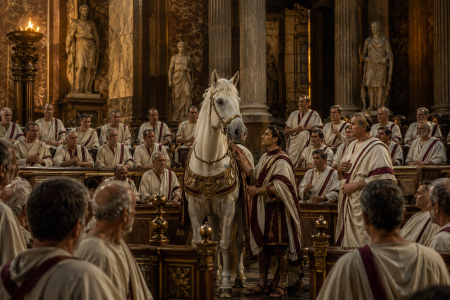
Caligula increasingly exposed the fiction. He mocked senators, demanded extravagant honors, revived or exploited accusations of maiestas (treason), and reminded aristocrats that their careers depended on imperial favor. Aloys Winterling has interpreted many of Caligula’s notorious actions as deliberate attacks on senatorial status rather than random acts of madness.
The famous story that Caligula planned to make his horse Incitatus a consul fits this political environment. No evidence shows that the horse actually held office. The reported threat communicated something more insulting: an emperor’s horse could receive wealth, servants, and honors, while Rome’s highest-ranking senators remained dependent on the emperor’s approval.
Caligula’s treatment of senators helped create the literary tradition that followed his death. Elite historians understood his reign as a humiliation of their social order. Their hostility does not make every allegation false, but it shaped which stories they selected and how they explained them.
Policies, Finance, Games, and Government
Revenue and Spending
Caligula inherited substantial reserves from Tiberius, who had governed cautiously and limited major expenses. The new emperor spent heavily on public distributions, court ceremonies, construction, games, transport, and the army. Ancient authors claim that he quickly exhausted the treasury and turned to confiscations, auctions, new charges, and aggressive fundraising.
The broad pattern of high spending is credible, but precise totals and dramatic claims should be treated cautiously. Roman imperial finances are poorly documented, and hostile writers used financial excess as a standard sign of tyranny. Caligula’s spending bought popularity, displayed imperial wealth, and supported projects whose usefulness extended beyond spectacle.
Games and the Emperor’s Public Image
Caligula sponsored chariot racing, theatrical performances, animal exhibitions, public banquets, and gladiatorial contests. He sometimes extended festivals or ordered spontaneous entertainment. Such events were political. They allowed the ruler to appear before large crowds, reward the population, and dramatize the relationship between emperor and people.
The permanent Flavian Amphitheatre was built decades after Caligula, but his reign belongs to the longer development of Roman spectacle explored in The Roman Colosseum: Arena of Blood, Glory and Empire.
Public Works and Aqueducts
Caligula began two of Rome’s most important aqueduct projects in 38 CE: Aqua Claudia and Anio Novus. Claudius completed and formally dedicated them in 52 CE, which sometimes causes the projects to be credited entirely to his reign. Their construction demonstrates that Caligula’s government invested in infrastructure as well as ceremony.
He also worked on imperial residences, temples, roads, harbors, and entertainment spaces. Some projects were extravagant, but Roman rulers were expected to build on a scale that communicated authority across the capital and provinces.
The Nemi Ships: Caligula’s Floating Palaces
The most striking archaeological remains associated with Caligula were two enormous vessels built for Lake Nemi, southeast of Rome. The ships were far larger and more elaborate than ordinary lake craft. They incorporated marble, decorative fittings, bronze fixtures, anchors, pumps, and advanced mechanical systems.
Their exact purpose remains debated. They may have served as ceremonial platforms connected with the nearby sanctuary of Diana, floating pleasure palaces, or symbols of imperial engineering. Whatever their function, they demonstrate that the luxury associated with Caligula was not invented entirely by later writers.
The vessels were recovered between 1929 and 1931 after the lake was partially drained. A museum was constructed to display them, but the original hulls were destroyed by fire in 1944. Surviving objects, documentation, and reconstructions preserve evidence of one of the most ambitious naval engineering projects of the early empire.
Caligula, Divinity, and the Imperial Cult
Ancient writers claimed that Caligula dressed as gods, spoke with divine statues, demanded worship, and treated himself as a living deity. The reality is more complicated because Roman imperial religion varied by location. Cities in the Greek-speaking eastern Mediterranean had long traditions of honoring living rulers, while Rome maintained more cautious distinctions between a living emperor, his divine spirit, and a ruler formally deified after death.
Caligula appears to have accepted and promoted divine imagery more aggressively than Augustus or Tiberius. This was not necessarily evidence that he literally believed himself to be Jupiter. Religious honors were also political language. They tested loyalty, ranked communities, and placed the emperor within a sacred framework.
The Jerusalem Temple Crisis
The most dangerous religious conflict of his reign concerned an order to install an imperial statue in the Jewish Temple at Jerusalem. For Jewish communities, placing an image of the emperor inside the sanctuary would have been an intolerable violation. The governor of Syria, Publius Petronius, delayed implementation while warning that resistance could produce war and disrupt the harvest.
Philo of Alexandria described the crisis as part of a wider conflict over Jewish rights and imperial authority. Intervention by Herod Agrippa and repeated delays helped prevent the order from being carried out before Caligula’s death. The episode shows how imperial symbolism could become a practical security crisis when applied without regard for local religious traditions.
Germany, Britain, and the Seashells Story
In 39 CE, Caligula traveled north with a large military force. The expedition involved the Rhine frontier, changes in army command, and the suppression of a conspiracy associated with the governor Gnaeus Cornelius Lentulus Gaetulicus. Caligula’s presence among the legions also evoked the memory of Germanicus and the military camps of his childhood.
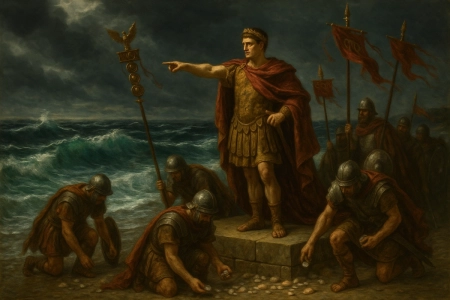
The army later reached the Channel coast, where preparations for an invasion of Britain may have taken place. The operation did not proceed. Suetonius and Cassius Dio mocked the conclusion, claiming that Caligula ordered soldiers to collect seashells as “spoils of the ocean.”
Historians have proposed several explanations. The event may have been a punishment for soldiers who refused to embark, a symbolic ceremony declaring victory over the sea, a misunderstood engineering operation, or a satirical invention expanded by hostile writers. The available evidence does not permit certainty.
Britain was invaded successfully under Claudius in 43 CE. Roman rule there later faced the major revolt described in Boudica: The Celtic Queen Who Led a Rebellion Against Rome.
The Death of Ptolemy of Mauretania
Caligula also summoned Ptolemy of Mauretania, a Roman client king and descendant of Mark Antony and Cleopatra, and had him executed around 40 CE. Ancient explanations emphasize envy of the king’s wealth or clothing, but the political motives are uncertain. The execution destabilized Mauretania and contributed to conflict before the kingdom was annexed under Claudius.
Court, Sisters, Marriage, and Scandal
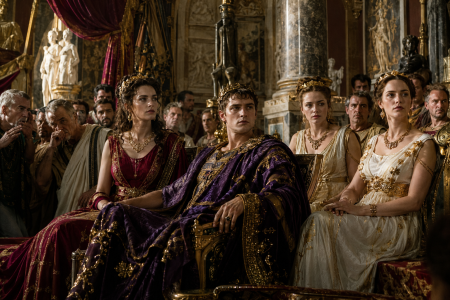
Caligula elevated his sisters Agrippina the Younger, Drusilla, and Livilla to extraordinary public prominence. Their names appeared in official oaths and political formulas, giving women of the imperial household a visible place in dynastic representation.
Drusilla appears to have held a particularly important position. When she died in 38 CE, Caligula ordered extensive mourning and had her deified as Diva Drusilla. Her elevation helped communicate the sacred status of the ruling family, but it also encouraged later stories about an improper relationship between brother and sister.
Suetonius claimed that Caligula committed incest with his sisters and seated them conspicuously near him at banquets. The banquet arrangement may reflect their unusual public position, but the sexual allegations cannot be confirmed. Contemporary writers such as Philo and Seneca, despite their hostility, do not clearly corroborate the incest tradition. The story became useful to later biographers because sexual violation was a standard way to depict a tyrant as an enemy of social and natural order.
In 39 CE, Agrippina and Livilla were accused of participating in a conspiracy involving Marcus Aemilius Lepidus and were exiled. Agrippina later returned under Claudius and became the mother of Emperor Nero.
Caligula married four times. His final wife, Milonia Caesonia, gave birth to his daughter Julia Drusilla. Ancient authors attacked Caesonia’s morality and repeated a story that a love potion caused Caligula’s madness. Such claims belong more securely to ancient stereotypes about dangerous women and poisoned rulers than to verifiable medical history.
Caligula’s Death: Assassination on 24 January 41 CE
Why Was Caligula Assassinated?
Caligula’s assassination resulted from overlapping grievances rather than a single dispute. Senators feared executions, confiscations, and public humiliation. Members of the imperial court faced unpredictable danger. Praetorian officers had direct access to the emperor but could also become targets of his mockery.
The central figure was Cassius Chaerea, a tribune of the Praetorian Guard. Ancient accounts state that Caligula repeatedly insulted Chaerea with humiliating passwords and accusations of effeminacy. Personal resentment combined with wider political hostility, allowing Chaerea and other officers to organize a palace conspiracy.
On 24 January 41 CE, Caligula attended theatrical or ceremonial events connected with the Palatine games. The conspirators attacked him in a covered passage as he moved away from the crowd. Chaerea struck first or gave the signal, and other attackers joined. Caligula died from multiple wounds at the age of twenty-eight.
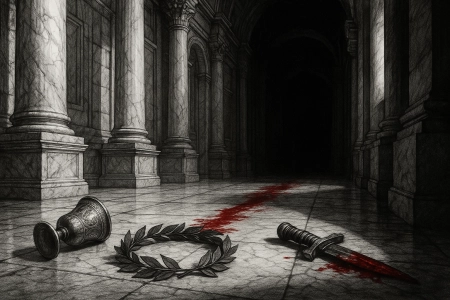
Caesonia and their young daughter were killed soon afterward. The murder of the child demonstrates that the conspiracy was not simply directed against one unpopular ruler. It attempted to eliminate his immediate dynasty and prevent supporters from rallying around an heir.
Claudius and the Failure to Restore the Republic
Some senators discussed restoring republican government, but they lacked unity, soldiers, and an agreed plan. Praetorian troops found Caligula’s uncle Claudius inside the palace complex and proclaimed him emperor. After negotiation and military pressure, the Senate accepted the decision.
Caligula’s death therefore did not weaken the imperial system. It revealed its foundation. The Senate could debate legitimacy, but the Praetorian Guard possessed the armed force needed to determine who controlled Rome.
Caligula: Myth vs. History
| Famous Claim | What the Evidence Supports | Likely Interpretation |
|---|---|---|
| Caligula became insane after an illness. | He suffered a serious illness in 37 CE, followed by political executions and a harsher regime. | The medical cause and psychological effect cannot be established. |
| He made his horse a consul. | No evidence shows Incitatus actually received the office. | The reported proposal was probably a threat or joke insulting senators. |
| He ordered soldiers to collect seashells. | Ancient sources report an event on the Channel coast, but disagree about context. | It may have been military theater, punishment, symbolism, misunderstanding, or exaggeration. |
| He committed incest with his sisters. | The allegations appear clearly in later hostile sources but lack firm contemporary corroboration. | The sisters’ unusual public prominence may have encouraged sexual rumors. |
| He declared himself a god. | He promoted divine imagery and accepted exceptional honors. | His ruler-cult policies were unusually aggressive but operated within existing Roman and Hellenistic traditions. |
| The Baiae bridge proved he was mad. | A temporary bridge of ships across the bay was technically possible and apparently constructed. | It was a costly display of logistics, wealth, and command rather than proof of insanity. |
How Reliable Are the Sources on Caligula?
The central difficulty in studying Caligula is not a total lack of evidence. It is the uneven quality of that evidence. Tacitus’s detailed narrative for the reign is lost, leaving later writers and works shaped by specific political, moral, or religious disputes.
| Source | Relationship to the Reign | Historical Value | Main Limitation |
|---|---|---|---|
| Philo of Alexandria | Contemporary participant in an embassy to Caligula. | Essential for the Alexandrian and Jerusalem crises and for observing the imperial court. | Writes as an advocate in a religious and political conflict. |
| Seneca | Contemporary senator and moral philosopher. | Preserves examples of fear, cruelty, and elite tension. | Uses historical figures to illustrate moral arguments. |
| Josephus | Later 1st-century historian with access to earlier traditions. | Provides the fullest account of the assassination and succession. | Writes decades later and arranges events into dramatic narrative. |
| Suetonius | Imperial biographer writing in the early 2nd century. | Preserves documents, names, policies, rumors, and court anecdotes. | Organizes material by character traits and rarely resists a memorable scandal. |
| Cassius Dio | Senatorial historian writing in the early 3rd century. | Offers a chronological political narrative. | Writes long afterward, and much of the Caligula section survives only through later excerpts. |
| Coins, inscriptions, and archaeology | Material evidence produced during or near the reign. | Reveals official titles, family imagery, construction, cult, and government messaging. | Usually shows what the regime wished to communicate, not private motives or complete events. |
The safest approach is comparison. A dramatic anecdote becomes stronger when supported by contemporary evidence, coins, inscriptions, archaeology, or multiple independent accounts. When a story appears only in later moralizing biographies, it should be presented as an allegation rather than an established fact.
What Was Life in Rome Like Under Caligula?
For most inhabitants of the empire, daily life continued through local institutions rather than direct encounters with the emperor. Provincial governors collected revenue, courts heard disputes, merchants traded, soldiers guarded frontiers, and city councils managed local affairs.
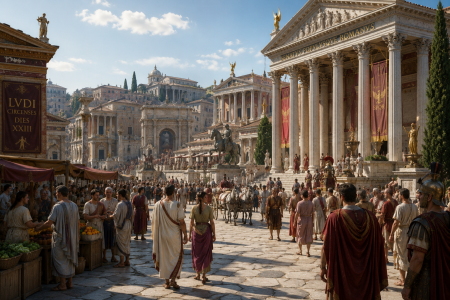
In Rome, Caligula was unusually visible. Crowds attended his races, games, distributions, and ceremonies. The urban population could welcome lavish entertainment even while senators feared the emperor’s court. Popularity and elite approval were not the same thing.
The Praetorian Guard occupied a third position. Its soldiers received imperial payments and protected the palace, but their proximity also made them potential conspirators. Caligula’s reign demonstrated that an emperor had to manage three constituencies simultaneously: the people, the aristocracy, and the armed forces.
Caligula and the Weakness of the Julio-Claudian System
The early empire had no written constitutional rule explaining exactly how an emperor should be selected. Augustus had built authority from offices, military command, family prestige, and personal influence. His successors inherited the result without inheriting a stable law of succession.
Caligula became emperor because he was the adult male survivor of Germanicus’s family, enjoyed military and public support, and was accepted by the Senate. Claudius succeeded him because the Praetorian Guard acted before the Senate could establish an alternative.
This unstable combination of dynasty, army loyalty, senatorial consent, and palace politics shaped the entire Julio-Claudian era. Caligula’s death did not solve the problem. It confirmed that imperial succession could be decided by conspiracy and armed force.
Caligula: Major Life Events and Timeline
- 12 CE: Gaius is born on 31 August, traditionally at Antium.
- 14–16 CE: The child accompanies Germanicus and Agrippina among the Rhine legions.
- 19 CE: Germanicus dies at Antioch.
- 29 CE: Agrippina the Elder and Caligula’s brother Nero are exiled.
- 31 CE: Caligula joins Tiberius on Capri.
- 33 CE: He serves as quaestor and marries Junia Claudilla.
- 35 CE: Tiberius names Caligula and Gemellus joint heirs in his will.
- 37 CE: Tiberius dies; Caligula becomes emperor and later suffers a serious illness.
- 38 CE: Drusilla dies and is deified; work begins on major aqueducts.
- 39 CE: Lepidus is executed; Agrippina and Livilla are exiled.
- 39–40 CE: Northern military operations, Baiae bridge, and Channel expedition.
- 40 CE: Jerusalem Temple crisis and execution of Ptolemy of Mauretania.
- 41 CE: Caligula is assassinated on 24 January; Claudius becomes emperor.
Fast Facts About Caligula
-
Caligula was a nickname:
His real name was Gaius. Soldiers called him “little boot” because he wore a child-sized military uniform.
-
He was twenty-four when he became emperor:
Caligula’s famous ancestry and the support of the Praetorian prefect Macro helped him succeed Tiberius.
-
He ruled for less than four years:
His reign lasted approximately three years and ten months, from March 37 to January 41 CE.
-
His horse never became consul:
The surviving accounts describe an intention or threat, not a completed appointment.
-
He began major infrastructure projects:
Construction of the Aqua Claudia and Anio Novus began under Caligula in 38 CE.
-
His ships were real:
Archaeologists recovered two enormous and luxurious Roman vessels from Lake Nemi.
-
His contemporaries did not all tell the same story:
Philo, Seneca, Josephus, Suetonius, and Cassius Dio wrote for different audiences and purposes.
-
His assassination strengthened the Praetorian Guard:
The Guard helped kill one emperor and then selected Claudius as the next ruler.
Conclusion: Caligula Beyond the Mad Emperor Myth
Caligula’s reputation cannot be separated from the writers who preserved it. His reign included executions, political intimidation, extravagant displays, religious confrontations, and an increasingly dangerous conflict with Rome’s elite. His assassination was not an accident of literary invention. Enough powerful people feared or hated him to organize his murder inside the imperial palace.
Yet the familiar portrait of an irrational monster explains too little. Caligula also published financial records, revised administrative practices, sponsored public entertainment, managed client kingdoms, began major aqueducts, and used imperial ritual to communicate power. Even his strangest stories often make greater sense when viewed as political humiliation, propaganda, or later exaggeration.
His greatest historical importance lies in what his reign revealed. Rome’s emperor possessed near-monarchical authority but depended on cooperation from senators, soldiers, palace officers, provincial elites, and urban crowds. Caligula exposed those tensions instead of concealing them. When that political balance collapsed, the men assigned to protect him became his assassins.
Caligula — Frequently Asked Questions
Who was Caligula?
Caligula, born Gaius Julius Caesar Germanicus, was the third Roman emperor. He ruled from 37 to 41 CE and was the son of the popular general Germanicus and Agrippina the Elder.
What does Caligula mean?
Caligula means “little boot.” Roman soldiers gave Gaius the nickname when he wore miniature military boots while living among the Rhine legions as a child.
How did Caligula become emperor?
After Tiberius died in March 37 CE, Caligula received support from the Praetorian prefect Macro, the Guard, the public, and the Senate. Tiberius’s will had named Caligula and Gemellus joint heirs, but the Senate set it aside and confirmed Caligula as sole ruler.
When was Caligula emperor of Rome?
Caligula became emperor in March 37 CE and ruled until he was assassinated on 24 January 41 CE.
How many years did Caligula rule?
He ruled for approximately three years and ten months. Although brief, his reign was longer than those of several emperors who ruled during later civil wars.
What is Caligula known for?
He is known for conflict with the Senate, lavish games, divine honors, the Incitatus horse story, the Channel seashells anecdote, the Nemi ships, the Jerusalem Temple crisis, and his assassination by Praetorian officers.
Was Caligula really insane?
No surviving evidence permits a reliable medical diagnosis. Ancient writers described him as mentally unstable, but they also used madness as a literary explanation for tyranny. Political strategy, cruelty, illness, trauma, and hostile exaggeration may all have contributed to the surviving portrait.
Did Caligula make his horse a consul?
No. Ancient sources claim that he intended or threatened to make Incitatus consul, but the horse never held the office. The story probably reflects Caligula’s contempt for the Senate.
Did Caligula really order soldiers to collect seashells?
Suetonius and Cassius Dio report that soldiers gathered shells on the Channel coast. The exact event is uncertain and may have involved symbolism, military punishment, an abandoned invasion, or later misunderstanding.
Did Caligula declare himself a god?
Caligula accepted or promoted unusually strong divine honors and imagery, but Roman ruler cult was complex. His actions were aggressive extensions of existing imperial and Hellenistic traditions rather than an entirely new belief.
Why was Caligula assassinated?
He was assassinated because of accumulated hostility among Praetorian officers, senators, courtiers, and other elites. Fear of executions and personal humiliation helped motivate Cassius Chaerea and the other conspirators.
Who killed Caligula?
Praetorian tribunes led by Cassius Chaerea and Cornelius Sabinus attacked him with support from additional officers and political conspirators.
What happened after Caligula died?
Some senators considered restoring the Republic, but the Praetorian Guard proclaimed Caligula’s uncle Claudius emperor. The Senate eventually accepted him.
How reliable are the stories about Caligula?
Some are supported by contemporary evidence, while others come from later hostile biographies. Suetonius and Cassius Dio remain valuable, but their stories should be compared with Philo, Josephus, Seneca, coins, inscriptions, archaeology, and modern scholarship.
Sources & References
- Suetonius, The Twelve Caesars: Gaius Caligula.
- Cassius Dio, Roman History, Book 59.
- Philo of Alexandria, On the Embassy to Gaius.
- Josephus, Antiquities of the Jews, Book 19.
- Seneca, On Anger and On Firmness.
- Anthony A. Barrett, Caligula: The Abuse of Power (Routledge, revised edition, 2015).
- Aloys Winterling, Caligula: A Biography (University of California Press, 2011).
- Anthony A. Barrett and J. C. Yardley, The Emperor Caligula in the Ancient Sources (Oxford University Press, 2023).
- Mary Beard, SPQR: A History of Ancient Rome (Liveright, 2015).
- The Metropolitan Museum of Art, Julio-Claudian portraiture and coin collections.
- Italian Ministry of Culture, Museo delle Navi Romane di Nemi and Aqua Claudia heritage resources.
More Articles