Pompeii: Life and Death Beneath Mount Vesuvius
A thriving Roman city was buried in a single catastrophe—preserving its streets, homes, voices, and victims beneath layers of volcanic ash.
Introduction
Pompeii is remembered as a city of death, but archaeology first reveals a city alive. Its stone streets carried carts, vendors, laborers, worshippers, politicians, enslaved people, children, and wealthy householders. Bakers ground grain behind their shops. Customers ate at street-side counters. Candidates painted election slogans on walls. Spectators crowded into an amphitheatre decades before Rome’s Colosseum was built.
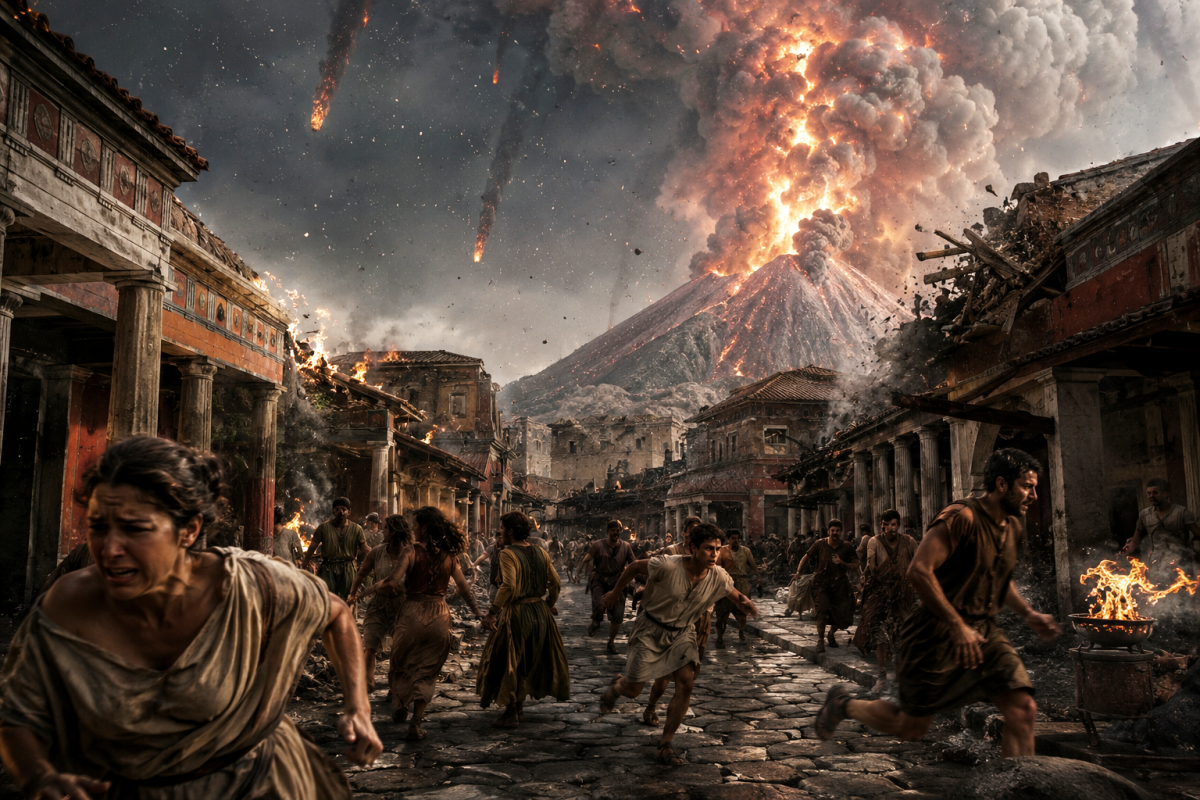
That ordinary life ended when Mount Vesuvius erupted in 79 CE. A towering column of ash and pumice rose above the Bay of Naples. Debris fell for hours, roofs collapsed, daylight disappeared, and many residents fled. During the final phase, fast-moving pyroclastic currents swept through the city and killed those who remained.
The catastrophe destroyed Pompeii but also preserved an extraordinary record of Roman society. Homes, temples, workshops, graffiti, food, gardens, paintings, and the hollow impressions of human bodies survived beneath the volcanic deposits. The result is not a perfectly frozen city, but something nearly as valuable—a damaged, incomplete, and deeply human archive of life and death in ancient Pompeii.
Pompeii Before the Eruption
Pompeii stood in Campania near the Bay of Naples, on fertile volcanic land overlooking important routes between the coast and the interior. The settlement developed over centuries rather than being founded as a single Roman project. Oscan-speaking communities, Greeks, Etruscans, and Samnites all influenced its language, religion, architecture, and trade.
Rome gradually expanded into southern Italy, and Pompeii became one of its allied communities. During the Social War of 91–87 BCE, several Italian allies rebelled after generations of military service without equal Roman citizenship. Pompeii joined the revolt and was besieged by the Roman general Lucius Cornelius Sulla.
After the war, Sulla established a veteran colony at Pompeii in 80 BCE. Latin became increasingly dominant, Roman institutions reshaped local politics, and elite families competed for influence through elections, public buildings, games, and religious offices.
By the 1st century CE, Pompeii was a prosperous commercial city within the Roman Empire. Its wealth came from agriculture, wine, olive oil, workshops, regional trade, and its position near the coast. It was not Rome in miniature, but it shared many features of urban life found across Italy.
Daily Life in Ancient Pompeii
Streets, Shops, and Food
Pompeii’s streets were busy, noisy, and uneven. Raised sidewalks separated pedestrians from wheeled traffic, mud, waste, and rainwater. Large stepping stones allowed people to cross while leaving space for cart wheels. Deep wheel ruts remain visible in the paving stones.
Shops opened directly onto the street. Bakers operated mills turned by animals or human labor, mixed dough, and baked round loaves divided into sections. Workshops produced cloth, metal goods, pottery, and household objects. Fulleries cleaned and processed fabric using water, alkaline substances, and collected urine.
Many residents purchased food from thermopolia—street-side establishments with masonry counters containing large storage jars. These were not identical to modern restaurants, but they offered prepared food, drink, and social space to people who lacked large private kitchens or simply ate away from home.
Pompeii’s Houses and Social Inequality
Pompeii contained enormous differences in wealth. The richest residences, including the House of the Faun, combined reception rooms, courtyards, gardens, mosaics, and painted walls. The celebrated Alexander Mosaic discovered there depicted the battle between Alexander the Great and the Persian king Darius III.
Outside the city walls, the Villa of the Mysteries preserved a remarkable sequence of life-sized frescoes often associated with Dionysian ritual. Their exact meaning remains debated, but they reveal the sophistication of Pompeian wall painting and elite entertainment.
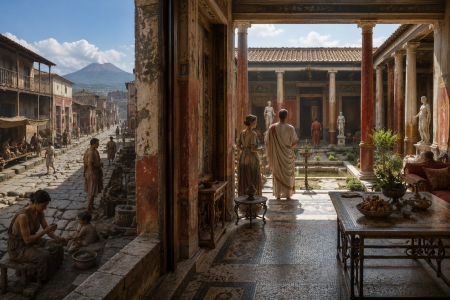
Not every resident lived in such surroundings. Small rooms were built above or behind shops. Laborers, tenants, freed people, and enslaved workers occupied spaces that left fewer luxurious traces. Archaeological discoveries of cramped sleeping rooms, workshops, and a bakery where people and donkeys labored together expose the harsher side of the urban economy.
Religion, Politics, and Graffiti
The Pompeii Forum was the civic and religious center of the city. Temples honored Apollo, Jupiter, Venus, and other deities, while household shrines connected religion with family identity and everyday protection.
Politics filled the walls. Painted notices urged voters to support candidates for local office. Other inscriptions advertised games, recorded debts, insulted rivals, declared love, celebrated sexual encounters, or simply announced that someone had been there.
Pompeii’s graffiti makes the city feel immediate because it preserves voices that formal Roman histories usually ignored.
Baths, Theatre, and the Pompeii Amphitheatre
Public baths served hygiene, exercise, business, and conversation. The Stabian Baths, Forum Baths, and other complexes contained changing rooms and heated, warm, and cold spaces. Bathhouses also reveal Roman engineering through furnaces, raised floors, pipes, and controlled circulation.
Pompeii possessed theatres for drama and musical performances as well as an amphitheatre built around 70 BCE. It is among the oldest surviving permanent Roman amphitheatres.
In 59 CE, violence erupted between spectators from Pompeii and nearby Nuceria during gladiatorial games. Tacitus reports that insults became stone-throwing and then armed fighting. The Senate punished Pompeii by banning similar gatherings for ten years, although the restriction may have been shortened.
A surviving wall painting appears to depict the riot, complete with the amphitheatre and nearby buildings. It is a rare visual record of crowd violence in the Roman world.
The Earthquake Before Vesuvius
In 62 or 63 CE, a powerful earthquake damaged Pompeii and neighboring communities. Temples, houses, streets, and public buildings required extensive repairs. Smaller tremors continued in the following years.
When Vesuvius erupted, Pompeii was still rebuilding. Some houses had stacks of construction material, unfinished wall decoration, or rooms temporarily used for storage. The city was therefore neither abandoned nor fully restored. It was an active urban center living through a long reconstruction.
Romans did not understand earthquakes and volcanoes through modern geology. Vesuvius had been quiet for generations and appeared as a cultivated mountain covered with fields, vineyards, and vegetation. The connection between repeated tremors and a catastrophic eruption was not understood clearly enough to produce a mass evacuation.
When Did Mount Vesuvius Erupt?
The eruption occurred in 79 CE, traditionally written as 79 AD. For centuries, historians accepted 24 August because that date appears in part of the manuscript tradition of Pliny the Younger’s letters.
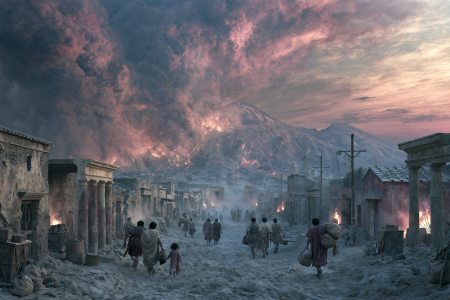
Archaeological evidence has strengthened the case for an autumn eruption. Discoveries include autumnal produce, heavy clothing, and a charcoal inscription carrying a date equivalent to 17 October. Because charcoal writing was unlikely to survive for many months, the eruption must have occurred after that day.
Many researchers now favor 24 or 25 October 79 CE. The exact date is still discussed because the surviving manuscripts disagree and archaeological evidence requires interpretation. The safest description is therefore that Vesuvius erupted in the autumn of 79 CE, probably in late October.
The Pompeii Eruption: How the City Was Buried
The Plinian Eruption Begins
Around midday, Vesuvius exploded with enormous force. Gas-rich magma fragmented into ash and pumice, producing an eruption column that rose high into the atmosphere. Pliny the Younger, observing from Misenum across the Bay of Naples, compared the cloud to a pine tree because it rose like a trunk before spreading outward into branches.
Wind carried much of the falling material toward Pompeii. White pumice began to accumulate, followed by darker volcanic material. The city entered a strange artificial night filled with ash, impacts, tremors, and collapsing structures.
Hours of Pumice Fall
The pumice fall did not kill everyone immediately. Many residents had time to flee, and the majority of Pompeii’s population probably escaped during the early phase. Others remained to guard property, waited for family members, sheltered indoors, or found roads increasingly difficult to use.
As the deposits deepened, walking became exhausting. Roofs and upper walls collapsed under the weight. People trapped inside houses could be crushed or buried. Earthquakes added further destruction while darkness made movement uncertain.
Pyroclastic Currents Reach Pompeii
During the night and early morning, the eruption column became unstable. Dense mixtures of hot gas, ash, and volcanic fragments raced down Vesuvius. Herculaneum was struck earlier and buried deeply by these currents.
The final pyroclastic surges eventually reached Pompeii. Those still exposed had little chance of survival. Extreme heat, ash, gases, debris, and violent impact killed people rapidly. The currents entered streets, rooms, and spaces left open within the pumice deposits, sealing the city beneath additional layers of volcanic material.
Vesuvius Eruption Timeline
| Phase | What Happened | Effect on Pompeii |
|---|---|---|
| Initial explosion | A towering column of gas, ash, and pumice rises above Vesuvius. | Residents see the cloud and experience falling ash and tremors. |
| Pumice fall | White and later darker pumice falls for many hours. | Roads become difficult, roofs collapse, and many inhabitants flee. |
| Night phase | Darkness, earthquakes, and accumulating debris increase the danger. | Some people become trapped in houses or shelters. |
| Column collapse | Hot pyroclastic currents race down the volcano. | Herculaneum is overwhelmed before the strongest currents reach Pompeii. |
| Final surges | Hot ash and gas sweep through Pompeii. | People remaining in the city are killed and buried. |
| Aftermath | The eruption subsides after roughly a day of destructive activity. | Pompeii disappears beneath several meters of volcanic deposits. |
Pliny the Younger’s Eyewitness Account
Much of the eruption’s human story comes from two letters written by Pliny the Younger to the historian Tacitus years later. Pliny was staying at Misenum with his mother and his uncle, the scholar and naval commander Pliny the Elder.
Pliny the Elder first approached the eruption out of scientific curiosity. After receiving a request for help, he turned the voyage into a rescue operation and sailed toward communities beneath the volcano. Falling debris prevented his ships from reaching part of the coast, so he continued to Stabiae.
There, ash, tremors, and fear intensified. Pliny the Elder eventually collapsed and died. The exact medical cause cannot be reconstructed with certainty. His nephew later described both his uncle’s final journey and his own escape from Misenum through darkness, ash, and panicked crowds.
The letters did not provide a direct street-level account from Pompeii, but they remain among antiquity’s most important descriptions of a natural disaster. Explosive eruptions with towering sustained columns are now called Plinian eruptions in recognition of Pliny’s description.
The Victims and Bodies of Pompeii
Archaeologists have found the remains of more than one thousand victims across Pompeii. This number does not represent the city’s entire population or the total death toll around Vesuvius. Many people escaped, while other victims may remain undiscovered or were lost through early excavation and later disturbance.
The victims died in different circumstances. Some were crushed by collapsing roofs or buried during the pumice fall. Others survived the first phase but were killed when pyroclastic currents reached the city.
How Were the Pompeii Plaster Casts Made?
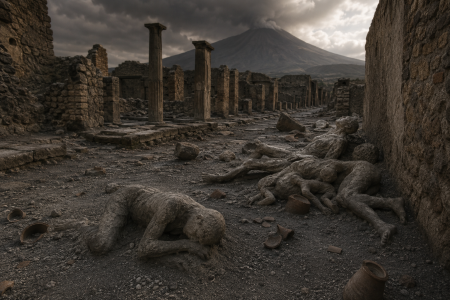
The famous “bodies of Pompeii” are usually plaster casts rather than preserved human bodies. After victims were buried, soft tissue decomposed and left cavities inside hardened layers of ash. Bones and personal objects sometimes remained within these hollow spaces.
In 1863, excavation director Giuseppe Fiorelli developed a method of pouring liquid plaster into the cavities before removing the surrounding volcanic material. Once the plaster hardened, archaeologists uncovered three-dimensional impressions of bodies, clothing, footwear, and objects.
The casts preserve final positions with disturbing intimacy: adults covering their faces, families sheltering together, people attempting to rise, and animals unable to escape. Modern researchers use scans, medical imaging, conservation materials, and careful study of the bones inside the casts.
The casts are powerful evidence, but they should not be treated as theatrical props. They represent individual people whose identities are usually unknown and whose remains require respectful preservation.
Pompeii and Herculaneum: What Was the Difference?
| Feature | Pompeii | Herculaneum |
|---|---|---|
| Location | Southeast of Vesuvius and farther from the crater. | West of Vesuvius and closer to the volcano. |
| Main early deposit | Long fall of ash, lapilli, and pumice. | Less initial pumice, followed by powerful pyroclastic currents. |
| Preservation | Large urban area, streets, public buildings, graffiti, and body cavities. | Organic materials, wooden structures, upper floors, food, and documents often survived exceptionally well. |
| Urban character | A larger commercial and civic center. | A smaller and wealthier coastal town. |
| Victim discoveries | Victims found in houses, streets, gardens, and shelters. | Large groups found near the ancient shoreline in waterfront chambers. |
The Rediscovery and Excavation of Pompeii
Pompeii was not completely erased from memory, and people returned to the buried zone after the eruption. Some recovered building materials or tunneled into accessible structures. Over time, however, the city’s exact layout disappeared beneath farmland and volcanic deposits.
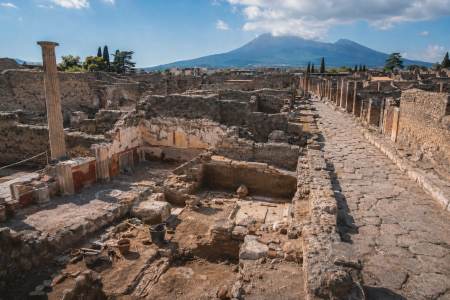
Construction work encountered ancient walls in the late 16th century, but systematic excavation began in 1748 under the Bourbon rulers of Naples. Early excavators often searched for paintings, sculpture, and valuable objects rather than documenting complete archaeological contexts.
Pompeii became a major destination on the European Grand Tour. Its architecture, decoration, and household objects helped inspire Neoclassical art, interior design, literature, and ideas about ancient domestic life.
Giuseppe Fiorelli introduced more systematic recording during the 19th century. He divided the city into regions, blocks, and numbered entrances—a system still used today. Archaeology later expanded beyond elite art to examine food, disease, migration, slavery, gender, commerce, gardens, waste, and ordinary households.
Pompeii Archaeology and New Discoveries
Pompeii is still an active archaeological site. Excavation now serves conservation as much as discovery. Archaeologists frequently work along the boundary between excavated and unexcavated areas, where unsupported volcanic deposits can threaten exposed buildings.
Recent work in Regio IX uncovered an elegant banquet hall with dark-painted walls and mythological scenes associated with the Trojan War. The paintings were designed not merely as decoration but as material for conversation during elite dinners.
Archaeologists also revealed a rare blue-painted room interpreted as a possible shrine, along with construction areas, children’s drawings, worker spaces, and evidence that several properties were being renovated when the eruption occurred.
In 2025, research brought renewed attention to a large private residence containing an elaborate bath complex and banqueting space. Its architecture demonstrated how wealthy Pompeians used bathing, dining, and hospitality to strengthen political and social relationships.
Each discovery complicates the idea of Pompeii as a city frozen in perfect order. It was a place under repair, full of inequality, political competition, unfinished work, and changing households.
Pompeii: Myth vs. Archaeological Evidence
-
Myth: Everyone in Pompeii died.
Evidence: Many inhabitants escaped during the long pumice-fall phase. -
Myth: The plaster casts are petrified bodies.
Evidence: Most are plaster or resin impressions formed from cavities left after bodies decomposed. -
Myth: Vesuvius buried Pompeii instantly.
Evidence: The disaster unfolded in several phases over roughly a day. -
Myth: Pompeii was preserved exactly as residents left it.
Evidence: Escape, collapse, ancient recovery, looting, excavation, bombing, weather, and restoration altered the site. -
Myth: The eruption certainly occurred on 24 August.
Evidence: Manuscript and archaeological evidence conflict, and late October is now widely favored. -
Myth: Pompeii reveals only wealthy Roman life.
Evidence: Shops, workshops, graffiti, worker rooms, bakeries, and human remains also document labor and poverty.
Timeline: The History of Pompeii
- 6th century BCE: A substantial settlement develops at Pompeii.
- Late 5th century BCE: Samnite communities gain control of the city.
- 3rd century BCE: Pompeii becomes increasingly connected to Roman power.
- 91–87 BCE: Pompeii participates in the Social War.
- 80 BCE: Sulla establishes a Roman veteran colony.
- 59 CE: A violent riot erupts during games in the amphitheatre.
- 62 or 63 CE: A major earthquake damages Pompeii.
- 79 CE: The eruption of Mount Vesuvius buries Pompeii and Herculaneum.
- 1748: Systematic Bourbon-era excavations begin.
- 1863: Giuseppe Fiorelli begins making plaster casts of victims.
- 1943: Allied bombing damages parts of the archaeological site.
- 1997: Pompeii and related Vesuvian sites become a UNESCO World Heritage property.
- 21st century: Conservation projects and targeted excavations reveal new houses, art, victims, and evidence of everyday life.
Fast Facts About Pompeii
-
Pompeii was not founded by Rome:
The settlement developed under several Italian and Mediterranean influences before becoming a Roman colony.
-
The city was still rebuilding:
Damage from the earthquake of 62 or 63 CE had not been fully repaired when Vesuvius erupted.
-
The eruption date remains debated:
Evidence now strongly favors an autumn date, probably in late October 79 CE.
-
Most residents probably escaped:
The pumice fall lasted for hours, giving many inhabitants time to leave the city.
-
More than one thousand victims have been found:
This represents only the remains discovered within Pompeii, not the full regional death toll.
-
The casts are impressions:
Plaster was poured into cavities left when bodies decomposed inside hardened ash.
-
Pompeii had an ancient food-service industry:
Numerous counters, taverns, bakeries, and street-side establishments served residents and travelers.
-
The city is still revealing new evidence:
Targeted excavation and conservation continue to uncover paintings, rooms, inscriptions, and human stories.
Conclusion: A Roman City Preserved by Disaster
Pompeii is famous because it died suddenly, but its greater historical value comes from how completely it records life. The city preserves political advertisements and private insults, grand dining rooms and cramped worker spaces, religious paintings and discarded food, public monuments and small personal possessions.
The eruption of Mount Vesuvius transformed these ordinary details into archaeological evidence. Falling pumice damaged buildings, pyroclastic currents killed those left behind, and volcanic deposits sealed surviving structures away from centuries of redevelopment.
Archaeology has not recovered a perfectly frozen moment. Ancient salvage, decomposition, excavation, wartime destruction, weather, and restoration all altered the site. Even so, Pompeii provides one of the clearest views of daily life anywhere in the Roman world.
Its enduring power lies in the contrast between scale and intimacy. Vesuvius was a geological catastrophe affecting an entire region, yet Pompeii tells that history through individual rooms, meals, messages, footprints, possessions, and bodies. Beneath the story of destruction remains the evidence of a living city.
Pompeii & Mount Vesuvius — Frequently Asked Questions
What happened to Pompeii?
Mount Vesuvius erupted in 79 CE, covering Pompeii with pumice, ash, and later pyroclastic deposits. Roofs collapsed during the pumice fall, and hot pyroclastic currents killed people who remained in the city.
When was Pompeii destroyed?
Pompeii was destroyed in 79 CE, traditionally written as 79 AD. Although 24 August was long accepted, archaeological evidence now favors an autumn eruption, probably in late October.
How long did the Pompeii eruption last?
The most destructive phases unfolded over roughly a day. Pumice fell for many hours before pyroclastic currents reached Pompeii during the later phase.
How did the people of Pompeii die?
Some victims were crushed or trapped when buildings collapsed beneath accumulated pumice. Others were killed rapidly by hot pyroclastic currents containing ash, gases, and volcanic debris.
How many people died in Pompeii?
The total is unknown. Archaeologists have found the remains of more than one thousand victims within Pompeii, but many residents escaped and other remains may never have been recovered.
Did anyone survive Pompeii?
Yes. The eruption’s early phase lasted for hours, allowing many residents to flee. Evidence from survivors and relocated Pompeian families indicates that the entire population was not killed.
Are the bodies in Pompeii real?
The casts represent real victims, but most are not intact petrified bodies. They were made by filling cavities left in the hardened ash after human remains decomposed. Bones may remain inside some casts.
How were the Pompeii plaster casts made?
Beginning in 1863, Giuseppe Fiorelli’s team poured plaster into body-shaped cavities discovered in the ash. After the plaster hardened, the surrounding deposit was removed to reveal the impression.
What was life like in Pompeii before the eruption?
Pompeii was a busy commercial city with shops, workshops, bakeries, baths, temples, theatres, an amphitheatre, private houses, street food counters, elections, and sharp differences between wealthy families and laborers.
When was Pompeii rediscovered?
Ancient remains were encountered before modern archaeology, but systematic excavation began in 1748 under the Bourbon rulers of Naples.
What is the difference between Pompeii and Herculaneum?
Pompeii was larger and was buried first by heavy pumice fall. Herculaneum was smaller, closer to Vesuvius, and buried mainly by pyroclastic currents that preserved wood, upper floors, food, and other organic material exceptionally well.
Was Pompeii rebuilt after the eruption?
No complete city was rebuilt on the buried site. Survivors and officials recovered some materials, but Pompeii remained largely beneath the volcanic deposits until modern excavation.
Is Mount Vesuvius still active?
Yes. Vesuvius remains an active volcano and has erupted many times since 79 CE. Its most recent eruption occurred in 1944, and the surrounding region remains closely monitored.
Sources & References
- Pliny the Younger, Letters, Books 6.16 and 6.20.
- Tacitus, Annals, Book 14, on the Pompeii amphitheatre riot and the Campanian earthquake.
- Pompeii Archaeological Park, official site guides, excavation reports, and research materials concerning the victims, casts, houses, and recent discoveries.
- UNESCO World Heritage Centre, Archaeological Areas of Pompeii, Herculaneum and Torre Annunziata.
- National Institute of Geophysics and Volcanology, research on the phases, deposits, and date of the 79 CE eruption.
- Mary Beard, Pompeii: The Life of a Roman Town (Profile Books, 2008).
- Robert Etienne, Pompeii: The Day a City Died (Thames & Hudson, revised edition).
- Andrew Wallace-Hadrill, Houses and Society in Pompeii and Herculaneum (Princeton University Press, 1994).
- Paul Zanker, Pompeii: Public and Private Life (Harvard University Press, 1998).
- Alison E. Cooley and M. G. L. Cooley, Pompeii and Herculaneum: A Sourcebook (Routledge, second edition, 2014).
- Giuseppe Fiorelli, archaeological records and reports concerning Pompeii’s excavation system and plaster-cast technique.
More Articles