Charlemagne: Father of Medieval Europe
The Frankish king who built an empire, revived learning, and redefined medieval power.
Introduction
Charlemagne stands at the center of early medieval history like a figure carved from stone: warrior, king, emperor, reformer, and symbol. Known in Latin as Carolus Magnus, or Charles the Great, he ruled the Franks from 768 to 814 CE and built the largest western European empire since ancient Rome. His reign connected battlefield conquest with church reform, royal law with education, and Frankish tradition with Roman memory. That combination explains why many later writers called him the “Father of Europe.”
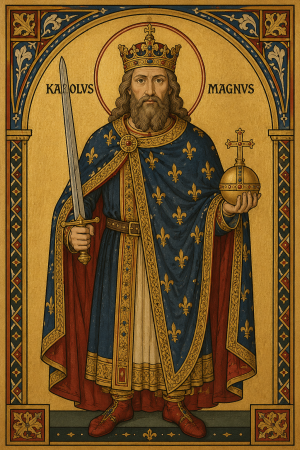
The phrase does not mean that Charlemagne created modern Europe by himself. His empire was fragile, violent, deeply Christian, and shaped by the politics of its time. Yet the label captures something real. Charlemagne united much of western and central Europe, strengthened the bond between kingship and the papacy, encouraged a revival of learning known as the Carolingian Renaissance, and created a model of Christian rulership that echoed through the Middle Ages. To understand Charlemagne is to understand how the ruins of Rome, the power of the Franks, and the religious imagination of medieval Europe came together.
The Frankish World Before Charlemagne
Charlemagne was born into a world still shaped by the fall of the Western Roman Empire. In the west, Roman emperors were gone, but Roman ideas had not disappeared. Bishops still wrote in Latin. Cities still remembered imperial law. Rulers still wanted the prestige of Rome, even when their armies, languages, and political customs came from Germanic traditions.
The Franks had risen from one of several post-Roman peoples into the strongest kingdom in western Europe. Their earlier Merovingian kings had once carried royal authority, but real power gradually passed to officials called mayors of the palace. Charlemagne’s grandfather, Charles Martel, became famous for his military strength, while his father, Pepin the Short, took the crown in 751 CE and began the Carolingian royal line.
Pepin also forged a powerful relationship with the papacy. When the Lombards threatened Rome, the pope looked north for protection. The Franks answered. This alliance gave the Carolingians sacred legitimacy, while the papacy gained a strong military patron. It was a turning point in medieval politics: western Europe was no longer looking only to Constantinople for imperial authority.
For readers interested in the older imperial world that still haunted Charlemagne’s age, see our article on Julius Caesar: Life, Wars & Death, which explores a very different kind of Roman power.
Charlemagne King of the Franks
When Pepin died in 768 CE, his kingdom was divided between his sons, Charlemagne and Carloman. The arrangement was tense from the beginning. Frankish custom favored division among heirs, but divided kingdoms often created rivalry. In 771 CE, Carloman died unexpectedly, and Charlemagne became sole King of the Franks.
From that point, Charlemagne moved with remarkable energy. He was not a distant ceremonial king. He rode with armies, summoned assemblies, issued laws, judged disputes, and traveled across his realm. His government depended on personal presence and loyalty. Counts managed local regions, bishops and abbots helped preserve order, and royal envoys known as missi dominici inspected the conduct of officials. It was not a modern state, but it was more organized than a simple warband kingdom.
Charlemagne’s rule also rested on conquest. His wars were not occasional border raids; they were a central feature of his kingship. Victory brought tribute, land, hostages, captives, and prestige. It also allowed him to present himself as a defender and spreader of Christianity, a theme that would become inseparable from his image.
Charlemagne and the Rise of the Frankish Empire
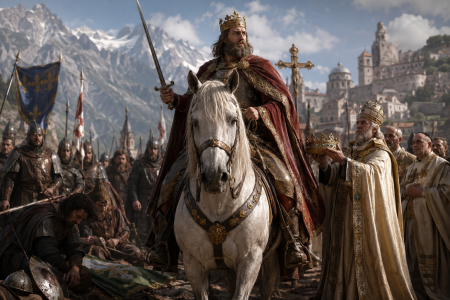
The rise of the Frankish Empire was built through campaigns in several directions. In 774 CE, Charlemagne crossed the Alps, defeated the Lombards, and took their crown. This made him King of the Franks and King of the Lombards, strengthening Frankish influence in Italy and securing his role as protector of the papacy.
His longest and most brutal conflict was the Saxon Wars, fought from 772 to 804 CE. The Saxons, living across parts of what is now northern Germany, resisted Frankish rule and Christian conversion for decades. Charlemagne responded with fortresses, forced baptisms, deportations, and harsh punishments. The conflict showed both the reach of his ambition and the violence behind the making of medieval Christendom.
He also campaigned against the Avars in central Europe, fought in northern Spain, and secured frontier zones that helped guard the empire. Not every campaign was successful. The famous defeat of his rear guard at Roncesvalles in 778 CE later inspired epic legend in The Song of Roland. Yet even failure could become part of Charlemagne’s myth.
| Region / Opponent | Approximate Dates | Outcome | Historical Importance |
|---|---|---|---|
| Lombard Kingdom | 773–774 CE | Charlemagne conquers Lombard power in northern Italy. | Strengthened Frankish control in Italy and deepened the alliance with the papacy. |
| Saxony | 772–804 CE | Long conquest followed by forced integration and Christianization. | Expanded the Frankish Empire into northern Europe but left a legacy of violence. |
| Spanish March | Late 8th century CE | Mixed results, including defeat at Roncesvalles. | Created a frontier zone between Frankish lands and Muslim-ruled Iberia. |
| Avar Khaganate | 790s CE | Frankish victories weakened Avar power. | Opened central European regions to Frankish influence and missionary activity. |
Charlemagne Crowned Emperor in 800
The most symbolic moment of Charlemagne’s life came on Christmas Day in 800 CE. During mass in Saint Peter’s Basilica in Rome, Pope Leo III placed a crown on his head and proclaimed him emperor. The ceremony connected Charlemagne to the memory of the Roman Empire and announced a new political idea: imperial authority could exist again in the Latin West.
The event was complicated. The Byzantine Empire still existed in the east and claimed Roman continuity. The papacy needed protection and wanted to assert its own authority. Charlemagne needed sacred legitimacy, but he also did not want to appear as though his power came only from the pope. Later sources even suggest that he may not have known exactly what Leo planned to do, though historians debate that point.
Many modern readers see Charlemagne described as the first Holy Roman Emperor. That phrase is useful but slightly anachronistic. His title was more closely tied to being “Emperor of the Romans.” The later Holy Roman Empire developed more clearly under Otto I in the 10th century. Still, Charlemagne’s coronation created the medieval model that later emperors would claim as their inheritance.
Charlemagne and the Carolingian Renaissance
Charlemagne was a conqueror, but his legacy was not built by swords alone. His court at Aachen became a center of reform, scholarship, and Christian learning. He invited scholars from across Europe, including Alcuin of York, to improve education, correct religious texts, standardize worship, and strengthen the intellectual life of the church.
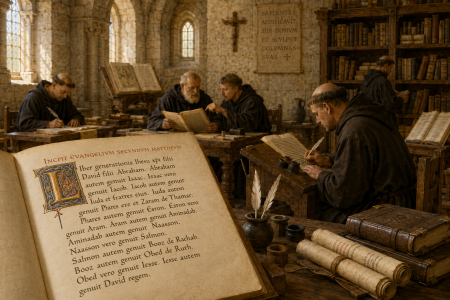
This movement is known as the Carolingian Renaissance. It was not a renaissance in the later Italian sense, but it was a real revival of learning. Monasteries and scriptoria copied books, preserved classical and Christian texts, and promoted clearer Latin. One of its most lasting achievements was Carolingian minuscule, a neat and legible script that influenced later European handwriting and printing.
These reforms mattered because medieval power depended on writing. Kings needed laws, letters, records, religious books, and educated clergy. A better-trained church could serve God, but it could also help govern the empire. In Charlemagne’s world, education, faith, and royal authority were tightly linked.
The long-term importance of copying and preserving texts can also be seen much later in our article on The Printing Press and the Birth of the Modern World, when the written word again transformed European society.
Why Is Charlemagne Called the Father of Europe?
Charlemagne is called the Father of Europe because his empire brought together lands that would later become parts of France, Germany, Italy, the Low Countries, Austria, and beyond. He did not create modern nations, and his subjects did not think of themselves as Europeans in a modern political sense. But his reign created a powerful memory of western unity after Rome.
He also shaped the medieval relationship between throne and altar. Kingship was not only a matter of bloodline or battlefield strength. It was presented as a Christian office with sacred duties. Charlemagne was expected to defend the church, punish disorder, promote correct belief, and rule with justice. That ideal influenced medieval rulers for centuries, even when reality fell short.
His image became larger than life. French kings, German emperors, crusading knights, monks, poets, and political thinkers all remembered him in different ways. Some saw him as a Christian hero. Others saw him as an imperial lawgiver. Medieval legend turned him into a champion of the faith, surrounded by heroic warriors. History was more complex, but the legend helped make Charlemagne one of the most famous rulers of the Middle Ages.
The Empire After Charlemagne
Charlemagne died at Aachen in 814 CE. His son Louis the Pious inherited the empire, but the Carolingian system struggled with a familiar problem: succession. Frankish tradition allowed rulers to divide lands among sons, and political unity depended heavily on the personal strength of the king.
In 843 CE, the Treaty of Verdun divided the empire among Charlemagne’s grandsons. West Francia would help form the roots of medieval France. East Francia would help shape the German lands. The central kingdom, stretching from the Low Countries through parts of Italy, became a contested zone for centuries. The map of Europe did not suddenly become modern, but the division helped create some of the major political directions of the medieval West.
Charlemagne’s empire was therefore both a success and a warning. It showed how much a powerful medieval ruler could achieve, but it also showed how difficult it was to hold together a vast realm without modern administration, stable succession, and shared political identity.
Fast Facts: Charlemagne
-
His name means Charles the Great:
Charlemagne comes from the Latin Carolus Magnus, meaning Charles the Great.
-
His birth year is debated:
Many modern references give 747 or 748 CE, while some older traditions give 742 CE.
-
He ruled the Franks for decades:
Charlemagne became King of the Franks in 768 CE and ruled until his death in 814 CE.
-
He was crowned emperor in Rome:
Pope Leo III crowned Charlemagne emperor on Christmas Day in 800 CE.
-
He promoted learning:
The Carolingian Renaissance encouraged schools, manuscript copying, Latin study, and church reform.
-
His empire did not last intact:
The Treaty of Verdun divided the Carolingian Empire in 843 CE, less than three decades after his death.
Legend vs. Fact
Charlemagne’s historical reputation grew far beyond the man himself. Medieval epic poetry imagined him as a holy warrior surrounded by noble companions. Later rulers used his memory to support their own claims to power. Modern Europe has also remembered him as a symbol of unity.
The facts are more layered. Charlemagne could be a patron of learning and a ruthless conqueror. He protected the church, but he also used religion to justify expansion. He encouraged reform, yet his empire depended on force, aristocratic loyalty, and constant movement. The real Charlemagne is more interesting than the legend because he reveals the contradictions of the early Middle Ages: violence and scholarship, faith and politics, Roman memory and Frankish ambition.
Conclusion: Charlemagne’s Medieval Legacy
Charlemagne earned his place in history because he changed what power could look like in the medieval West. He expanded the Frankish Empire, tied kingship to Christian reform, revived the imperial title in western Europe, and supported a cultural movement that preserved learning for future generations. He did not create Europe in the modern sense, but he gave medieval Europe one of its strongest political myths: the dream of a united Christian empire.
His achievements were impressive, but they were not simple. Charlemagne’s rule was built through war as well as reform. His empire inspired later generations, but it fractured after his death. His coronation connected him to Rome, but it also created centuries of tension over the relationship between popes and emperors. That is why Charlemagne remains so important. He was not only a ruler of the past; he became a blueprint, a warning, and a legend for the medieval world.
Charlemagne — Frequently Asked Questions
Why is Charlemagne called the Father of Europe?
Charlemagne is called the Father of Europe because he united much of western and central Europe, revived the idea of western empire, supported Christian reform, and shaped the political culture of the medieval West.
Was Charlemagne French or German?
Charlemagne was Frankish, not French or German in the modern national sense. His empire included lands that later became part of France, Germany, Italy, Belgium, the Netherlands, and other European regions.
When was Charlemagne crowned emperor?
Charlemagne was crowned emperor by Pope Leo III in Rome on Christmas Day, 800 CE. The ceremony took place in Saint Peter’s Basilica and symbolized the revival of imperial authority in western Europe.
Was Charlemagne the first Holy Roman Emperor?
Charlemagne is often described that way, but the phrase can be misleading. His title was emperor of the Romans. The later Holy Roman Empire developed more clearly under Otto I in the 10th century, though Otto and later emperors looked back to Charlemagne’s coronation as a model.
What was the Carolingian Renaissance?
The Carolingian Renaissance was a revival of learning, church reform, manuscript copying, Latin education, and artistic production encouraged under Charlemagne and his successors. It helped preserve classical and Christian texts during the Early Middle Ages.
What happened to Charlemagne’s empire after he died?
After Charlemagne died in 814 CE, his son Louis the Pious inherited the empire. In 843 CE, the Treaty of Verdun divided the empire among Charlemagne’s grandsons, creating political divisions that influenced later medieval France, Germany, and central Europe.
Sources & References
- Einhard, The Life of Charlemagne, translated editions of the medieval biography.
- Rosamond McKitterick, Charlemagne: The Formation of a European Identity, Cambridge University Press, 2008.
- Roger Collins, Charlemagne, University of Toronto Press, 1998.
- Pierre Riché, The Carolingians: A Family Who Forged Europe, University of Pennsylvania Press, 1993.
- Johannes Fried, Charlemagne, Harvard University Press, 2016.
- World History Encyclopedia, “Charlemagne” and “Carolingian Dynasty.”
- The Metropolitan Museum of Art, Heilbrunn Timeline of Art History, articles on Carolingian art, central Europe, and the Holy Roman Empire.
- Encyclopedia.com / Gale, “Carolingian Renaissance.”
- British Library and manuscript catalog resources on Carolingian books, scripts, and learning.