The Printing Press and the Birth of the Modern World
Johannes Gutenberg did not invent printing from nothing—he built the European system that made books reproducible on an unprecedented scale.
Introduction: When Was the Printing Press Invented?
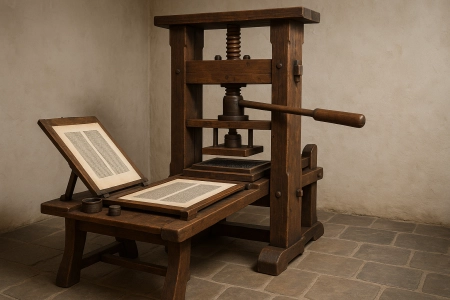
The modern European printing press was developed by Johannes Gutenberg in Mainz, Germany, during the 1440s. There was no single afternoon on which the machine suddenly appeared. Gutenberg spent years combining metalworking, type casting, ink preparation, page composition, and a screw-driven press into a reliable production system. His workshop was operating by the early 1450s, and the magnificent Gutenberg Bible was completed around 1454–1455.
Gutenberg was not the first person in world history to print texts or experiment with movable type. Chinese artisans had used woodblock printing for centuries, Bi Sheng developed ceramic movable type in the 11th century, and Korean printers produced the surviving metal-type Jikji in 1377. Gutenberg’s achievement was different: he created a commercially scalable European system suited to alphabetic scripts, paper markets, urban workshops, and long print runs.
The result was more than a faster way to make books. Printing lowered the cost of reproducing information, multiplied the number of available texts, and changed how readers encountered religion, politics, science, law, literature, and news. It strengthened the Renaissance, accelerated the Protestant Reformation, supported the Scientific Revolution, and created new struggles over censorship, misinformation, ownership, and authority. In that sense, the history of the printing press is also the history of the first great revolution in mass communication.
The Printing Press: Quick Answers
| Question | Answer |
|---|---|
| Who made the printing press? | Johannes Gutenberg developed Europe’s first successful movable-metal-type printing system. |
| When was the printing press invented? | Gutenberg developed it during the 1440s; his major Bible was printed around 1454–1455. |
| Where was the printing press invented? | Gutenberg’s mature system was developed in Mainz, in the Holy Roman Empire—now Germany. |
| What was the printing press? | A system that combined reusable type, ink, arranged pages, and mechanical pressure to reproduce many copies of a text. |
| Was Gutenberg the first printer in history? | No. Printing and movable type existed earlier in East Asia. His breakthrough transformed printing in Europe. |
| Why was the printing press important? | It made texts more abundant, encouraged wider reading, accelerated public debate, and changed religion, education, science, politics, and commerce. |
Printing Before Gutenberg: China, Korea, and the Wider Story
The story of printing began long before 15th-century Europe. In East Asia, artisans carved complete pages into wooden blocks, covered the raised surfaces with ink, and pressed paper against them. This method was highly effective for religious texts, official documents, calendars, and images. The Diamond Sutra, printed in China in 868, is the oldest known complete dated printed book that survives.
Around 1040, the Chinese artisan Bi Sheng created individual characters from baked clay. These pieces could be arranged, printed, removed, and reused. Korean printers later worked with movable metal type. The Buddhist text known as the Jikji, printed at Cheongju in 1377, is recognized as the oldest surviving book printed with movable metal type.
These developments were not failed rehearsals for Europe. They belonged to sophisticated East Asian printing cultures with their own materials, institutions, scripts, and markets. Movable type offered different advantages in languages using thousands of characters than it did in alphabetic Europe. Woodblock printing could remain efficient because a carved block preserved an entire page and could be stored for later reuse.
Why Movable Type Spread Differently in Europe
European printers worked with a comparatively small Latin alphabet, although they still needed capitals, lowercase letters, punctuation, abbreviations, ligatures, and multiple sizes. Growing paper production reduced dependence on expensive parchment. Universities, churches, courts, merchants, and urban schools created demand for legal texts, religious works, grammars, calendars, and practical manuals. Dense trade networks then allowed printers to sell beyond their home cities.
Gutenberg’s importance therefore lies not in being the first human to imagine movable type, but in building a complete production method that could be copied by other European workshops. His system linked metallurgy, typography, ink, paper, mechanical pressure, skilled labor, financing, and commercial distribution.
Johannes Gutenberg and the Invention of the European Printing Press

Johannes Gutenberg was born in Mainz around 1400 into a patrician family connected to metalworking and the minting trades. Much of his life remains obscure. Documents place him in Strasbourg during the 1430s, where he became involved in a secretive commercial venture that may have included early printing experiments. By the late 1440s, he had returned to Mainz and obtained financing from the wealthy businessman Johann Fust.
Gutenberg’s system depended on precision. Every piece of type had to stand at the same height so the entire page received even pressure. Each letter also needed consistent proportions so lines could be justified and locked into a stable metal frame. He is generally associated with a punch-and-matrix method: a hard metal punch bearing a letter was driven into a softer matrix, which could then be placed in an adjustable hand mould to cast repeated copies of the same character.
The resulting type was likely made from a lead-based alloy containing materials such as tin and antimony. The precise formula and every detail of Gutenberg’s original workshop remain debated because he left no technical manual. What matters is that the type could be manufactured in quantity, arranged into pages, printed, and returned to cases for reuse.
What Did Gutenberg Actually Invent?
No single component was entirely new. Screw presses already compressed grapes, olives, paper, and textiles. Metalworkers already knew casting techniques. Oil-based pigments were used by painters. Paper had reached Europe centuries earlier. Gutenberg’s achievement was to make these elements function as one repeatable industrial workflow.
| Element | Function | Why it mattered |
|---|---|---|
| Reusable metal type | Individual letters were arranged into words, lines, and pages. | The same type could be redistributed and used for another page or book. |
| Punch, matrix, and hand mould | Created repeated letters with consistent dimensions. | Uniform type made clear pages and reliable mechanical impressions possible. |
| Oil-based ink | Adhered to metal and transferred cleanly to paper or vellum. | Water-based writing inks did not perform as effectively on metal type. |
| Screw-driven press | Applied controlled pressure across the printing surface. | Produced clearer, more consistent impressions than rubbing by hand. |
| Workshop organization | Divided labor among type founders, compositors, press crews, correctors, and binders. | Specialization allowed production to continue at a much larger scale. |
| Commercial financing | Paid for metal, paper, labor, buildings, and long production runs. | Printing became a capital-intensive business rather than a single artisan’s task. |
How Was the Printing Press Made and Used?
Early printing was not automatic. A wooden hand press required a coordinated team, careful preparation, and considerable physical labor. The following sequence could be repeated for every side of every sheet in a book.
-
1. Type was designed and cast
A letter punch created a matrix, and a hand mould produced multiple individual pieces known as sorts.
Key tools: Punches, matrices, hand moulds, files, and lead-based type metal.
-
2. The compositor built the page
Letters were selected from type cases and arranged backward in a composing stick, line by line.
Key tools: Type cases, composing stick, galleys, spacing material, chase, and quoins.
-
3. The forme was locked
Completed pages were secured inside a frame so the type would not move under pressure.
Key concern: A loose letter could damage a sheet or disrupt an entire print run.
-
4. Ink was applied
Press workers spread a controlled layer of thick ink over the raised type, traditionally using ink balls covered with leather.
Key concern: Too much ink blurred letters; too little produced weak impressions.
-
5. The sheet was pressed
Paper was positioned in a hinged frame, moved beneath the platen, and pressed against the inked type.
Key tools: Tympan, frisket, carriage, platen, screw, bar, and wooden press frame.
-
6. Sheets were checked and finished
Printed sheets dried before being folded into gatherings, assembled, decorated when desired, and bound.
Finishing work: Proofreading, rubrication, illumination, sewing, trimming, and binding.
A skilled workshop could produce many hundreds of impressions in a working day, but books remained expensive investments. Type setting consumed time, paper represented a major cost, and bindings were often purchased separately. Printing made copying dramatically more efficient without turning books into instantly cheap objects for everyone.
The Gutenberg Bible: Printing’s First European Masterpiece
Gutenberg’s most famous achievement was the 42-line Bible, now commonly called the Gutenberg Bible. Printed in Mainz around 1454–1455 with the financial participation of Johann Fust, it was the first major large-format European book produced with movable metal type. Scholars estimate a print run of approximately 180 copies—most on paper and a smaller number on vellum.
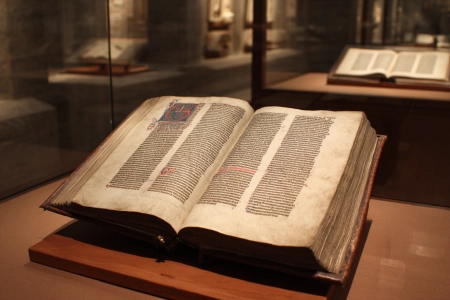
The Bible did not advertise itself as a machine-made object. Gutenberg designed dense blackletter type to resemble the formal handwriting found in prestigious manuscripts. Spaces were left for rubricators and illuminators to add colored initials, headings, and decoration by hand. Each surviving copy therefore combines mechanical repetition with individual craftsmanship.
Fewer than 50 copies survive in complete or fragmentary form, and only a much smaller number remain complete. The project demonstrated that a workshop could produce dozens of visually consistent copies of a massive text—a feat that would have required years of scribal labor if performed entirely by hand.
The Lawsuit That Cost Gutenberg Control
Gutenberg’s technical success did not guarantee financial security. In 1455, Johann Fust sued him over unpaid loans and interest. The surviving legal record is incomplete, but Fust appears to have gained control of important equipment or assets. Fust then worked with Gutenberg’s former associate Peter Schöffer, a skilled calligrapher and printer.
Their Mainz Psalter of 1457 was historically important in its own right. It included a printed date and printer information, and it used sophisticated colored initials. The episode reveals a recurring feature of media revolutions: invention, financing, ownership, branding, and legal conflict develop together.
How the Printing Press Spread Across Europe
The technology did not remain secret for long. Political conflict in Mainz, including the sack of the city in 1462, dispersed trained printers to other commercial centers. Workshops appeared in cities such as Strasbourg, Cologne, Basel, Rome, Venice, Paris, Nuremberg, and Augsburg. William Caxton established a press at Westminster in 1476 after learning the trade on the Continent.
Venice became one of Europe’s largest printing centers because it combined capital, paper supplies, skilled labor, shipping, and access to international markets. Printers such as Aldus Manutius became known for scholarly Greek and Latin editions, compact books, elegant type, and recognizable publishing marks.
Books printed in Europe from the beginning of movable-type printing through 1500 are known as incunabula, from a Latin word associated with a cradle or infancy. The cutoff is a later cataloguing convention rather than a technical break. Modern projects record roughly 28,000 surviving editions from this period, represented by hundreds of thousands of known copies in collections around the world. The original number of editions and copies was higher because many works disappeared completely.
| Period | Development | Historical significance |
|---|---|---|
| 1440s–1450s | Gutenberg develops and demonstrates the Mainz system. | Movable-type printing becomes commercially workable in Europe. |
| 1460s–1470s | Printers establish workshops across German, Italian, French, and Low Countries cities. | Technical knowledge spreads through mobile workers and business partnerships. |
| 1480s–1500 | Venice, Paris, Lyon, Nuremberg, Basel, and other cities become major publishing centers. | Printing develops specialized markets, brands, fonts, and international distribution. |
| Early 1500s | Vernacular books and inexpensive pamphlets reach growing audiences. | Print becomes central to religious controversy, politics, schooling, and news. |
The Printing Press, Renaissance, and Reformation
How Printing Strengthened the Renaissance
Renaissance humanists searched for classical works, compared manuscripts, corrected corrupt passages, and produced new translations. Printing allowed an edited text to reach scholars in many cities instead of remaining confined to one library or copying network. It also made disagreement more visible: readers could annotate the same edition, compare variants, and publish corrections.
Print did not automatically create perfectly identical books. Printers corrected type while a run was already underway, mixed sheets from different states, and sometimes introduced new errors. Nevertheless, the availability of numerous copies gave scholarship a more stable shared foundation than manuscript transmission alone could provide.
Figures such as Leonardo da Vinci lived within this changing information environment, even though most of Leonardo’s own notebooks remained unpublished during his lifetime. Printed editions of classical authors, mathematical texts, maps, anatomical books, and technical treatises increasingly connected artists, physicians, engineers, merchants, and university scholars.
Martin Luther and the Reformation Pamphlet Boom
When Martin Luther challenged church practices beginning in 1517, the printing industry was already widespread. Printers rapidly reproduced his sermons, polemics, open letters, and translations. Between 1517 and 1524, the German pamphlet market expanded dramatically, while Luther’s name and recognizable presentation helped turn theological controversy into a public media event.
Short pamphlets were cheaper and faster to produce than large scholarly books. Woodcuts communicated ideas to readers with limited literacy, while public readings extended their reach to people who did not own copies. Catholic authors, secular rulers, and other reformers used the same medium. Print did not cause the Reformation by itself, but it made sustained argument, rapid reply, translation, and mass persuasion possible on a new scale.
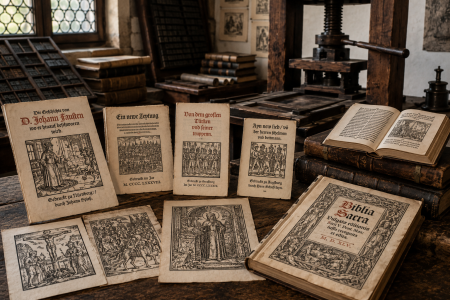
Religious authorities and governments soon recognized the threat. Licensing systems, university review, confiscations, prosecutions, and banned-book lists attempted to restrict publication. Controversial texts moved across borders under false imprints or anonymous authorship. The history of the Inquisition therefore intersects with the history of print: institutions tried to control a medium whose speed and mobility repeatedly exceeded local enforcement.
News, Propaganda, and the First Information Wars
Printing transformed how rulers, rebels, merchants, and ordinary readers encountered distant events. Reports of battles, executions, miracles, disasters, crimes, and political scandals could be copied quickly and sold in multiple cities. Accuracy competed with speed and commercial appeal from the beginning.
The violent reputation of Vlad the Impaler was magnified by German-language pamphlets and woodcuts that turned real executions into sensational stories. Columbus’s 1493 letter announcing his Atlantic voyage appeared in multiple printed editions, helping news of the expedition circulate across Europe; see Christopher Columbus: The 1492 Voyage to the Americas. Print could preserve information, but it could also harden propaganda into apparent historical fact.
Printing Press Fast Facts
-
European inventor:
Johannes Gutenberg developed the successful European movable-type system.
Why it mattered: His integrated method could be reproduced by other workshops.
-
Date:
Development occurred mainly during the 1440s; major printed works appeared in the 1450s.
Why it mattered: “1450” is a useful approximation, not one exact invention date.
-
Place:
Mainz, within the Holy Roman Empire.
Why it mattered: The Rhineland connected metalworking, trade, finance, and paper markets.
-
Earlier movable type:
Bi Sheng used ceramic type in China; Korean printers later used metal type.
Why it mattered: Printing history is global rather than exclusively European.
-
Famous book:
The Gutenberg Bible, printed around 1454–1455.
Why it mattered: It proved that a large, prestigious book could be produced in many consistent copies.
-
Original print run:
Approximately 180 Gutenberg Bibles on paper and vellum.
Why it mattered: A single workshop could create more major Bibles than a team of scribes could copy in the same period.
-
Incunabula:
European books printed through 1500.
Why it mattered: They document printing’s rapid transformation from experiment to international industry.
-
Reformation impact:
Pamphlets, translations, and woodcuts spread arguments quickly after 1517.
Why it mattered: Religious debate became difficult for any single authority to contain.
-
Scientific impact:
Printed diagrams, tables, reports, and journals supported cumulative research.
Why it mattered: Scholars could compare claims across time and distance.
-
Long-term legacy:
Steam, rotary, offset, and digital technologies increased speed, but retained the basic goal of reproducible communication.
Why it mattered: Gutenberg’s workshop helped establish the publishing system from which later mass media developed.
The Printing Press and the Scientific Revolution
Scientific knowledge depends on communication. Printing made it easier to preserve observations, reproduce diagrams, circulate mathematical tables, and compare results. Works such as Copernicus’s On the Revolutions of the Heavenly Spheres, Vesalius’s illustrated anatomy, and Galileo’s publications reached communities of readers who could evaluate, criticize, or extend their claims.
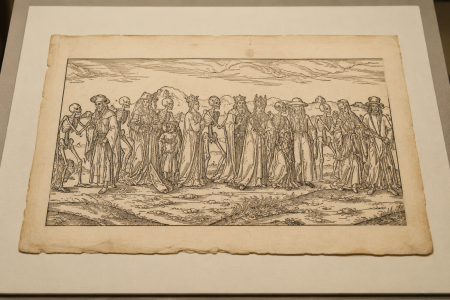
Images were especially important. A printed anatomical figure, map, machine, or astronomical diagram could be reproduced with far more consistency than a chain of hand-drawn copies. Errors still occurred, but multiple scholars could now refer to substantially similar visual evidence.
In 1665, France’s Journal des sçavans and England’s Philosophical Transactions began publication. Henry Oldenburg launched Philosophical Transactions in March as a way to circulate reports, correspondence, book notices, experiments, and observations. The journal later helped shape ideas of scientific priority, archiving, organized review, and regular publication.
Print did not make scientific claims automatically true—it made them easier to preserve, compare, challenge, and build upon.
Literacy, Language, Education, and Everyday Reading
Printing did not instantly make books affordable to everyone or cause universal literacy. Schooling remained limited, rural access varied, and many households could not purchase large volumes. Literacy also existed in degrees: a person might read a prayer, sign a name, understand numbers, or follow a broadside without reading a scholarly book.
Over time, however, greater availability changed expectations. Primers, catechisms, almanacs, calendars, song sheets, chapbooks, practical manuals, and inexpensive religious texts reached beyond universities and monasteries. Reading aloud made printed material available to groups, while illustrations helped transmit meaning across literacy levels.
Printers often chose forms of language likely to attract regional markets. Repeated publication promoted certain spellings, grammatical conventions, and prestigious dialects, although standardization was gradual and contested. Printed dictionaries, grammars, and schoolbooks later reinforced national and administrative languages.
The spread of reference works also changed how knowledge was organized. Indexes, page numbers, tables of contents, cross-references, maps, atlases, dictionaries, and encyclopedias made information easier to locate and reuse. Many of these features had manuscript precedents, but print made them more common and consistent.
Printing as Business, Technology, and Political Power
A printing shop required substantial investment. Metal type had to be cast, paper purchased, workers paid, and finished books stored until buyers appeared. A poorly chosen title could tie up capital and bankrupt a printer. Successful publishers therefore studied markets, reused type and woodcuts, shared costs, sought patrons, and built distribution relationships with booksellers and trade fairs.
Printers also developed recognizable identities. Typefaces, title-page designs, devices, editorial reputations, and workshop addresses functioned like brands. At the same time, unauthorized reprints could quickly undercut a successful edition. Privileges granted by rulers or cities gave temporary exclusive rights, helping lay foundations for later copyright systems.
Governments recognized that printed laws, tax notices, military ordinances, and official gazettes could strengthen administration. Technical manuals and illustrated works helped circulate practical knowledge alongside the battlefield transformations described in Knights to Cannons: The Gunpowder Revolution. Yet the same press could reproduce criticism, satire, forbidden theology, or opposition propaganda.
- Licensing: Authorities required permission before certain works could be printed.
- Censorship: Religious and political institutions examined, prohibited, confiscated, or destroyed publications.
- Cross-border printing: Authors and printers moved production to jurisdictions with more favorable rules.
- Anonymous publication: Controversial writers concealed names or used false publication information.
- Smuggling: Banned books traveled in cargo, clothing, barrels, crates, and private correspondence.
- Official print: States used the same technology for laws, propaganda, diplomacy, and administrative control.
Printing Press Myths and Historical Debates
Myth: Gutenberg Invented All Printing
Printing, paper, ink, and movable type all had earlier histories. Gutenberg developed the system that revolutionized European book production. Calling him the inventor of the European movable-type press is more accurate than calling him the first printer in world history.
Myth: The Printing Press Was Invented in Exactly 1450
The date 1450 is a convenient approximation. Gutenberg experimented over many years, and the evidence does not identify one definitive completion day. His operation produced securely datable works by the mid-1450s.
Myth: Printed Books Immediately Replaced Manuscripts
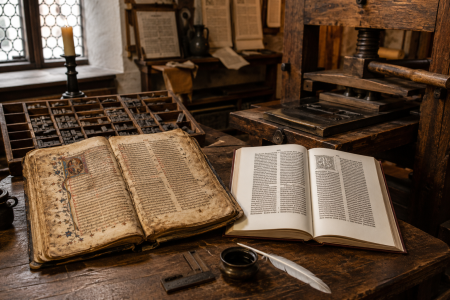
Manuscripts and printed books coexisted for generations. Readers continued to copy texts by hand, add notes, decorate printed pages, and commission luxury manuscripts. Early printed books often imitated manuscript appearance because buyers valued familiar forms.
Myth: Every Copy from a Print Run Was Identical
Printers corrected errors while sheets were being produced, replaced damaged type, and sometimes combined sheets from different stages of a run. Hand-applied decoration and binding created further differences. Print increased reproducibility without eliminating variation.
Debate: Did Printing Create the Modern World?
Historians agree that printing had enormous consequences, but they debate how directly technology caused social change. Books only mattered when people wrote, financed, transported, sold, read, discussed, translated, censored, or acted upon them. The printing press was not an independent force; it worked through institutions, markets, political struggles, religious communities, and human choices.
From Gutenberg to Steam Presses and Digital Media
The wooden hand press remained recognizable for centuries, even as type design, paper production, engraving, and workshop organization improved. In the early 19th century, steam-powered cylinder presses dramatically increased output. Rotary presses, stereotype plates, machine-made paper, linotype composition, and modern distribution systems later supported mass newspapers, advertising, inexpensive novels, and national publishing industries.
Offset printing and phototypesetting changed production again during the 20th century. Digital publishing then separated text from a permanently printed object, allowing nearly instantaneous reproduction around the world. Yet many problems remain familiar: who owns information, who controls distribution, how readers judge credibility, and how new media reshape political power.
The later history of communication follows the same pattern of invention, infrastructure, business, and social change. History Prime’s article on The Telephone: Invention and Global Impact explores another technology that compressed distance and transformed daily life.
Conclusion: Why the Printing Press Changed the World
Johannes Gutenberg’s printing system succeeded because it united precise metal type, suitable ink, mechanical pressure, organized labor, finance, and expanding markets. It did not begin the global history of printing, but it transformed the European production of books and helped create an international publishing industry.
The printing press widened access without making knowledge equal, standardized texts without making every copy identical, and encouraged debate without guaranteeing truth. It empowered reformers and governments, scientists and propagandists, teachers and censors. That mixture of liberation, disruption, commerce, and control is why the invention still feels modern.
The 15th century that produced Gutenberg also witnessed the rise of Mehmed II, the Atlantic voyage of Christopher Columbus, the world of Leonardo da Vinci, and the spread of gunpowder warfare. Printing helped preserve, debate, exaggerate, and reinterpret all of these histories. The modern information world began not with a single machine, but with a new ability to reproduce ideas faster than institutions could fully control them.
Frequently Asked Questions About the Printing Press
Who invented the printing press?
Johannes Gutenberg developed Europe’s first commercially successful movable-metal-type printing system in the 15th century. Earlier printing and movable type existed in China and Korea, so he was not the first printer in world history.
When was the printing press invented?
Gutenberg developed his system during the 1440s, and his workshop produced major works in the early 1450s. The Gutenberg Bible was completed around 1454–1455. The commonly used date “1450” is an approximation.
Where was the printing press invented?
Gutenberg’s mature European printing system was developed in Mainz, a city in the Holy Roman Empire located in present-day Germany. He may also have conducted earlier experiments while living in Strasbourg.
What was the first printing press in the world?
There is no simple single answer because printing developed in stages. East Asian woodblock printing predates Gutenberg by centuries, Bi Sheng used ceramic movable type around 1040, and Korea’s Jikji was printed with movable metal type in 1377. Gutenberg created the influential mechanical movable-type system used in Europe.
How did Gutenberg’s printing press work?
Workers arranged reusable metal letters into a locked page, applied thick ink to the raised surfaces, positioned paper above the type, and used a screw-driven platen to press the sheet evenly. The type was then cleaned and reused for another page.
What was the first major book printed by Gutenberg?
The Gutenberg Bible, also known as the 42-line Bible, was his most famous major publication. It was printed in Mainz around 1454–1455, probably in approximately 180 copies on paper and vellum.
When did the printing press become popular?
Printing spread rapidly during the second half of the 15th century. By 1500, presses were operating in hundreds of European towns, and major centers such as Venice, Paris, Nuremberg, and Basel supported international book markets.
How did the printing press affect the Renaissance?
It enabled wider circulation of classical texts, humanist scholarship, translations, grammars, maps, and scientific works. Scholars could compare editions, publish corrections, and participate in intellectual communities across long distances.
How did the printing press affect the Reformation?
Printers reproduced sermons, pamphlets, translations, woodcuts, and replies with unprecedented speed. Martin Luther and his opponents used print to reach audiences across Europe, turning theological conflict into a mass public controversy.
Did the printing press immediately make everyone literate?
No. Literacy rose slowly and unevenly. Printing increased the number and variety of texts, but schooling, income, language, geography, and social expectations still determined who could read and what they could access.
Sources & References
- Library of Congress, The Gutenberg Bible at the Library of Congress: A Resource Guide and related collection essays.
- UNESCO Memory of the World resources on the Korean Jikji and movable metal type.
- Incunabula Short Title Catalogue and the University of Oxford’s 15cBOOKTRADE project.
- Elizabeth L. Eisenstein, The Printing Press as an Agent of Change (Cambridge University Press, 1979).
- Elizabeth L. Eisenstein, The Printing Revolution in Early Modern Europe (Cambridge University Press, 2nd ed., 2005).
- Lucien Febvre and Henri-Jean Martin, The Coming of the Book: The Impact of Printing, 1450–1800.
- Andrew Pettegree, The Book in the Renaissance (Yale University Press, 2010).
- Andrew Pettegree, Brand Luther: 1517, Printing, and the Making of the Reformation (Penguin Press, 2015).
- Adrian Johns, The Nature of the Book: Print and Knowledge in the Making (University of Chicago Press, 1998).
- Albert Kapr, Johann Gutenberg: The Man and His Invention.
- The Royal Society, historical resources on Philosophical Transactions and scientific publishing since 1665.
- British Library and Morgan Library collection materials on early European printing and surviving Gutenberg Bibles.
More Articles