Gothic Cathedrals: Engineering the Medieval Sky
How stone, glass, geometry, and faith raised Europe’s most breathtaking medieval cathedrals.
Introduction
Gothic cathedrals were among the most ambitious structures ever built in medieval Europe. Rising above towns and cities, they turned stone into height, glass into light, and architecture into a public statement of faith, wealth, engineering, and civic pride. Their towers and spires did not merely decorate the skyline. They announced that a community had the skill, money, labor, and spiritual ambition to build toward heaven.
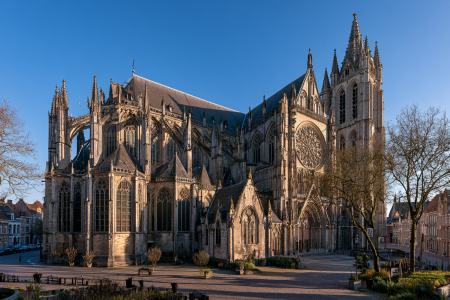
The story of Gothic Cathedrals: Engineering the Medieval Sky is the story of a new architectural language. Pointed arches, rib vaults, flying buttresses, stained glass windows, and careful stone masonry allowed builders to create taller, lighter, and more luminous churches than the heavy Romanesque buildings that came before them. These cathedrals were not only places of worship. They were schools of geometry, workshops of sculpture, centers of music, symbols of urban identity, and monuments to medieval engineering.
Before Gothic: The Romanesque World
To understand Gothic architecture, it helps to begin with Romanesque architecture. Romanesque churches were often massive, fortress-like buildings with thick walls, rounded arches, small windows, and heavy stone vaults. Their strength came from mass. Walls needed to be thick because stone vaults pushed outward as well as downward. Large windows were difficult, because too many openings weakened the structure.
Romanesque buildings could be beautiful and powerful, but they created darker interiors and limited vertical reach. Gothic builders wanted something different. They wanted height, light, rhythm, and openness. The goal was not simply to make churches larger. It was to make them feel transformed: earthly buildings filled with heavenly light.
This transition was not instant. Gothic architecture grew out of older forms and borrowed ideas from many building traditions. But the great achievement of Gothic cathedral architecture was the way it combined several structural features into one integrated system. Pointed arches, rib vaults, and flying buttresses worked together to redirect force, reduce wall mass, and open the building to stained glass.
The Birth of Gothic Architecture
Gothic architecture is often associated with the Île-de-France, the region around Paris. One of its key early monuments was the Abbey Church of Saint-Denis, rebuilt in the 12th century under Abbot Suger. Saint-Denis helped show what a new church could be: bright, ordered, symbolic, and filled with colored glass. The style was not called “Gothic” by its builders. That label came later, when Renaissance critics used the term in a negative way. Medieval builders often thought of their work as modern, French, or simply new.
From France, Gothic architecture spread across Europe. It appeared in cathedrals, abbeys, chapels, universities, civic buildings, and later palaces. Each region adapted the style to local taste, materials, traditions, and politics. French Gothic emphasized height and structural clarity. English Gothic developed its own long, horizontal plans, decorative vaulting, and elaborate tracery. German, Spanish, Italian, and Central European examples each followed different paths.
Yet across these variations, the shared ambition remained clear: Gothic builders wanted architecture to rise, glow, and guide the eye upward.
Gothic Cathedral Engineering: Stone as a Skeleton
The genius of Gothic cathedral engineering lies in structure. A cathedral may look like a solid stone mountain, but Gothic builders increasingly treated stone as a skeleton. Instead of relying on thick continuous walls, they concentrated forces into piers, ribs, arches, and buttresses. This made the building more like a framework than a sealed box.
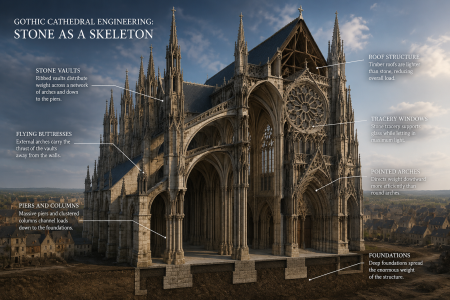
In a Gothic cathedral, the eye may first notice the stained glass or spires. But the invisible drama is the movement of weight. Stone vaults push downward and outward. Arches collect and redirect that pressure. Piers receive loads. Flying buttresses carry outward thrust away from the upper walls and down into exterior supports. Every part has an artistic role and an engineering role.
The result was a new kind of medieval architecture: tall, open, and luminous. Builders were not using modern steel or concrete. They were working with stone, timber scaffolding, lime mortar, iron ties, geometry, experience, and trial. Their success came from observation, craft knowledge, and generations of masons learning how far stone could be pushed before it failed.
| Gothic Feature | Structural Role | Visual Effect | Why It Mattered |
|---|---|---|---|
| Pointed Arches | Directed weight more efficiently than rounded arches. | Created a strong vertical rhythm and upward movement. | Helped builders create taller, more flexible spaces. |
| Rib Vaults | Concentrated ceiling loads along stone ribs. | Produced patterned ceilings that looked ordered and elegant. | Allowed lighter vaults and more complex interior plans. |
| Flying Buttresses | Carried outward thrust from vaults into exterior supports. | Created dramatic exterior stone arcs. | Made taller walls and larger windows possible. |
| Stained Glass | Filled wall openings made possible by the structural frame. | Transformed interiors with colored light and biblical imagery. | Taught stories, shaped devotion, and created sacred atmosphere. |
| Stone Tracery | Supported and divided large window openings. | Created delicate patterns, rose windows, and visual richness. | Combined engineering with ornament and symbolism. |
Flying Buttresses: How Gothic Cathedrals Reached Higher
The flying buttress is one of the most recognizable features of Gothic cathedrals. It looks like a stone arm reaching from the upper wall to an exterior pier. Its purpose was practical. Vaulted stone ceilings created outward pressure. Without support, that thrust could push walls outward and cause cracking or collapse. The flying buttress helped carry that force away from the wall and down into the ground.
This solution changed everything. Once the wall no longer had to carry all the load by itself, it could become thinner and more open. Large windows became possible. Height became safer. Light entered the building in ways that earlier architecture could not easily allow.
Flying buttresses were not only engineering devices. They became part of the cathedral’s beauty. Seen from outside, they gave the building a dramatic rhythm of stone arcs, piers, and shadows. A Gothic cathedral was therefore impressive from within and without. Its structure became visible sculpture.
Rib Vaults, Pointed Arches, and the Geometry of Height
Rib vaults were another key innovation. Instead of building a heavy continuous vault, masons used ribs to define the structure of the ceiling. The spaces between the ribs could be filled with lighter masonry. The ribs guided weight toward columns and piers, helping organize the building into a controlled structural system.
Pointed arches made this system more flexible. Rounded arches work best when spans are similar in width and height. Pointed arches could be adjusted more easily across different spaces. This allowed builders to design complex plans while keeping vault heights more consistent.
Geometry mattered deeply. Medieval cathedral builders did not use modern engineering software, but they understood proportion, layout, and construction practice. Plans were drawn, measured, corrected, and transmitted through workshops. Master masons combined mathematics with experience. Their knowledge was not abstract theory alone; it was tested in stone.
Stained Glass: Light as Architecture
Gothic cathedrals are often remembered for stained glass. These windows were not merely decoration. They were part of the architecture’s purpose. Colored light changed the emotional character of the interior. It turned stone space into a glowing environment of saints, prophets, kings, trades, biblical scenes, and symbolic patterns.
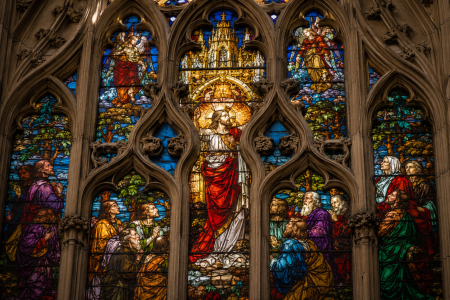
In a world where many people could not read Latin, stained glass helped teach stories and ideas. Windows could show scenes from the Bible, the lives of saints, local patrons, guilds, and royal donors. They connected theology, memory, politics, and community identity.
Chartres Cathedral is especially famous for its medieval stained glass. Its windows helped make the building not only a structural achievement, but a visual encyclopedia of Christian belief and medieval society. The Gothic cathedral was a book of stone and light.
Cathedral Builders: Masons, Carpenters, Glassmakers, and Laborers
Gothic cathedrals were not built by a single architect in the modern sense. They were created by large communities of skilled and unskilled workers. Master masons planned and supervised the stonework. Quarrymen cut stone. Carpenters built scaffolding, cranes, roof frames, and lifting devices. Glassmakers, sculptors, blacksmiths, lime burners, roofers, painters, and laborers all contributed.
Building could take decades or even centuries. A cathedral begun in one generation might be finished by another. Plans changed. Towers were added. Fires damaged earlier work. Money ran out. Political conflict interrupted progress. New styles replaced old ones before a building was complete.
This long process makes Gothic cathedrals valuable historical records. Their stones preserve changes in taste, technology, wealth, and ambition. A single cathedral may contain early Gothic, High Gothic, and later additions in one structure. It is both a monument and a timeline.
Faith, Cities, and Power
Gothic cathedrals were religious buildings, but they were also civic landmarks. They stood at the center of urban life. Markets, festivals, processions, schools, courts, and guilds often gathered around them. A cathedral was a place of worship, but also a sign of a city’s wealth and importance.
Bishops, kings, nobles, merchants, guilds, and ordinary believers all had reasons to support cathedral construction. Donors gave money for chapels, windows, sculptures, altars, and memorials. Guilds could be represented in glass. Rulers used cathedrals to display legitimacy. Cities used them to compete.
The construction of a cathedral could unite a community, but it could also strain it. Massive projects required taxes, gifts, labor, and long-term commitment. The result, however, was a building that could define a city for centuries. In this way, Gothic cathedrals were not only engineering achievements; they were social achievements.
Notre Dame, Chartres, Salisbury, and the Gothic Imagination
Notre Dame Cathedral in Paris remains one of the most famous examples of Gothic architecture. Its pointed arches, rose windows, sculptural program, and flying buttresses helped make it a symbol of medieval Paris. The building also shows how Gothic structures lived through change: repairs, modifications, damage, restoration, and modern memory.
Chartres Cathedral is often praised for its sculptural portals, stained glass, and High Gothic unity. Salisbury Cathedral in England offers a different version of Gothic beauty, known for its long horizontal composition, elegant interior, and soaring spire. These buildings show that Gothic architecture was not one rigid formula. It was a flexible language.
Like the story of Charlemagne: Father of Medieval Europe, Gothic cathedrals reveal a medieval world where faith, political authority, artistic ambition, and technical skill worked together. They also connect naturally to later transformations in knowledge and communication, explored in The Printing Press and the Birth of the Modern World.
Fast Facts: Gothic Cathedrals
-
Gothic was not the original name:
Medieval builders did not call their style Gothic. The term became common later and was first used critically by Renaissance writers.
-
Pointed arches changed structure:
They helped distribute weight more flexibly and emphasized vertical movement.
-
Flying buttresses made walls lighter:
By carrying outward thrust to exterior supports, they allowed higher walls and larger windows.
-
Stained glass was educational:
Windows taught biblical stories, honored donors, and filled interiors with symbolic colored light.
-
Cathedrals took generations:
Many major cathedrals were built, modified, repaired, and expanded over long periods.
-
Gothic architecture spread widely:
Born in medieval France, the style developed regional forms across Europe and later inspired Gothic Revival architecture.
Legend vs. Fact
Gothic cathedrals are sometimes imagined as mysterious creations built by anonymous medieval people who did not understand engineering. The reality is more impressive. Cathedral builders possessed deep practical knowledge. They understood materials, weight, proportion, scaffolding, quarrying, and construction sequencing. Their calculations were not modern, but their experience was highly refined.
Another myth is that Gothic cathedrals were purely religious structures with no connection to politics or economics. In fact, they were deeply connected to both. They expressed devotion, but also city pride, episcopal authority, royal patronage, guild wealth, and competition between communities.
Conclusion: Engineering the Medieval Sky
Gothic cathedrals changed medieval architecture by turning weight into height and stone into light. Their pointed arches, rib vaults, flying buttresses, and stained glass windows created a building system that was both technical and symbolic. The structure carried loads; the light carried meaning.
These cathedrals still matter because they show the ambition of the medieval world. They were not dark relics of a backward age, but daring experiments in design, faith, labor, and engineering. They required thousands of hands, enormous resources, and generations of commitment. Their towers and vaults continue to remind visitors that medieval builders did not merely construct buildings. They engineered the sky.
Gothic Cathedrals — Frequently Asked Questions
What defines Gothic architecture?
Gothic architecture is usually defined by pointed arches, rib vaults, flying buttresses, large stained glass windows, vertical height, tracery, and elaborate sculptural decoration.
How were Gothic cathedrals built so tall?
Gothic builders used pointed arches, rib vaults, piers, and flying buttresses to redirect weight and outward thrust. This allowed walls to rise higher and include larger windows.
How do flying buttresses work?
Flying buttresses transfer the outward pressure from the upper walls and vaults into exterior supports. This helps prevent the walls from being pushed outward by the stone ceiling.
Why were stained glass windows important?
Stained glass filled cathedrals with colored light and visual storytelling. The windows showed biblical scenes, saints, donors, guilds, and symbolic patterns that helped teach and inspire worshippers.
What is the difference between Romanesque and Gothic architecture?
Romanesque architecture usually has thick walls, rounded arches, small windows, and heavy forms. Gothic architecture uses pointed arches, rib vaults, flying buttresses, taller spaces, and larger stained glass windows.
Why were Gothic cathedrals important in medieval Europe?
They were religious, civic, artistic, and engineering landmarks. They served as places of worship, symbols of city pride, centers of community life, and demonstrations of medieval technical skill.
Sources & References
- Bony, Jean, French Gothic Architecture of the 12th and 13th Centuries, University of California Press, 1983.
- Frankl, Paul, revised by Paul Crossley, Gothic Architecture, Yale University Press, 2000.
- Wilson, Christopher, The Gothic Cathedral: The Architecture of the Great Church, 1130–1530, Thames & Hudson, 1990.
- Kidson, Peter, Murray, Peter, and Thompson, Paul, A History of English Architecture, Penguin Books, 1962.
- The Metropolitan Museum of Art, resources on Gothic architecture, cathedral design, and medieval architectural drawings.
- Smarthistory, educational resources on Gothic architecture, flying buttresses, rib vaults, and cathedral structure.
- Washington National Cathedral, Gothic Architecture 101, explanation of pointed arches, rib vaults, and flying buttresses.
- Victoria and Albert Museum, resources on medieval architecture, stained glass, and Gothic design.
- Encyclopaedia Britannica, reference entries on Gothic architecture, Chartres Cathedral, Notre Dame Cathedral, and Salisbury Cathedral.