Marco Polo: Life, Travels, and Legacy
The Venetian traveler whose journey across Asia became one of the most famous accounts of the medieval world.
Introduction
Marco Polo remains one of the most famous travelers in world history. His name evokes caravans, deserts, distant courts, ocean routes, and the long commercial networks later known as the Silk Road. He was not the first European to reach Asia, and he did not “discover” China. But his account gave many European readers one of their most vivid descriptions of the Mongol Empire, Yuan China, Central Asia, India, and the wider medieval world.
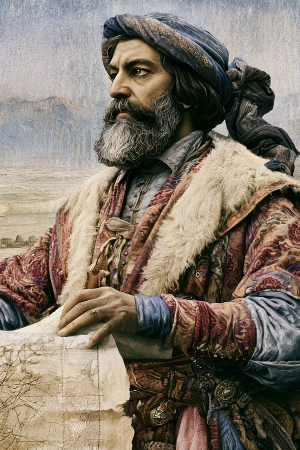
The story of Marco Polo: Life, Travels, and Legacy begins in Venice, a city built on trade and maritime ambition. It passes through the lands of the Mongols, the court of Kublai Khan, and the pages of a book that mixed observation, memory, commercial detail, and wonder. Marco Polo’s travels became famous not only because of where he went, but because his story survived. His book shaped European imagination, raised questions that historians still debate, and helped turn Asia into a place of fascination for later merchants, mapmakers, and explorers.
Marco Polo and Venice: A City of Trade
Marco Polo was born around 1254 CE in Venice, one of the great commercial powers of the medieval Mediterranean. Venice was a city of merchants, sailors, warehouses, shipyards, contracts, and political calculation. Its wealth came from movement: spices, silk, metalwork, glass, grain, slaves, luxury goods, and information passed through its networks.
Marco grew up in a family connected to long-distance trade. His father, Niccolò, and his uncle, Maffeo, had already traveled east before Marco joined them. Their world was not divided into simple categories of Europe and Asia. Merchants followed opportunities wherever routes, alliances, and risks allowed. The Mongol Empire made some of those routes more connected than they had been before, creating conditions in which travelers could cross enormous distances under the protection, or at least the influence, of Mongol power.
Venice also shaped Marco’s later reputation. When he returned home, his stories sounded extraordinary, but they were told in a city that understood trade, profit, and travel. Marco Polo was not only a medieval explorer in the modern romantic sense. He was also a Venetian merchant from a family that knew the value of routes, goods, courts, and contacts.
Marco Polo Travels Across the Silk Road
In 1271 CE, Marco Polo left Venice with Niccolò and Maffeo. Their journey was long, dangerous, and uneven. They traveled through the eastern Mediterranean and across regions linked by caravan routes, mountain passes, deserts, trading towns, and imperial stations. The phrase “Silk Road” can be misleading if imagined as one straight road. It was really a web of land and sea routes connecting merchants, envoys, pilgrims, soldiers, and rulers across Eurasia.
Marco’s account describes unfamiliar landscapes and societies through the eyes of a medieval Venetian. He writes about cities, customs, religions, trade goods, currencies, animals, minerals, and political authority. Some descriptions are precise and practical, while others are colored by hearsay, wonder, or the literary style of the age. That mixture is one reason The Travels of Marco Polo is so fascinating. It is not a modern field report, but it is a window into how one medieval traveler, and later his European readers, imagined the wider world.
The journey also shows how connected the medieval world could be. Like the rise of warrior societies in Japan explored in Samurai: Rise of Japan’s Warrior Class, Marco Polo’s story reminds readers that medieval history was not limited to castles and kings in Europe. It was a vast, interconnected world of courts, trade routes, armies, religions, and cultural exchange.
Marco Polo, Kublai Khan, and the Mongol Empire
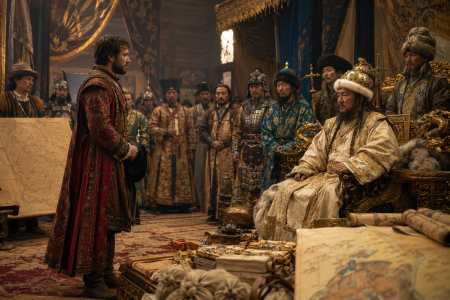
The most famous section of Marco Polo’s biography is his time in the world of Kublai Khan. Kublai was a grandson of Genghis Khan and one of the most powerful rulers of the 13th century. He founded the Yuan Dynasty in China and ruled an empire that connected China with wider Mongol networks across Asia. His court was a place of wealth, administration, ceremony, and political complexity.
According to Marco Polo’s account, Kublai Khan received the Polos and eventually used Marco in imperial service. Marco claimed to have traveled on missions through parts of the empire, observing cities, peoples, and resources. Historians continue to debate the details of these claims, but the book presents Marco as a useful foreign observer in a court that was already international in character.
The Mongol Empire was important because it connected regions that had often been separated by distance, war, and political boundaries. Merchants and envoys still faced danger, but Mongol power helped open channels of communication across Eurasia. Marco Polo’s story belongs to that world. It was not simply a tale of one man’s courage. It was made possible by empire, trade, diplomacy, and the demands of rulers who needed information.
| Place / Region | Role in Marco Polo’s Story | Historical Importance | Common Article Angle |
|---|---|---|---|
| Venice | Marco’s birthplace and commercial background. | Major medieval trading city with strong Mediterranean networks. | Marco Polo Venice, merchant origins, Venetian traveler. |
| Silk Road Routes | Overland and connected routes used by merchants and envoys. | Linked Europe, the Middle East, Central Asia, India, and China. | Marco Polo Silk Road, medieval travel, trade networks. |
| Mongol Empire | Imperial system that helped make long-distance travel possible. | Created powerful connections across Eurasia in the 13th century. | Marco Polo Mongol Empire, Kublai Khan, Yuan Dynasty. |
| Yuan China | Central setting for Marco’s most famous claims. | China under Mongol rule, with Kublai Khan as emperor. | Marco Polo China, Marco Polo Kublai Khan. |
| Genoa | City where Marco was imprisoned and his book was dictated. | Helped turn oral memories into one of history’s famous travel books. | The Travels of Marco Polo, Rustichello da Pisa. |
The Travels of Marco Polo
Marco Polo returned to Venice in 1295 CE after roughly 24 years away. His fame might have ended as local memory if not for war between Venice and Genoa. In 1298 CE, Marco was captured and imprisoned in Genoa. There he met Rustichello da Pisa, a writer of romance literature. Together, they produced the work now known as The Travels of Marco Polo, also called Il Milione or The Book of the Marvels of the World.
The book is not a simple diary. Marco did not write it day by day while traveling. It was shaped later through memory, storytelling, editing, translation, manuscript copying, and the literary tastes of medieval Europe. Rustichello’s role mattered. He helped turn Marco’s recollections into a readable and dramatic account filled with cities, rulers, marvels, customs, wealth, danger, and wonder.
For European readers, the book was extraordinary. It described paper money, coal, postal relay systems, enormous cities, rare goods, and courtly splendor. It also included stories that sounded unbelievable to many readers. Some called Marco a liar. Others treated his account as a treasure of information. In either case, the book survived, circulated, and influenced how later Europeans imagined Asia.
The history of Marco Polo’s book also connects to the later transformation of European reading culture. Centuries after manuscript copies carried his story, print would reshape the spread of knowledge. For that larger shift, see The Printing Press and the Birth of the Modern World.
What Did Marco Polo Discover?
A common question is, “What did Marco Polo discover?” The answer requires care. Marco Polo did not discover China, Asia, or the Silk Road. These places and routes were already known to the people who lived and traded there. Chinese, Persian, Arab, Turkic, Mongol, Indian, and many other travelers had long histories of movement and exchange.
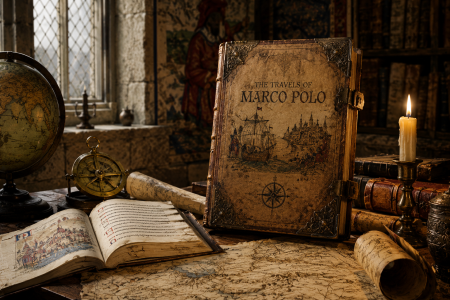
Marco’s importance lies elsewhere. He helped introduce many European readers to detailed descriptions of Asian cities, trade systems, court customs, religious diversity, and Mongol imperial power. His book made distant places feel imaginable. It also showed Europeans that the world of trade and empire extended far beyond the Mediterranean.
In this sense, Marco Polo’s legacy is not discovery but transmission. He transmitted a version of Asia to Europe. That version was filtered through his memory and medieval storytelling, but it was influential. It encouraged curiosity, shaped maps, and became part of the mental world of later travelers and explorers.
Was Marco Polo Really in China?
One of the most famous debates in Marco Polo history asks whether he truly reached China. Some skeptics have pointed to missing details in his book. He does not clearly mention tea drinking, the Great Wall as later Europeans imagined it, or foot binding, and Chinese sources do not clearly identify him by name. These gaps have led some writers to question whether he personally visited all the places he described.
Many historians, however, argue that the case against Marco is not decisive. The Great Wall was not the same famous Ming structure later known to travelers. Foot binding was not necessarily the kind of detail a foreign male merchant would record. Chinese records often omit foreign visitors, and names could be translated or lost. Marco’s book also contains detailed observations that seem difficult to explain if he had no access to reliable information about Yuan China.
The most balanced view is that Marco Polo’s account should be read critically, not rejected or accepted without question. He likely mixed personal experience, secondhand reports, commercial knowledge, memory, and literary shaping. That does not make the book worthless. It makes it a medieval source, and medieval sources must be interpreted with care.
Marco Polo’s Legacy in World History
Marco Polo’s legacy rests on the power of a book. Without The Travels, he might have been one of many medieval merchants whose journeys disappeared from the record. Instead, his name became a symbol of long-distance exploration. His account entered manuscript culture, influenced geographic imagination, and later appeared in printed editions that reached wider audiences.
Later European explorers knew of Marco Polo’s work. Christopher Columbus owned a copy of the book and read it in the context of his own ambitions to reach Asia by sailing west. That does not mean Marco caused the Age of Exploration, but his account helped shape the image of Asia as a land of wealth, powerful rulers, spices, cities, and opportunity. For the later Atlantic turning point, see Christopher Columbus: The 1492 Voyage to the Americas.
Marco Polo also remains important because his story reveals how connected the medieval world was. Europe, the Middle East, Central Asia, India, and China were not isolated worlds. They were linked by merchants, diplomats, armies, pilgrims, ports, caravan routes, and imperial ambitions. His life reminds readers that history often moves through contact, not isolation.
Fast Facts: Marco Polo
-
He was Venetian:
Marco Polo was born in Venice around 1254 CE, when the city was a major Mediterranean trading power.
-
He traveled with family:
Marco journeyed east with his father, Niccolò, and his uncle, Maffeo.
-
His famous journey began in 1271 CE:
The Polos left Venice and traveled across routes connecting the Mediterranean, Central Asia, and China.
-
He is linked to Kublai Khan:
Marco’s account places him at the court of Kublai Khan, ruler of Yuan China.
-
His book was created in prison:
After being captured during conflict between Venice and Genoa, Marco dictated his account to Rustichello da Pisa.
-
His legacy is debated:
Historians continue to discuss which parts of his account reflect personal observation, secondhand information, or literary shaping.
Legend vs. Fact
The legendary Marco Polo is sometimes imagined as a lone explorer who opened Asia to Europe. The historical Marco was more complex. He traveled with family, moved through existing trade and imperial networks, and depended on the Mongol world that made long-distance movement possible. He did not reveal Asia to itself, and he did not discover China.
Yet the legend grew because there was truth behind the wonder. Marco Polo’s account gave many Europeans a powerful image of Asian wealth, scale, diversity, and political sophistication. Even when readers doubted him, they remembered him. That is the mark of his historical importance: Marco Polo became both a person and a symbol of the medieval world’s vast horizons.
Conclusion: Why Marco Polo Still Matters
Marco Polo matters because his life sits at the crossroads of travel, trade, empire, and storytelling. He was a Venetian merchant shaped by a city of commerce. He traveled through the connected world of the Silk Road. He entered the orbit of the Mongol Empire and Kublai Khan’s Yuan Dynasty. Then, through imprisonment and collaboration with Rustichello da Pisa, his memories became a book that changed how many Europeans imagined Asia.
His story should be read with curiosity and caution. Some details are debated, and his account is not a modern travel report. Still, The Travels of Marco Polo remains one of the most influential works of medieval travel literature. It reveals not only what one traveler claimed to see, but also how stories move across cultures. Marco Polo’s life, travels, and legacy endure because they remind readers that the medieval world was wider, richer, and more connected than many imagine.
Marco Polo — Frequently Asked Questions
Who was Marco Polo?
Marco Polo was a Venetian merchant and traveler, traditionally dated c. 1254–1324 CE, whose account of travels across Asia became one of the most famous works of medieval travel literature.
Why is Marco Polo famous?
Marco Polo is famous for The Travels of Marco Polo, a book describing Asian cities, trade routes, customs, wealth, and the court of Kublai Khan. It helped shape European ideas about Asia.
Did Marco Polo travel to China?
Most traditional accounts place Marco Polo in Yuan China, but some historians debate the details. His book contains both valuable observations and areas that require careful interpretation.
What was Marco Polo’s connection to Kublai Khan?
Marco Polo’s account says that he and his family reached the court of Kublai Khan and that Marco served the ruler in various capacities. The exact nature of that service is debated by historians.
Did Marco Polo discover China?
No. China was already an ancient civilization, and many Asian, Middle Eastern, and European travelers moved through Eurasian routes before Marco Polo. His importance lies in the influence of his written account.
Who wrote The Travels of Marco Polo?
The book was based on Marco Polo’s stories and was written down with the help of Rustichello da Pisa while both men were imprisoned in Genoa around 1298 CE.
Sources & References
- Polo, Marco, The Travels of Marco Polo, various translated editions.
- Larner, John, Marco Polo and the Discovery of the World, Yale University Press, 1999.
- Bergreen, Laurence, Marco Polo: From Venice to Xanadu, Alfred A. Knopf, 2007.
- Jackson, Peter, The Mongols and the West, 1221–1410, Routledge, 2005.
- Wood, Frances, Did Marco Polo Go to China?, Westview Press, 1996.
- Vogel, Hans Ulrich, Marco Polo Was in China: New Evidence from Currencies, Salts and Revenues, Brill, 2012.
- World History Encyclopedia, articles on Marco Polo, the Silk Road, Kublai Khan, and the Yuan Dynasty.
- Library of Congress, digitized manuscript resources for The Travels of Marco Polo.
- The Metropolitan Museum of Art, Heilbrunn Timeline resources on Yuan China, Mongol rule, and medieval Asian exchange.