The Black Death Unleashed: Plague Ships to Graves
Explore the devastating impact of the Black Death on medieval Europe.
Introduction
When the Black Death reached Europe’s ports in 1347 CE, medieval society faced a catastrophe so sudden that many chroniclers called it the Great Mortality. In Sicily, one account describes twelve Genoese galleys entering the harbor of Messina in October 1347—and the sickness spreading even as authorities tried to expel the ships. From these early maritime footholds, the plague surged through port cities and inland market networks, leaving mass graves and a transformed world in its wake.
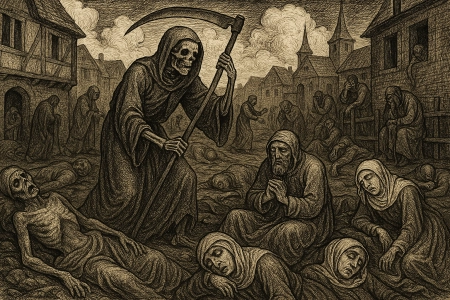
This article explains what caused the Black Death, how it traveled along trade routes, why it killed so many, and how it reshaped labor, faith, and power. It draws on chronicles, archaeology of plague pits, and modern DNA/genomic studies of Yersinia pestis to give a clear, engaging overview.
What Was the Black Death?
The Black Death was the most devastating phase of the Second Plague Pandemic in Afro-Eurasia (14th-18th centuries). Most scholars identify the primary pathogen as Yersinia pestis, a bacterium capable of causing three clinical forms:
- Bubonic plague (swollen lymph nodes or “buboes,” fever, vomiting), the most common.
- Pneumonic plague (infection of the lungs), allowing person-to-person spread via droplets.
- Septicemic plague (bloodstream infection), often rapidly fatal.
While bubonic transmission typically involves flea vectors (often carried by rodents), the pandemic's speed varied with season, climate, crowding, and whether pneumonic outbreaks ignited in cities.
Where Did the Black Death Start—and How Did It Spread?
Steppe to Sea: Long-Distance Routes
Many historians trace origins to Central or East Eurasia, with movement along Silk Road corridors into the Black Sea. In 1346 CE, plague appeared near Kaffa (Crimea), a Genoese trading hub. Whether via siege-related transmission or commerce, ships soon sailed west carrying infected fleas and rats, crew, and cargo.
Ports and Trade: Europe's Gateways (1347-1348 CE)
- Messina (Sicily), Genoa, Venice, Marseilles: early European entry points in 1347-1348, where maritime traffic turned harbors into amplifiers.
- From these port cities, plague radiated to hinterlands along market roads and river routes, creating overlapping waves.
Which Port City in 1347 Became One of Europe’s First Plague Gateways?
A widely cited early gateway was Messina (Sicily), where plague was reported in October 1347 after the arrival of Genoese ships from the eastern Mediterranean. From there, other major maritime hubs such as Genoa, Venice, and Marseilles helped accelerate spread into Europe’s trade and road networks.
Continental Spread (1348-1353 CE)
- Italy: From the Tyrrhenian and Adriatic coasts into Tuscany and the Po Valley.
- France & the Low Countries: Northward through trade hubs and fairs.
- England: Likely via the English Channel in 1348-1349; London suffered heavy mortality.
- Iberia: Entered via Mediterranean and Atlantic ports, then inland.
- Germany & Central Europe: By 1349, outbreaks along the Rhine and major towns.
- North Africa & the Middle East: Maritime and caravan links carried plague to Egypt, the Maghreb, and Levantine cities.
Key point: The Black Death timeline (1347-1353) was not a single uniform wave; local peaks rose and fell depending on seasonality, connectivity, and social conditions.
Was It Really Rats and Fleas?
Traditional models emphasize rat reservoirs (especially Rattus rattus) and flea vectors (Xenopsylla cheopis). Modern scholarship adds nuance:
- Some outbreaks show patterns consistent with pneumonic transmission, explaining rapid urban spread in cold seasons.
- Environmental and architectural factors (grain storage, housing materials, harbor ecology) shaped local dynamics.
- Genomic work confirms medieval Y. pestis lineages, while allowing debate about reservoir locations and reintroductions.
Bottom line: A mixed-transmission picture—fleas/rodents plus human-to-human in some phases—best explains the pandemic's variability.
Symptoms, Care, and Medieval Medicine
What People Saw
Chroniclers describe sudden fever, vomiting, delirium, and buboes in the groin, armpit, or neck. In pneumonic cases, coughing blood and rapid decline were common. Septicemic cases could kill within a day.
How They Treated It
Without germ theory, caregivers drew on humoral medicine, astrological timing, and religious rites. Treatments included herbals, fumigation, bloodletting, and quarantine-like isolation when authorities experimented with restrictions. While most remedies failed against Y. pestis, care practices (nursing, fluids, hygiene) sometimes aided survival.
From Plague Ships to Mass Graves
Burial Pressure and Charnel Pits
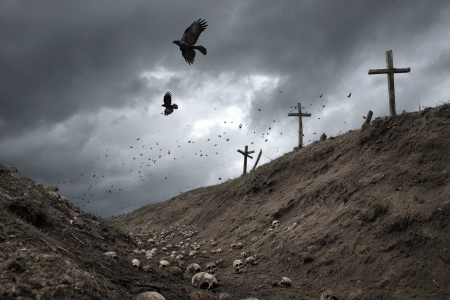
Explosive mortality overwhelmed parish cemeteries, forcing authorities to open plague pits (mass graves). Archaeology reveals layered burials, sometimes with evidence of hasty rites. Despite the crisis, many communities tried to maintain Christian funerary norms—a testament to social cohesion under stress.
Case Study: London’s East Smithfield Plague Cemetery
In London, emergency burial expanded beyond crowded churchyards. One of the most famous plague cemeteries is East Smithfield, founded during the 1348–1349 crisis near the Tower of London. Excavations revealed carefully organized mass-burial trenches—bodies tightly packed, yet often laid in orderly rows. It’s a chilling reminder that even at the height of disaster, communities still tried to preserve dignity in death.
“Memento Mori” and the Danse Macabre
Art and literature absorbed the shock: memento mori motifs and the danse macabre reminded viewers of mortality's universality, democratizing death imagery across classes and ages.
How Many Died? Mortality Rates and Demography
Estimates vary by region, but many scholars suggest 30-50% mortality in parts of Europe between 1347 and 1353. Factors included urban density, nutrition and climate, seasonal waves, and connectivity along trade networks.
- Urban density: crowding and poor sanitation.
- Nutrition & climate: famine years amplified vulnerability.
- Seasonality: pneumonic spikes in colder months.
- Connectivity: trade hubs and road networks suffered earliest and often.
Demography: Parish registers, tax lists, wills, and archaeological samples point to long-term decline, with some regions taking a century or more to recover.
Social and Economic Consequences
Labor Shortages and Rising Wages
With labor scarce, surviving peasants and artisans gained leverage. In many places, wages rose, rents softened, and serfdom loosened. Landholders and towns attempted to freeze wages or restrict movement, sparking tensions that later fed uprisings. Some historians also link post-plague realignments to later information revolutions—see The Printing Press and the Birth of the Modern World for how communication shifts reshaped power and belief.
Markets, Consumption, and Opportunity
Land redistribution and inheritances altered property maps. Merchants who survived could seize opportunities; guilds adapted; women sometimes assumed new roles in commerce and craft, though gains were uneven and often temporary.
Faith, Fear, and the Search for Meaning
Religious Responses
Communities turned to processions, fasts, and votive offerings. Clergy mortality was high due to exposure while ministering to the sick. Some people deepened devotion; others became skeptical of human efforts in the face of divine judgment.
Flagellants and Scapegoats
Wandering flagellant bands practiced public penance, alarming church and civic authorities. Meanwhile, rumors fed scapegoating, including violent persecutions—most tragically anti-Jewish pogroms in parts of Central Europe. These episodes reflected social panic rather than evidence and left long-lasting scars; for a later example of how fear and legend entwined with violence and rumor, see Elizabeth Báthory: The Blood Countess of Hungary.
Public Health in Medieval Europe: Early Quarantine
“Quarantena” and Lazarettos
By the late 14th and 15th centuries, port cities began building durable systems to slow contagion. In 1377, officials at Ragusa (today Dubrovnik) ordered arriving travelers and ships to wait in isolation for a set period—an early form of preventive quarantine. Venice later expanded these ideas: in 1423 the republic established the Lazzaretto Vecchio to isolate the sick, and additional quarantine stations and inspection routines evolved over time as maritime health controls became a tool of state administration.
Why It Mattered
Although imperfect, these measures represent a public health turning point—governments treating disease as a civic challenge requiring surveillance, isolation, and administration.
Venice and Plague Control: A Fast Timeline
| Date | What Happened | Why It Matters |
|---|---|---|
| 1348 | Early waves reach Italy’s trading world and spread through dense port neighborhoods. | Ports become accelerators of transmission. |
| 1377 | Ragusa formalizes isolation rules for arrivals from infected areas. | One of Europe’s earliest organized quarantine policies. |
| 1423 | Venice establishes the Lazzaretto Vecchio to isolate the infected. | Permanent plague infrastructure becomes state policy. |
| 1575–1577 | A major epidemic strikes Venice during the early modern period. | Large outbreaks drive stricter controls and surveillance practices. |
| 1630–1631 | Another severe wave hits Venice and northern Italy. | Marks the late peak of the long-running Second Plague Pandemic in many regions. |
For a later example of fear, authority, and coercion shaping institutions, see The Dark History of the Inquisition.
Evidence and Sources: How We Know
- Chronicles and Letters: Monks, notaries, merchants, and physicians documented symptoms, daily life, and social responses.
- Parish Records and Wills: Spikes in burials and probate help estimate mortality.
- Archaeology of Plague Pits: Excavations reveal burial practices, age profiles, and health markers.
- DNA and Genomics: Ancient DNA from dental pulp confirms medieval Y. pestis strains, enabling phylogenetic reconstructions.
Teaching tip: Pair a short primary-source excerpt with a modern genomic study summary to show how textual and scientific evidence complement one another.
Comparisons and Context
Earlier and Later Plague Outbreaks
The Justinianic Plague (6th-8th centuries) and later recurrences (14th-18th centuries) show plague's deep history. The Black Death stands out for its scope, speed, and social impact.
Black Death vs. Spanish Flu (1918-1919)
Both were global shocks, but they differ: bacterial vs. viral, vector-borne vs. airborne, medieval vs. modern contexts. Each, however, reshaped societies, economies, and public health thinking.
Resilience and Recovery After Plague
Communities rebuilt. Agricultural landscapes shifted toward pasture in some regions. Institutions, from guilds to parish charities, adapted to support orphans and the poor. Over generations, technological change and market reconfiguration influenced Europe's economic trajectory—some historians link aspects of post-plague Europe to later commercial dynamism.
Quick Facts
- Moniker: “Great Mortality” / “Black Death”.
- Dates: 1347-1353 CE (Europe).
- Pathogen: Yersinia pestis.
- Clinical forms: Bubonic, Pneumonic, Septicemic.
- Mortality: Often 30-50% in affected regions.
- Spread: Plague ships, fleas & rats; some pneumonic transmission.
Conclusion: Why the Black Death Still Matters
The Black Death was more than a catastrophic medieval plague. It was a social earthquake that reordered labor, belief, and governance. From plague ships to mass graves, it exposed the fragility—and resilience—of communities. It also seeded the public-health idea that societies can organize against disease through quarantine, surveillance, and care. In the 15th century's turmoil and recovery, figures such as Joan of Arc emerged amid shifting demographics, economies, and faith—reminders that crisis can reorder the world as much as it destroys it.
FAQ: Clear Answers to Common Questions
What caused the Black Death?
Primarily the bacterium Yersinia pestis, spreading via fleas/rodents and, at times, directly between humans (pneumonic form).
How many died in the Black Death?
Estimates range widely; many regions experienced 30-50% mortality. Europe's population fell dramatically and recovered slowly.
How did the Black Death end?
Waves diminished unevenly by the early 1350s due to exhaustion of susceptibles, seasonal changes, local controls, and chance. Plague recurred later.
Was it really rats and fleas?
Often yes, but mixed transmission (including pneumonic spread) best explains the pandemic's speed and seasonality in certain places.
Where did the Black Death start?
Likely in Central/East Eurasia, moving along trade routes to the Black Sea and then to Mediterranean ports via plague ships.
Which port city in 1347 became one of the first European gateways for the plague?
Messina (Sicily) is commonly cited as one of the earliest European entry points in October 1347, after the arrival of ships from the eastern Mediterranean. Other major ports such as Genoa and Venice soon played key roles in wider spread.
Sources & References
- Ole J. Benedictow, The Black Death, 1346-1353 (2nd ed., 2021).
- John Hatcher, The Black Death: An Intimate History (2008).
- Philip Ziegler, The Black Death (updated editions).
- Monica H. Green (ed.), Pandemic Disease in the Medieval World (2014).
- Contemporary chronicles (e.g., Boccaccio, Gabriele de' Mussis), parish records, wills, and municipal plague ordinances.
- Ancient DNA studies confirming medieval Y. pestis lineages (e.g., Krause Lab and collaborators).
More Articles