Joan of Arc: Between History and Legend
Unraveling the real story of the Maid of Orléans — through faith, war, trial, and legend.
Who Was Joan of Arc?
Joan of Arc was a French peasant teenager who emerged during the final phase of the Hundred Years’ War, claimed that saints had instructed her to aid the French claimant Charles, helped transform the campaign around Orléans, and pressed for Charles’s coronation at Reims. Captured in 1430, she was tried by an ecclesiastical court operating in English-held Rouen and burned at the stake on 30 May 1431, probably around the age of nineteen.
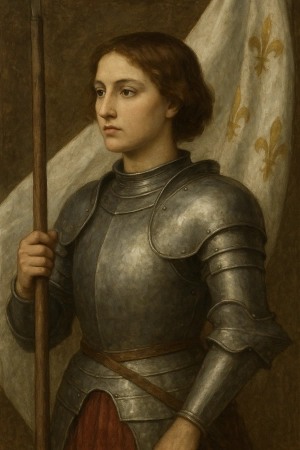
Joan was unquestionably a real historical person. What makes her unusual is the quantity of surviving evidence about someone of her social background: trial records preserve detailed answers attributed to her, while letters, chronicles, military accounts, and testimony collected in the 1450s illuminate her family, campaigns, beliefs, and reputation. Yet the evidence also produced centuries of interpretation. Saint, military leader, visionary, heretic, patriot, political symbol, and legend have all been layered onto the same short life.
This article separates that later mythology from the historical record while explaining why Joan became known as the Maid of Orléans, how she affected the Hundred Years’ War, what happened at her trial, and why her story still carries unusual power nearly six centuries after her death.
Joan of Arc: History at a Glance
| Question | Historical answer |
|---|---|
| Was Joan of Arc real? | Yes. Her life is documented by letters, chronicles, the 1431 trial record, and the 1456 nullification proceedings. |
| When did she live? | She was born around 1412 and died on 30 May 1431, during the late medieval period. |
| Where was she from? | Domrémy, a village on the northeastern frontier of the French political world. |
| Why was she called the Maid of Orléans? | Her arrival and participation in the 1429 campaign became closely associated with the lifting of the English siege of Orléans. |
| What was her defining achievement? | Helping reverse French momentum in 1429 and pressing successfully for Charles VII’s coronation at Reims. |
| How did she die? | She was burned at the stake in Rouen after being condemned as a relapsed heretic. |
The France Joan Was Born Into: Agincourt, Civil War, and a Disputed Crown
Joan’s story makes little sense without the political disaster that preceded it. In 1415, England’s Henry V defeated a much larger French force at the Battle of Agincourt. The victory did not end the Hundred Years’ War, but it strengthened English power at a moment when France was already fractured by civil conflict between the Armagnac and Burgundian factions.
The crisis deepened with the Treaty of Troyes in 1420. The agreement recognized Henry V and his heirs as successors to the French crown, disinheriting the dauphin Charles. Henry V and the French king Charles VI both died in 1422, leaving the infant Henry VI to be proclaimed king of France by the English and their allies while the dauphin maintained his own claim as Charles VII. Paris and much of northern France lay outside Charles’s control, and he had not been crowned at Reims, the traditional site of French royal consecration.
Joan’s village of Domrémy lay near the political frontier. Raids, displaced families, rival loyalties, taxation, and fear of armed bands were part of the landscape. Her mission was therefore not born in an abstract patriotic drama. She grew up in a region where the wider dynastic war could directly affect fields, livestock, churches, and families.
The military world around Joan was also changing. Fortifications, longbows, cavalry, siege engines, and increasingly important gunpowder weapons coexisted on the same battlefields. For the broader transformation of late medieval warfare, see Knights to Cannons: The Gunpowder Revolution.
Joan of Arc’s Early Life in Domrémy
Joan was born around 1412 to Jacques d’Arc and Isabelle Romée. Her family belonged to the rural peasantry but was not destitute. Jacques farmed land and held minor responsibilities in village affairs. Joan later said she had learned domestic work such as spinning and sewing, and witnesses remembered her as devout, charitable, and frequent in church.
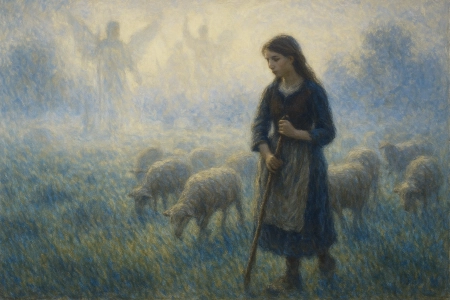
She did not receive the formal education of a cleric or noblewoman and was probably unable to read extended texts. Her surviving letters were normally dictated to scribes. At least a few documents, however, preserve forms of her name as a signature, a small but striking trace of a young woman whose voice otherwise survives largely because officials repeatedly questioned and recorded her.
Later retellings often describe Joan simply as an impoverished shepherd girl. The reality was more ordinary and more interesting: she came from a settled agricultural household in a frontier village. Nothing in that background prepared contemporaries to expect that she would soon appear before a royal court and demand an army escort.
The Voices: Faith, Vision, and a Divine Mission
Joan later testified that she first heard a voice at about thirteen years old. She identified her heavenly guides principally as Saint Michael the Archangel, Saint Catherine of Alexandria, and Saint Margaret of Antioch. She said that the experiences included voices and, at times, light. Over time, the message became political and military: she was to aid Charles, help relieve Orléans, and see him taken to Reims for coronation.
Medieval Christians did not automatically accept claims of revelation. Visions could be regarded as divine, deceptive, or self-generated, and Joan’s supporters understood that attaching a royal campaign to an untested visionary was dangerous. After she reached Charles at Chinon in early 1429, she was examined by clerics and theologians at Poitiers. The surviving record of that examination is incomplete, but the inquiry did not find grounds to bar her from assisting the royal cause.
Modern attempts to diagnose Joan from a distance have proposed epilepsy, migraine, psychiatric conditions, and other explanations. None can be demonstrated from 15th-century testimony. For historians, the more secure conclusion is that Joan consistently treated the voices as real divine commands and organized her decisions around them. Their medical or supernatural cause lies beyond what the evidence can prove.
From Vaucouleurs to Chinon: How a Teenager Reached the Royal Court
Joan first sought assistance from Robert de Baudricourt, the captain at Vaucouleurs. He initially rejected her. She returned, persisted, gained local supporters, and in February 1429 received an armed escort for the dangerous journey through contested territory to Chinon. She traveled in male clothing, which was practical for riding and would later become one of the most consequential details of her trial.
The famous story that Charles disguised himself among courtiers and Joan miraculously identified him is difficult to establish in its familiar dramatic form. What is certain is that she obtained an audience and persuaded Charles and his advisers to take her claims seriously enough to investigate them. By spring, she had been supplied with armor, a banner, attendants, and a place with the relief expedition bound for Orléans.
The Maid of Orléans: The Campaign That Changed Joan’s Life
Orléans had been under English siege since October 1428. Its fall threatened Charles’s position south of the Loire and carried enormous psychological weight. Joan entered the city on 29 April 1429 with supplies and troops. She did not arrive as the sole commander of the French army; experienced captains such as the Bastard of Orléans, La Hire, and others already directed military operations. But Joan became an unusually forceful advocate for offensive action and a highly visible presence at the front.
French forces attacked the English fortifications around the city in early May. On 7 May, during the assault on the Tourelles, Joan was wounded by an arrow near the shoulder but returned to the fighting after treatment. On 8 May, the English withdrew. A siege that had lasted for months had been broken little more than a week after her arrival.
The victory created the reputation that still defines her. Joan’s presence did not erase the contributions of commanders, artillery crews, soldiers, townspeople, logistics, or previous French efforts. Her importance lay in the combination of military participation and symbolic authority: she encouraged aggressive operations, projected certainty that victory was possible, and gave Charles’s cause a religious narrative at precisely the moment it needed one.
| Campaign moment | Date | Why it mattered |
|---|---|---|
| Arrival at Orléans | 29 April 1429 | Brought reinforcements, supplies, and a powerful morale boost to the besieged city. |
| Siege lifted | 8 May 1429 | Ended a major English operation and transformed the political mood around Charles. |
| Loire campaign | June 1429 | French forces captured strategic positions and drove English armies from the Loire corridor. |
| Battle of Patay | 18 June 1429 | A French vanguard inflicted a severe defeat on an English field army, opening the road toward Reims. |
| Coronation at Reims | 17 July 1429 | Converted battlefield momentum into sacred and political legitimacy for Charles VII. |
Did Joan of Arc Really Lead an Army?
Yes, but the phrase needs context. Joan was not a modern general exercising sole command over a national army. French forces operated through noble captains, household troops, local contingents, and royal officials. Joan nevertheless participated directly in military councils and campaigns, pressed commanders toward aggressive action, rode in armor, carried her standard near fighting, and was wounded more than once.
Her banner was central to her public role. Joan later indicated that she preferred carrying it to using a weapon, and contemporary descriptions repeatedly place her standard at the front of French action. This combination of religious imagery and battlefield exposure made her a visible rallying point. Soldiers who might disagree over strategy could still understand the message: the royal cause was advancing under a figure who claimed divine approval.
Joan’s military impact therefore came from both action and morale. She did not single-handedly win battles, but reducing her to a ceremonial mascot is equally misleading. Her insistence on movement after Orléans, her support for the Loire offensive, and above all her push toward Reims helped change the pace and political direction of the 1429 campaign.
Reims, the Coronation, and the Limits of Joan’s Momentum
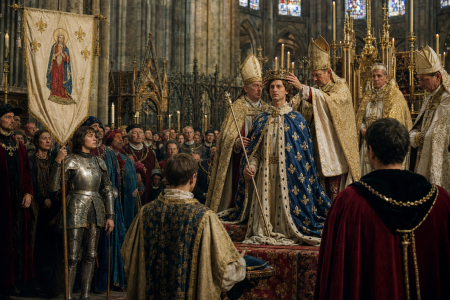
After the Loire victories, Joan argued that Charles should move quickly to Reims. The route crossed territory whose loyalties were uncertain, but several towns opened their gates as the royal army advanced. On 17 July 1429, Charles was crowned Charles VII in Reims Cathedral, with Joan present near her banner.
This was arguably Joan’s greatest political achievement. The coronation did not settle the dynastic war, but medieval kingship depended heavily on ritual legitimacy. Charles was no longer merely an uncrowned claimant based in the Loire valley; he had received the traditional French consecration in the traditional city.
Success did not continue uninterrupted. An assault on Paris on 8 September 1429 failed, and Joan was wounded. Charles increasingly favored negotiation and consolidation rather than the relentless offensive strategy Joan preferred. She continued campaigning, but the extraordinary sequence of victories that had begun at Orléans had ended.
Capture at Compiègne and the Failed Escape
On 23 May 1430, Joan joined a sortie from Compiègne against Burgundian forces. The attack failed, retreat became chaotic, and Joan was captured. Because the Burgundians were allied with the English, possession of the most famous symbol of Charles VII’s cause carried enormous political value.
During captivity at Beaurevoir, Joan attempted to escape by leaping from a tower. She survived the fall but was injured. At her later trial, she explained that she feared being delivered to the English and was distressed by reports concerning Compiègne. The episode is one of the clearest reminders that the fearless heroine of later legend was also a frightened prisoner actively trying to avoid the fate she believed awaited her.
The Trial of Joan of Arc: Heresy, Politics, and Male Clothing
Joan’s trial was held at Rouen, the administrative center of English power in Normandy. It was an ecclesiastical prosecution led by Pierre Cauchon, Bishop of Beauvais, a churchman politically aligned with the Anglo-Burgundian cause. English authorities had an obvious interest in discrediting Joan: if the young woman who helped bring Charles VII to coronation could be condemned as a false visionary or heretic, the religious meaning attached to his cause could also be attacked.
The surviving record is exceptionally detailed. Joan was interrogated repeatedly about her voices, her banner, her conduct in war, her certainty of divine guidance, her willingness to submit to church authority, and her decision to wear male clothing. She faced trained theologians without a defense advocate comparable to what a modern defendant would expect, yet her answers frequently frustrated attempts to force her into simple theological traps.
Male clothing became especially important. Joan had worn a doublet, hose, boots, and other male garments while traveling with soldiers and during imprisonment. Such dress violated ordinary gender expectations, but medieval theology recognized circumstances in which clothing associated with the other sex might be justified by necessity. The 1431 court nevertheless treated her persistence in male dress as part of a wider pattern of disobedience.
On 24 May 1431, under intense pressure and faced with the prospect of immediate execution, Joan made an abjuration. She temporarily adopted women’s clothing. Within days she was again wearing male dress and reaffirmed her voices. Why she resumed it has been debated ever since. Testimony gathered in the 1450s alleged coercion, danger from guards, or removal of her women’s clothing; the 1431 record emphasizes her own return to the dress and revelations. What mattered legally was that the judges labeled her a relapsed heretic.
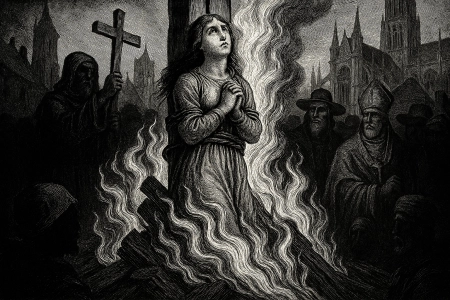
On 30 May 1431, Joan was handed to secular authority and burned at the stake in the Old Market Square at Rouen. She was about nineteen. The common statement that she was executed as a witch is inaccurate: accusations involving superstition and her allegedly false revelations appeared in the proceedings, but the final legal mechanism was condemnation for relapsed heresy.
How Do We Know Joan of Arc Was Real?
Compared with most non-elite people of the 15th century, Joan left an extraordinary documentary trail. The most important body of evidence is the 1431 trial record, compiled from the proceedings at Rouen and later translated into an official Latin version. It is not a neutral transcript in the modern sense, but it preserves extensive questioning and many answers attributed directly to Joan.
Joan also dictated letters during her campaigns, including demands addressed to the English and appeals to towns and political leaders. Chroniclers described her activities, and military and administrative records establish the broader campaigns in which she took part. Then, during the nullification proceedings of the 1450s, witnesses who had known her as a child, soldier, prisoner, or defendant supplied additional testimony.
These sources sometimes disagree and were produced for different purposes. That is precisely why Joan remains such a rich historical subject: historians can compare hostile testimony, favorable recollections, legal records, letters, and later memory rather than relying on a single biography.
The 1456 Retrial: How Joan’s Conviction Was Overturned
Joan’s legal story changed dramatically after the political situation changed. By the early 1450s, Charles VII had recovered much of English-held France, including Rouen. Joan’s mother, Isabelle, and her brothers pursued a review of the conviction. Under authority ultimately granted by Pope Calixtus III, a new tribunal examined the original proceedings and heard extensive witness testimony.
On 7 July 1456, the judges declared the 1431 condemnation invalid. The nullification judgment attacked serious procedural abuses and overturned the sentence rather than simply issuing a modern-style pardon. Joan’s name was formally cleared twenty-five years after her execution. The Vatican later described the proceeding as the Trial of Nullity of the Condemnation.
The reversal did not make Joan a saint. That process came centuries later. She was beatified in 1909 and canonized by Pope Benedict XV on 16 May 1920. By then she had become both a Catholic saint and one of the most recognizable symbols of France.
How Did Joan of Arc Change History?
Joan did not personally end the Hundred Years’ War. Fighting continued long after her death, and Charles VII’s eventual success depended on military reform, finance, diplomacy, changing Burgundian alliances, commanders, artillery, and years of campaigning. But Joan’s impact in 1429 was real and unusually concentrated.
-
She helped transform morale at Orléans.
The lifting of the siege shattered a prolonged English operation and changed expectations about what Charles’s forces could achieve.
-
She pressed for rapid offensive action.
Joan consistently favored movement and attack rather than delay, contributing to the momentum of the Loire campaign.
-
She made Reims a strategic priority.
The coronation gave Charles VII the traditional sacred legitimacy of French kingship.
-
She changed the political language of the war.
Supporters could interpret victories as signs of divine favor, while enemies had to explain how a teenage visionary had become a military and propaganda threat.
-
Her death created a durable symbol.
The trial, execution, and later reversal made her useful to generations arguing about faith, national identity, gender, resistance, and political legitimacy.
-
Her own words survived.
The trial record gave later historians rare access to the responses of a non-elite medieval woman confronted by powerful institutions.
Joan of Arc: Myths and Historical Reality
| Popular claim | What the evidence supports |
|---|---|
| Joan of Arc was a fictional or legendary person. | False. Her life is unusually well documented for a person of her class and century. |
| She was burned as a witch. | Her execution followed conviction as a relapsed heretic; witchcraft is an oversimplification of the trial. |
| She single-handedly commanded and won every French battle. | She worked alongside experienced captains and had genuine influence, but victories were collective military operations. |
| She personally won the Battle of Patay. | The decisive fighting was carried out by the French vanguard before the main body of the army fully entered the engagement. |
| She rebelled against Christianity. | Joan regarded herself as an orthodox Christian obeying God; her conflict was with the authority and conclusions of the court judging her. |
| Her visions have been medically explained. | No retrospective diagnosis has been proved; the historical evidence establishes her reported experiences, not their medical cause. |
From Historical Joan to National Legend
Joan’s legend changed with the needs of later generations. Royalists could emphasize her loyalty to a king; Catholics her visions, chastity, and martyr-like death; republicans her humble origins and service to France; later resistance movements her defiance of foreign occupation. The same woman could therefore be claimed by political traditions that agreed on very little else.
Print later accelerated that transformation. Chronicles, histories, plays, devotional books, and political literature could circulate Joan’s image far beyond the communities that had known her. The information revolution explored in The Printing Press and the Birth of the Modern World helped ensure that medieval figures could acquire increasingly standardized public identities in early modern Europe.
Modern film and fiction added another layer: the armored girl alone before armies, the saint hearing voices in brilliant light, the martyr abandoned by king and Church. These images are powerful because they grow from real episodes, but history becomes clearer when the symbol is placed back among the captains, theologians, villagers, political factions, and institutions that shaped her world.
Conclusion: Between History and Legend
Joan of Arc’s historical importance does not depend on accepting every later legend about her. A teenager from Domrémy entered one of Europe’s longest dynastic wars, helped alter the momentum of a major siege, became central to the coronation of Charles VII, endured a politically charged heresy trial, and left behind a documentary record that still allows historians to hear something close to her own voice.
Her career lasted only a few years, but it unfolded during a century of profound change. Elsewhere, Mehmed II was building a new Ottoman imperial order, while gunpowder warfare and, later, the printing press were transforming how states fought and how stories traveled. Joan belongs to that same 15th-century world — medieval in faith and political structure, yet already moving toward new forms of warfare, communication, and state power.
The legend persists because the documented life is already extraordinary. Joan was real. Her victories were real, her failures were real, and her trial was real. The enduring question is not whether she existed, but how one short life accumulated so many meanings after the flames at Rouen were extinguished.
Joan of Arc — Frequently Asked Questions
Who was Joan of Arc?
Joan of Arc was a French peasant teenager and visionary who became involved in the Hundred Years’ War in 1429. She helped inspire and support French military operations at Orléans and strongly promoted Charles VII’s coronation at Reims.
Was Joan of Arc real?
Yes. Joan is documented by contemporary letters, chronicles, administrative evidence, and especially the extensive records of her 1431 trial and the later proceedings that overturned her conviction.
Where was Joan of Arc from?
Joan came from Domrémy, a small village in northeastern France near a frontier contested during the Hundred Years’ War.
Why was Joan of Arc called the Maid of Orléans?
Joan became closely associated with Orléans after arriving there with a French relief force on 29 April 1429. English troops abandoned the siege on 8 May, and the victory became the event that established her fame.
What was Joan of Arc’s key defining moment?
The lifting of the siege of Orléans was the breakthrough that made Joan famous. Politically, however, the coronation of Charles VII at Reims on 17 July 1429 may have been even more important because it gave his kingship traditional religious legitimacy.
Did Joan of Arc really lead armies into battle?
She participated directly in campaigns, wore armor, carried her banner near combat, was wounded, argued for offensive action, and exercised real influence. She nevertheless worked alongside experienced French captains rather than commanding every operation by herself.
Why was Joan of Arc executed?
An ecclesiastical court at Rouen prosecuted Joan over her claimed revelations, submission to church authority, conduct, and male clothing. After an abjuration and her subsequent return to male dress and her voices, the court declared her a relapsed heretic. She was burned on 30 May 1431.
Was Joan of Arc burned for witchcraft?
Not formally. Her enemies associated her with false or demonic inspiration, but the legal basis of her execution was her condemnation as a relapsed heretic.
When was Joan of Arc declared innocent?
A papally authorized nullification proceeding overturned the 1431 condemnation on 7 July 1456. The judgment declared the earlier proceedings and sentence invalid.
When did Joan of Arc become a saint?
Joan was beatified in 1909 and canonized by Pope Benedict XV on 16 May 1920. Her Catholic feast day is observed on 30 May.
How did Joan of Arc change history?
Joan helped change French morale and military momentum in 1429 and was instrumental in making Charles VII’s coronation at Reims an immediate objective. She did not end the Hundred Years’ War by herself, but her short career reshaped the political and symbolic direction of the conflict.
Is Joan of Arc medieval?
Yes. Joan lived from about 1412 to 1431 in the late medieval period. Her world of dynastic monarchy, saints’ cults, chivalric warfare, ecclesiastical courts, and fortified cities was distinctly medieval, even though she lived during the 15th century.
Sources & References
- Daniel Hobbins, trans., The Trial of Joan of Arc (Harvard University Press, 2005).
- Craig Taylor, ed. and trans., Joan of Arc: La Pucelle — Selected Sources (Manchester University Press, 2006).
- Helen Castor, Joan of Arc: A History (Faber & Faber, 2014).
- Kelly DeVries, Joan of Arc: A Military Leader (Sutton, 1999).
- Régine Pernoud and Marie-Véronique Clin, Joan of Arc: Her Story (St. Martin’s Press, 1999).
- Fordham University Internet Medieval Sourcebook, The Trial of Joan of Arc and related Hundred Years’ War documents.
- Vatican, General Audience of Pope Benedict XVI, Saint Joan of Arc (26 January 2011), discussing the 1456 Trial of Nullity and canonization.
- Encyclopaedia Britannica, Saint Joan of Arc, biographical and historical overview.
More Articles