Mehmed II: The Conqueror of Constantinople
At 21, Mehmed II captured Constantinople—then used war, law, and reconstruction to build an imperial capital.
Introduction: Who Was Mehmed II?
Mehmed II, also known as Mehmed the Conqueror or Fatih Sultan Mehmed, ruled the Ottoman Empire twice: briefly from 1444 to 1446 and again from 1451 until his death in 1481. He is remembered above all for conquering Constantinople on 29 May 1453, when he was only 21 years old. The victory ended the Byzantine Empire and gave the Ottomans control of one of the world’s most strategically and symbolically important cities.
Constantinople, however, was not the end of Mehmed’s project. During a reign of nearly three decades, he expanded Ottoman power through the Balkans, Anatolia, the Aegean, and the Black Sea. He defeated rival states, fought Venice, confronted Albanian, Hungarian, Wallachian, and Moldavian resistance, and briefly established an Ottoman foothold in southern Italy. At the same time, he repopulated his new capital, sponsored markets and religious institutions, reorganized the court, and strengthened the central authority of the sultan.
Mehmed’s career therefore belongs to more than the history of one siege. It reveals how a late medieval dynasty became an early modern imperial power through a combination of artillery, logistics, diplomacy, law, forced migration, cultural patronage, and calculated violence. His victories earned him the title “the Conqueror,” but his failures at Belgrade and Rhodes also show the limits of Ottoman expansion during his lifetime.
Mehmed II: Quick Answers
| Question | Answer |
|---|---|
| Who was Mehmed II? | An Ottoman sultan who conquered Constantinople and ruled from 1444–1446 and 1451–1481. |
| When was Mehmed II born? | 30 March 1432, in Edirne. |
| How old was Mehmed II in 1453? | 21 years old when Constantinople fell. |
| What did Mehmed conquer in 1453? | Constantinople, the capital of the Byzantine Empire. |
| What did Mehmed make his capital? | Constantinople became the principal imperial capital of the Ottoman Empire. |
| When did Mehmed II die? | 3 May 1481, near Gebze, at age 49. |
Early Life and the First Reign of the Boy Sultan
Mehmed was born in Edirne on 30 March 1432, a son of Sultan Murad II and Hüma Hatun. As an Ottoman prince, he received instruction in religion, literature, history, administration, and warfare. Later traditions credited him with an exceptional command of languages. Although the exact extent of his fluency is difficult to prove, his court clearly displayed sustained interest in Arabic and Persian learning, Greek history, and Italian art and diplomacy.
In 1444, Murad II temporarily withdrew from government and placed the throne in the hands of his approximately 12-year-old son. The decision came at a dangerous moment. A Christian crusading army advanced into Ottoman territory, and experienced commanders called Murad back to lead the campaign that ended in an Ottoman victory at Varna. Mehmed remained the nominal sultan for a time, but court rivalry, military pressure, and a Janissary disturbance in 1446 contributed to Murad’s full restoration.
The first reign exposed Mehmed to the fragility of royal authority. A sultan could possess a title yet still depend on ministers, military households, provincial commanders, and the loyalty of the Janissaries. When Murad died in 1451, the 19-year-old Mehmed returned to power with a clearer understanding of the institutions he needed to control.
Return to Power and the Plan for Constantinople
Mehmed began his second reign in February 1451. Byzantine Constantinople stood between the Ottomans’ European and Anatolian territories, while its position on the Bosporus gave it strategic influence over traffic between the Black Sea and the Mediterranean. The city’s population and territory had declined severely, but its walls, history, and religious prestige still made it a formidable prize.
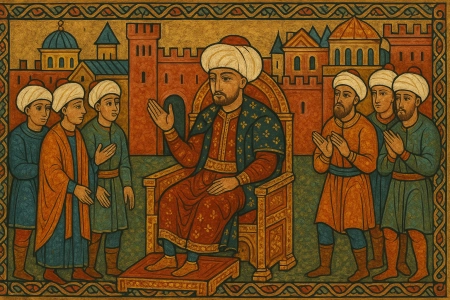
Previous Ottoman sultans had tried and failed to capture the city. Mehmed treated the campaign not as an impulsive assault but as a problem of geography, supply, engineering, and diplomacy. He made temporary agreements with neighboring powers, watched Hungary and Venice, improved the Ottoman fleet, gathered troops and siege equipment, and prepared roads capable of carrying enormous artillery from Edirne to Constantinople.
Rumeli Hisarı: The Fortress That Closed the Bosporus
In 1452, Mehmed ordered the construction of Rumeli Hisarı on the European shore of the Bosporus, opposite the older Ottoman fortress of Anadolu Hisarı. The new stronghold was also known as Boğazkesen—a name that could suggest both “strait cutter” and “throat cutter.” Its guns allowed the Ottomans to challenge ships attempting to pass through the strait without permission and reduced the possibility of aid arriving from the Black Sea.
The fortress demonstrated Mehmed’s style of war. He did not rely on a single battle or weapon. He reshaped the strategic environment before the siege began, combining fortification, artillery, naval patrols, diplomacy, and intimidation. For wider context on the weapons changing warfare during this period, see Knights to Cannons: The Gunpowder Revolution.
Fast Facts: Mehmed II at a Glance
- Full name: Mehmed bin Murad, commonly called Mehmed II.
- Born: 30 March 1432 in Edirne; he was 21 when Constantinople fell.
- Titles: Ottoman sultan, Fatih or “the Conqueror,” and claimant to the Roman imperial legacy.
- Reigns: 1444–1446 and 1451–1481.
- Greatest victory: Conquest of Constantinople after a 53-day siege in 1453.
- Major methods: Artillery, siege engineering, naval pressure, diplomacy, intelligence, and logistical preparation.
- Major conquests: Constantinople, Serbia, the Morea, Trebizond, much of Bosnia, Karamanid territory, and Genoese Black Sea colonies.
- Important failures: Belgrade in 1456 and Rhodes in 1480.
- Capital policy: Rebuilt and repopulated Constantinople as an Ottoman imperial center.
- Death: 3 May 1481 during preparations for a new campaign; its intended destination remains disputed.
The Siege and Fall of Constantinople in 1453
The Ottoman siege began on 6 April 1453. The attacking army was much larger than the defending force, but exact numbers vary widely among the sources. Emperor Constantine XI Palaiologos commanded Byzantine defenders supported by Genoese, Venetian, and other foreign volunteers. The experienced Genoese soldier Giovanni Giustiniani played a central role along the vulnerable land walls.
Constantinople’s main defense was the layered system of the Theodosian Walls, strengthened by towers, an outer wall, and a moat. These fortifications had resisted attackers for centuries. Mehmed’s task was not simply to create a breach, but to prevent defenders from repairing damage while blocking relief by sea and maintaining pressure along an enormous perimeter.
Artillery, Bombards, and Siege Engineering
Mehmed assembled a varied artillery train that included a massive bombard associated with the engineer known as Orban or Urban. The largest guns were difficult to transport, slow to reload, and vulnerable to mechanical failure, but their repeated fire damaged walls and forced defenders to make repairs under dangerous conditions. Smaller artillery pieces, trenches, mining operations, mobile defenses, and repeated infantry attacks worked alongside the famous bombards.
Cannons did not win the siege by themselves. Their importance lay in the continuous strain they placed on the defense. Ottoman crews could reopen damaged sections faster than the exhausted defenders could permanently strengthen them. The siege was a coordinated system of gunpowder, labor, supplies, intelligence, and manpower rather than a demonstration by one miraculous weapon.
The Golden Horn and the Ships Moved Over Land
A heavy chain blocked the entrance to the Golden Horn, protecting Byzantine and allied ships inside the harbor. After Ottoman attempts to force the entrance failed, Mehmed carried out the siege’s most famous naval maneuver. During the night of 21–22 April, Ottoman forces moved dozens of lighter vessels along a prepared, greased route behind Galata and launched them into the Golden Horn.
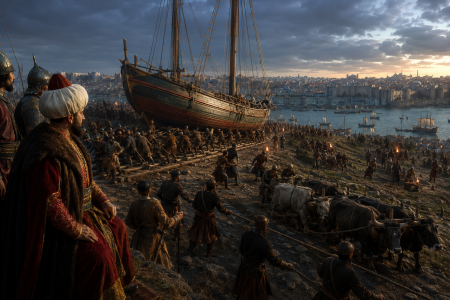
Contemporary accounts disagree over the exact number of vessels, giving totals ranging from the high 60s to around 80. The maneuver did not by itself defeat the city, but it forced defenders to guard the harbor walls, weakened morale, and allowed the Ottomans to apply pressure from a direction previously considered secure. Mehmed also supported construction of a floating bridge or platform across part of the Golden Horn, expanding the siege works around the city.
The Final Assault on 29 May
After 53 days, Mehmed ordered a general assault before dawn on 29 May 1453. Ottoman attacks came in successive waves, exhausting defenders before elite Janissary units entered the battle. Giustiniani was seriously wounded and removed from the walls, damaging the defenders’ coordination and morale. Ottoman soldiers eventually broke through the land defenses, while Constantine XI was killed during the fighting.
The city was subjected to looting, killing, and enslavement after the breakthrough. Mehmed entered Constantinople later on 29 May and then moved to restore order and preserve it as the capital he intended to rule. Hagia Sophia was converted into an imperial mosque, while many other Christian communities and institutions continued under Ottoman authority. The conquest ended the Byzantine Empire, but it did not end the city’s history—it opened a new imperial chapter.
What Did the Ottomans Accomplish in 1453?
Under Mehmed II, the Ottomans finally captured a city they had unsuccessfully besieged before. The conquest removed a strategically placed rival from the center of Ottoman territory, ended the last direct line of Byzantine emperors in Constantinople, and gave Mehmed an imperial capital with extraordinary religious, commercial, and political prestige.
- They ended the Byzantine Empire: Constantine XI died defending the city, and no Byzantine emperor again ruled from Constantinople.
- They united Ottoman territories more securely: The city no longer separated major Ottoman possessions in Europe and Anatolia.
- They gained control of a strategic maritime crossroads: The Bosporus connected Black Sea commerce with the Mediterranean world.
- They acquired a new imperial center: Mehmed rebuilt Constantinople as the seat of his court and government.
- They transformed Ottoman prestige: The victory presented Mehmed as a universal conqueror and heir to earlier imperial traditions.
From Conquered City to Ottoman Capital
Constantinople had suffered population decline before 1453 and severe disruption during the siege and sack. Mehmed responded with an ambitious reconstruction program. He ordered people from many parts of the empire to settle in the city, sometimes voluntarily and sometimes through compulsory relocation. Muslims, Greek Orthodox Christians, Armenians, Jews, merchants, artisans, and laborers helped repopulate different quarters.
Mehmed established administrative offices, markets, religious foundations, palaces, and charitable complexes. The Old Palace was built first, followed later by the palace complex now known as Topkapı. The Fatih Mosque complex, constructed on the site of the Church of the Holy Apostles, became an important center of worship, education, and welfare.
The city remained religiously diverse. Mehmed appointed Gennadios II Scholarios as Greek Orthodox patriarch, integrating the patriarchate into the new political order. This did not create modern equality or unrestricted tolerance; non-Muslim communities occupied subordinate legal positions and were subject to imperial control. It did, however, allow major Christian institutions and communities to persist within an Islamic empire.
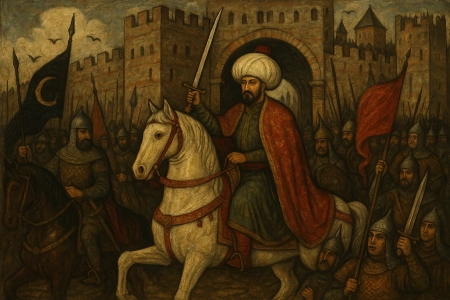
Although modern readers often imagine a sudden official renaming from Constantinople to Istanbul, names developed more gradually. Ottoman documents used forms including Kostantiniyye, while Istanbul also circulated in speech and writing. The decisive change in 1453 was political: the former Byzantine capital became the central city of the Ottoman dynasty.
Mehmed II’s Conquests Beyond Constantinople
Mehmed’s wider strategy aimed to remove rival dynasties, control trade routes, secure the Balkans and Anatolia, dominate the Black Sea approaches, and limit the influence of Venice and Hungary. Some lands were annexed directly, while others became tributary or vassal states. Because these arrangements changed over time, Mehmed’s empire cannot be measured accurately through one simple total of square miles conquered.
| Year | Campaign or territory | Outcome and significance |
|---|---|---|
| 1453 | Constantinople | Ended the Byzantine Empire and created a new Ottoman capital. |
| 1454–1459 | Serbia | Repeated campaigns ended the independent Serbian Despotate with the fall of Smederevo. |
| 1456 | Belgrade | Major Ottoman siege failed after resistance led by John Hunyadi and allied forces. |
| 1458–1460 | Morea | Ottoman campaigns removed the Byzantine-ruled despotate in the Peloponnese. |
| 1461 | Sinop and Trebizond | Expanded Ottoman control along the southern Black Sea and ended the Empire of Trebizond. |
| 1462 | Wallachia | Vlad III resisted through raids, scorched earth, and the Night Attack; Ottoman-backed Radu gained the throne. |
| 1463 | Bosnia | Most of the kingdom was conquered, although frontier warfare with Hungary continued. |
| 1463–1479 | War with Venice | Long conflict over Aegean islands, ports, Albania, and maritime influence ended with Ottoman gains. |
| 1468 | Karaman | Reduced a major Anatolian rival and strengthened Ottoman authority in central Anatolia. |
| 1475 | Crimean and Genoese colonies | Ottoman forces captured Caffa and other colonies; the Crimean Khanate accepted Ottoman suzerainty. |
| 1476 | Moldavia | Mehmed defeated Stephen the Great at Valea Albă but failed to secure a decisive conquest of the principality. |
| 1480 | Rhodes | Ottoman forces failed to capture the stronghold of the Knights Hospitaller. |
| 1480 | Otranto | Ottoman troops captured a foothold in southern Italy, which was lost after Mehmed’s death. |
Mehmed II and Vlad the Impaler
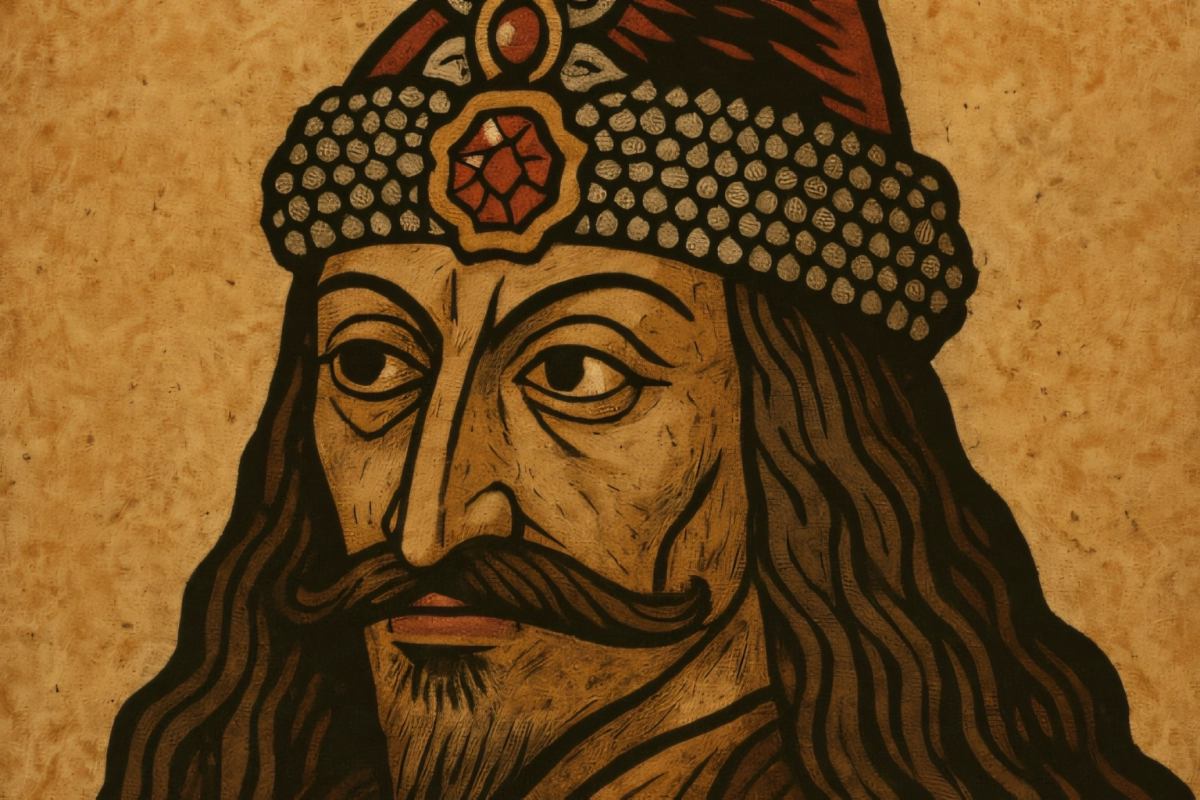
Mehmed’s conflict with Vlad the Impaler grew from the politics of tribute, frontier raids, and control of Wallachia. Vlad and his brother Radu had spent part of their youth as political hostages at the Ottoman court. Radu later aligned with Mehmed, while Vlad became one of the sultan’s most violent opponents.
In the winter of 1461–1462, Vlad attacked Ottoman positions south of the Danube. Mehmed then led a major invasion of Wallachia. Vlad avoided a conventional battle, used scorched-earth tactics, and launched the famous Night Attack against the Ottoman camp in June 1462. Mehmed survived, and Vlad was eventually displaced as support shifted toward Radu.
The campaign illustrates both Mehmed’s reach and the difficulty of ruling frontier regions. Ottoman armies could invade and influence the Wallachian throne, but local geography, rival elites, Hungarian intervention, and mobile resistance prevented a simple permanent annexation.
How Mehmed II Strengthened the Ottoman Empire
Mehmed strengthened the empire not only by conquering territory but by concentrating authority around the dynasty and palace. His government relied on officials trained for imperial service, provincial cavalry supported through the timar system, Janissaries and other household troops, judges, tax administrators, and religious scholars. By balancing these institutions, Mehmed reduced the independence of older aristocratic families and expanded the sultan’s direct control.
Law, Palace Government, and Centralization
Legal compilations associated with Mehmed’s reign organized court hierarchy, offices, ceremony, taxation, and government practice. Ottoman rule combined sharia, the body of Islamic jurisprudence, with kanun, regulations issued under the authority of the sultan. Mehmed’s lawgiving helped present the ruler as the source of order across a diverse empire.
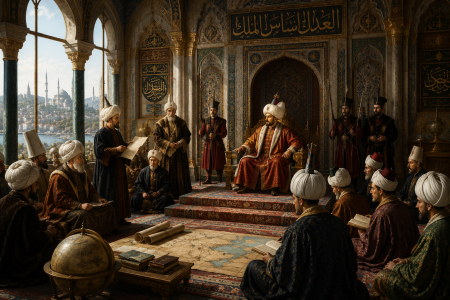
One of the most controversial provisions associated with his dynastic law allowed a victorious prince to kill brothers when considered necessary for the “order of the world.” Ottoman succession did not follow strict primogeniture, and rival princes could trigger civil war. The policy attempted to prevent prolonged conflict through an extreme form of dynastic violence.
Trade and Strategic Geography
Mehmed’s campaigns targeted commercial routes as well as political enemies. Control of Constantinople and the Bosporus strengthened Ottoman influence over Black Sea traffic. Conquests at Trebizond, Caffa, and other ports reduced Genoese power and tied maritime commerce more closely to Ottoman taxation and security. Wars with Venice likewise concerned islands, ports, shipping, and access to revenue as much as religious rivalry.
Scholar, Patron, and Claimant to Rome
Mehmed cultivated an image larger than that of a frontier warrior. After conquering Constantinople, he claimed succession to its imperial tradition and used the title Kayser-i Rûm—Caesar of Rome. The claim did not convince every rival, but it expressed his ambition to rule as the sovereign of a universal empire rather than merely as the leader of one people or region.
His court welcomed Muslim scholars, poets, historians, architects, and artists, while also engaging with Greek and Italian intellectual traditions. Mehmed collected or commissioned manuscripts and showed interest in geography, classical history, portraiture, and technical knowledge. His patronage reflected both personal curiosity and political calculation: an emperor needed cultural symbols as well as armies.
Gentile Bellini and the Sultan’s Renaissance Portrait
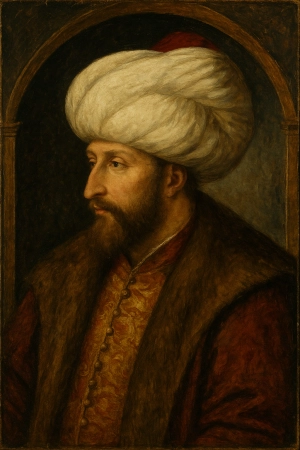
After the Ottoman-Venetian peace of 1479, the Venetian painter Gentile Bellini traveled to Mehmed’s court. Bellini’s famous 1480 portrait presented the sultan through the visual language of Renaissance rulership. Italian medals also portrayed Mehmed as a classical conqueror associated with Asia, Greece, and Trebizond.
These works reveal a court connected to the same 15th-century exchange of art, engineering, and political imagery that shaped Renaissance Italy. For broader context on this intellectual world, see Leonardo da Vinci: Renaissance Genius.
Debates, Violence, and Contradictions
Sources describe Mehmed from sharply different viewpoints. Ottoman writers praised a victorious ruler who restored order and expanded Islam’s political power. Byzantine, Venetian, and other Christian authors recorded military disaster, enslavement, taxation, and the destruction of an old imperial order. Modern histories must read these traditions critically rather than replacing one heroic or hostile legend with another.
Mehmed could preserve institutions when they served imperial stability and destroy rivals when they threatened it. He sponsored churches and patriarchal authority for some Christian communities while converting Hagia Sophia and other churches into mosques. He encouraged trade and scholarship while using compulsory population transfers, executions, dynastic violence, and warfare. His pragmatism was real, but so was the coercion on which his empire depended.
The often-repeated statement that Constantinople’s fall single-handedly caused the Renaissance is also too simple. Greek scholars and manuscripts had been moving west before 1453, and Italian humanism was already well established. The conquest intensified existing contacts and became a powerful symbol of historical change, but it did not create the Renaissance by itself.
Final Campaigns, Otranto, and Mehmed II’s Death
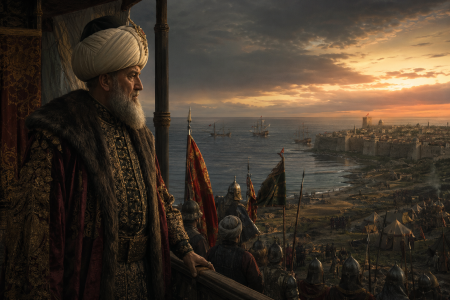
Mehmed’s final years showed both the reach and limits of his empire. In 1480, an Ottoman army failed to capture Rhodes from the Knights Hospitaller. During the same year, another Ottoman force under Gedik Ahmed Pasha crossed the Adriatic and captured Otranto in southern Italy. The seizure alarmed Italian states and raised fears of a deeper Ottoman campaign.
In the spring of 1481, Mehmed left Constantinople with another army. He became seriously ill near Gebze and died on 3 May 1481 at the age of 49. His intended target remains uncertain; historians have proposed Italy, Rhodes, or a campaign in Anatolia and the eastern Mediterranean. Claims that he was poisoned are longstanding but unproven.
His death produced a succession struggle between his sons Bayezid and Cem. Bayezid II secured the throne, while the Italian foothold at Otranto was lost in 1481. Mehmed was buried in the complex of the Fatih Mosque in Constantinople, the capital whose conquest and rebuilding defined his reign.
How Mehmed II Changed the Ottoman Empire
Mehmed inherited a powerful but still developing Ottoman state. By the time of his death, it held Constantinople, controlled most of the Balkans south of the Danube, dominated much of Anatolia, and exercised growing influence across the Black Sea and eastern Mediterranean. He did not create every Ottoman institution, nor did he conquer without setbacks, but he accelerated the transformation of the dynasty into a centralized imperial power.
His most important achievement was the combination of conquest and consolidation. Artillery opened breaches, but administrators collected taxes. Armies seized cities, but builders, merchants, settlers, judges, and religious foundations made those cities governable. Constantinople became a lasting capital because Mehmed treated it as an economic, demographic, cultural, and political project after treating it as a military objective.
Mehmed’s reign also shaped the wider 15th-century world. His conquest redirected diplomacy and warfare across southeastern Europe, influenced Venetian and Black Sea commerce, and became a point of reference for later explorers seeking routes to Asian markets. Within decades, Christopher Columbus’s 1492 voyage would open a different arena of imperial competition. Both stories reveal states using navigation, technology, finance, and claims of universal authority to expand their reach.
Conclusion: The Conqueror and the Empire Builder
Mehmed II is remembered because he achieved what earlier Ottoman rulers had not: the conquest of Constantinople. Yet the deeper significance of his reign lies in what followed. He transformed the damaged city into an imperial capital, extended Ottoman power across several regions, reorganized palace and legal authority, and used culture and Roman imperial imagery to strengthen his claim to universal rule.
His empire was built through creativity and coercion, scholarship and warfare, reconstruction and destruction. That combination makes Mehmed neither a simple hero nor a one-dimensional villain. He was a ruler of extraordinary ambition whose decisions ended one empire, accelerated the rise of another, and permanently altered the political geography of Europe and the eastern Mediterranean.
Mehmed II — Frequently Asked Questions
Who was Mehmed II?
Mehmed II was an Ottoman sultan who ruled from 1444–1446 and 1451–1481. Known as Mehmed the Conqueror, he captured Constantinople in 1453 and expanded Ottoman power across the Balkans, Anatolia, and the Black Sea region.
How old was Mehmed II when he conquered Constantinople?
Mehmed was 21 years old. He was born on 30 March 1432, and Constantinople fell on 29 May 1453.
What did the Ottomans finally accomplish in 1453?
They captured Constantinople, ended the Byzantine Empire, gained a strategic capital on the Bosporus, and strengthened the connection between Ottoman territories in Europe and Anatolia.
Did cannons alone conquer Constantinople?
No. Artillery damaged the walls, but the victory also depended on engineering, supplies, infantry assaults, naval pressure, intelligence, mining attempts, and the defenders’ exhaustion after a 53-day siege.
Did Mehmed II really move ships over land?
Yes. Contemporary sources agree that Ottoman forces transported dozens of vessels along a prepared route into the Golden Horn in April 1453. They disagree about the precise route, number of ships, and how much work occurred during the famous single night.
How much land did Mehmed II conquer?
No reliable single total exists. Medieval borders were fluid, and Mehmed controlled a mix of directly annexed provinces, tributary states, contested frontiers, and temporary occupations. His reign nevertheless added major territories in the Balkans, Anatolia, and the Black Sea region, plus the temporary Italian foothold at Otranto.
Did Mehmed II make Constantinople the Ottoman capital?
Yes. After the conquest, Mehmed established Constantinople as his principal imperial capital and launched major programs of resettlement, construction, administration, and religious patronage.
Was Mehmed II undefeated?
No. His forces failed to capture Belgrade in 1456 and Rhodes in 1480, and campaigns in Albania, Wallachia, and Moldavia encountered prolonged resistance. His reputation rests on major victories, not an uninterrupted record of success.
How did Mehmed II die?
Mehmed became ill and died near Gebze on 3 May 1481 while setting out on another military campaign. The exact illness, intended destination, and later poisoning stories remain uncertain.
Why is Mehmed II called “the Conqueror”?
The title reflects his conquest of Constantinople and his many later campaigns. In Turkish, he is widely known as Fatih Sultan Mehmed, meaning Sultan Mehmed the Conqueror.
Sources & References
- Franz Babinger, Mehmed the Conqueror and His Time. Princeton University Press, 1978.
- Halil İnalcık, The Ottoman Empire: The Classical Age, 1300–1600. Phoenix, 2001.
- Colin Imber, The Ottoman Empire, 1300–1650: The Structure of Power. Palgrave Macmillan.
- Caroline Finkel, Osman’s Dream: The History of the Ottoman Empire. Basic Books.
- Marios Philippides and Walter K. Hanak, The Siege and the Fall of Constantinople in 1453. Ashgate, 2011.
- Roger Crowley, 1453: The Holy War for Constantinople and the Clash of Islam and the West. Hyperion, 2005.
- Steven Runciman, The Fall of Constantinople 1453. Cambridge University Press.
- Çiğdem Kafescioğlu, Constantinopolis/Istanbul: Cultural Encounter, Imperial Vision, and the Construction of the Ottoman Capital. Pennsylvania State University Press, 2009.
- Julian Raby, studies on Mehmed II’s Italian portrait medals and artistic patronage.
- Encyclopaedia Britannica, “Mehmed II” and “Fall of Constantinople.”
- History of Istanbul, studies on the 1453 siege and the reconstruction of the Ottoman capital.
- The Metropolitan Museum of Art and National Gallery of Art, collection records for Renaissance medals and portraits of Mehmed II.
More Articles