Leonardo da Vinci: Renaissance Genius
How Leonardo reshaped Renaissance art while pursuing anatomy, engineering, nature, and science through relentless observation.
Who Was Leonardo da Vinci?
Leonardo da Vinci was an Italian Renaissance painter, draftsman, engineer, anatomist, designer, and investigator of nature who lived from 1452 to 1519. Although he completed relatively few paintings, works such as the Mona Lisa, The Last Supper, and Virgin of the Rocks helped reshape European art. At the same time, thousands of pages of drawings and notes reveal sustained investigations into anatomy, mechanics, water, optics, geology, flight, architecture, and military technology.
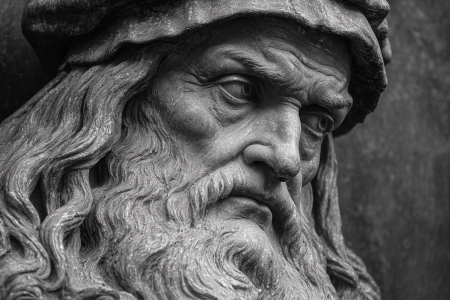
Leonardo is often described as the ideal Renaissance man or polymath. That reputation does not come simply from having many interests. What made him unusual was his habit of connecting them. Anatomy improved his painting of bodies; optics shaped his understanding of light and shadow; geometry informed perspective; observations of water inspired engineering ideas; and drawing became a tool for thinking through almost every problem he encountered.
His historical impact, however, needs an important distinction. Leonardo’s paintings and drawing style influenced artists during and immediately after his lifetime. Much of his scientific and anatomical work did not have the same contemporary effect because his notebooks remained largely unpublished for centuries. His fame today therefore combines two legacies: the enormously influential Renaissance artist known to his contemporaries and the scientific investigator revealed much more fully after his papers were studied in the modern era.
Leonardo da Vinci: Quick Answers
| Question | Short answer |
|---|---|
| What was Leonardo da Vinci famous for? | Painting, drawing, anatomy, engineering studies, scientific observation, and works including the Mona Lisa and The Last Supper. |
| Why was Leonardo important to the Renaissance? | He united natural observation, classical learning, art, geometry, anatomy, and engineering in ways that helped define the intellectual ideal of the Renaissance. |
| What century was Leonardo da Vinci? | He was born in the 15th century in 1452 and lived into the early 16th century, dying in 1519. |
| Was Leonardo a Renaissance man? | Yes. He is perhaps the most famous historical example of the Renaissance ideal of pursuing knowledge across multiple disciplines. |
| What did Leonardo discover? | He made important observations in anatomy, heart function, fluid motion, geology, optics, and mechanics, although most were unpublished and did not directly reshape contemporary science. |
| Did Leonardo invent the helicopter or tank? | Not in the modern sense. He drew concepts resembling later machines, but most were never built and were not direct prototypes of modern technology. |
Early Life and How Leonardo Became an Artist
Leonardo was born on 15 April 1452 near Vinci, a Tuscan hill town within the Republic of Florence. His father, Ser Piero da Vinci, was a successful notary, while his mother was a woman named Caterina. Because his parents were not married, Leonardo did not follow the conventional professional path of his father’s legitimate heirs.
Caterina’s exact background remains debated. She was traditionally described as a local woman of relatively modest status, while more recent archival research has revived the possibility that she may have been an enslaved woman brought to Tuscany from the Black Sea or Caucasus region. Historians continue to debate whether the newly identified documents refer to Leonardo’s mother specifically, so the claim should not yet be treated as settled fact.
Leonardo spent much of his youth around Vinci and Florence. Unlike boys prepared for university, law, or medicine, he did not receive an extensive classical education in Latin. His path into the Renaissance elite came through artistic training.
Training in Verrocchio’s Workshop
As a teenager, Leonardo entered the workshop of Andrea del Verrocchio, one of Florence’s leading artists. Renaissance workshops were not simply painting schools. Verrocchio’s shop produced paintings, sculptures, metalwork, decorative objects, and major commissions. An apprentice could therefore encounter drawing, pigments, casting, geometry, construction, mechanical problems, and the practical organization of large artistic projects.
Leonardo participated in collaborative workshop paintings, most famously Verrocchio’s Baptism of Christ, and gradually began receiving independent commissions. By 1472, he was recorded among Florence’s professional painters.
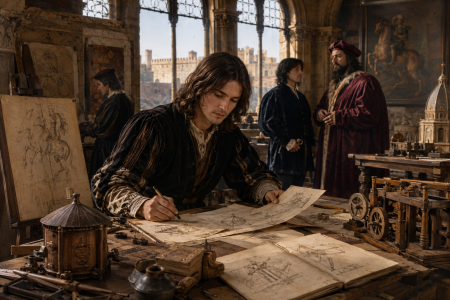
Florence offered the ideal environment for this development. Artists were experimenting with perspective, anatomy, oil painting, classical forms, portraiture, and new approaches to naturalism. Humanist scholars were recovering and interpreting ancient texts, while technologies such as the printing press were beginning to change how knowledge circulated across Europe.
Milan: Artist, Engineer, and Court Designer
Around 1482, Leonardo left Florence for Milan, where the Sforza dynasty offered opportunities on a much larger courtly scale. In the famous letter in which he advertised his skills to Ludovico Sforza, Leonardo emphasized military and engineering abilities before discussing painting and sculpture.
The letter is revealing. Leonardo presented himself as someone able to design bridges, siege equipment, fortifications, artillery-related devices, and machines for both attack and defense. Renaissance courts valued artists not simply as painters but as designers capable of solving military, architectural, theatrical, and ceremonial problems.
Milan became one of the most productive periods of Leonardo’s career. He worked on portraits, court entertainments, engineering projects, the enormous but unfinished Sforza equestrian monument, Virgin of the Rocks, and eventually The Last Supper. His interests in anatomy, mechanics, architecture, and natural philosophy also widened substantially during these years.
Leonardo’s military work belonged to the same transitional world explored in Knights to Cannons: The Gunpowder Revolution, when Italian rulers increasingly needed engineers who understood artillery, fortification, canals, transport, and siege warfare.
Leonardo da Vinci’s Impact on Renaissance Art
Leonardo’s most immediate historical influence came through painting and drawing. Renaissance painters had already developed sophisticated perspective, naturalism, portraiture, and anatomical representation before him. Leonardo did not invent these ideas, but he pushed several of them in unusually ambitious directions.
Naturalism, Emotion, and Sfumato
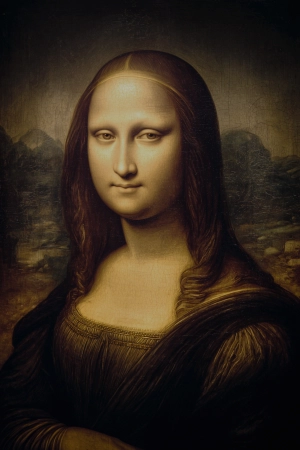
Leonardo studied how bodies move, how faces register emotion, how light passes across rounded surfaces, and how distance changes color and clarity. Instead of relying heavily on sharp outlines, he often modeled forms through gradual transitions between light and shadow. This technique became famous as sfumato — literally associated with the softness of smoke.
The effect was particularly powerful in portraiture. Faces no longer seemed simply drawn inside contours; skin, shadow, expression, and atmosphere seemed to merge. His figures also interact psychologically, responding through gestures, glances, and posture rather than appearing as isolated symbols.
Major Works at a Glance
| Work | Approximate date | Why it matters |
|---|---|---|
| Ginevra de’ Benci | c. 1474–1478 | Early psychological portrait and the only Leonardo painting permanently held in the Americas. |
| Virgin of the Rocks | 1480s onward | Demonstrates atmospheric unity, complex figure interaction, geology, and dramatic light. |
| Lady with an Ermine | c. 1489–1491 | A dynamic court portrait in which body, head, gaze, and animal create a sense of movement and psychological presence. |
| Vitruvian Man | c. 1490 | Connects the study of human proportion with geometry, classical architectural theory, and direct measurement. |
| The Last Supper | 1495–1497 | Revolutionized narrative drama through perspective, gesture, group composition, and individualized emotional reactions. |
| Mona Lisa | c. 1503–1519 | Became a landmark of portraiture through sfumato, atmospheric landscape, psychological ambiguity, and subtle bodily movement. |
The Last Supper: Innovation and Disaster
Painted in the refectory of Santa Maria delle Grazie in Milan, The Last Supper depicts the instant after Christ announces that one of the apostles will betray him. Leonardo grouped the apostles into clusters of three, each responding differently, while architectural perspective draws the eye toward Christ.
Leonardo also experimented technically. Instead of working in true wet fresco, he painted on a prepared dry wall using a technique that allowed slower revisions and subtle effects. The method gave him artistic freedom but proved disastrously fragile. Deterioration began within decades and the mural has required repeated conservation efforts.
How Leonardo Inspired Other Artists
Leonardo’s influence was visible during his own lifetime. Painters working in and around Milan adopted his softly modeled faces, dreamlike landscapes, graceful figure arrangements, and emotional expressions. Modern art historians use the term Leonardeschi for artists whose work reflects this Milanese influence.
His approach also contributed to the emerging High Renaissance, in which artists sought monumental compositions, ideal beauty, convincing space, psychological depth, and technical refinement. Leonardo was therefore not simply a brilliant isolated painter; he helped establish artistic problems and solutions that other major Renaissance artists would confront.
Leonardo’s Notebooks: Drawing as a Way of Thinking
Leonardo’s surviving notebooks provide the clearest explanation for why he is considered a polymath. Rather than separating “art” from “science,” he repeatedly used drawing as a way to investigate how things worked.
His pages contain studies of:
- Human anatomy and dissection
- Birds, flight, and air currents
- Water flow and turbulence
- Plants, rocks, fossils, and landscapes
- Optics, light, shadow, and perspective
- Gears, bearings, pulleys, and mechanical motion
- Military machines and fortifications
- Maps, canals, architecture, and urban planning
Many surviving sheets are written in Leonardo’s characteristic mirror writing, moving from right to left. Popular culture sometimes treats this as evidence that he was hiding secret knowledge. There is little reason to believe that. Leonardo was left-handed, mirror writing was habitual for him, and documents intended for other people could be written in the conventional direction.
Important collections include the Codex Atlanticus in Milan, the Codex Arundel in London, the Codex Leicester, and hundreds of sheets in the Royal Collection at Windsor. These papers preserve thousands of observations but should not be mistaken for finished textbooks. Many are working notes — exploratory, contradictory, revised, and sometimes abandoned.
The Vitruvian Man: Why It Became a Renaissance Symbol
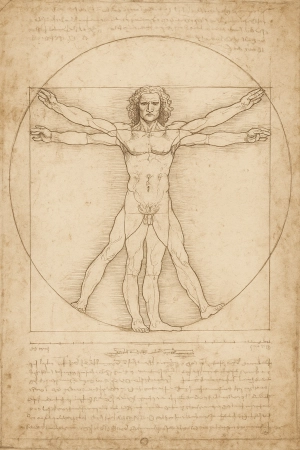
Leonardo’s Vitruvian Man, created around 1490, is among the most recognizable drawings in history. It places the human body within a circle and a square while exploring systems of bodily proportion associated with the ancient Roman architect Vitruvius.
The drawing is often presented as a simple illustration of Vitruvius, but recent scholarship shows that Leonardo’s investigation was more complex. His measurements also relate to Renaissance discussions of proportion associated with thinkers such as Leon Battista Alberti and to broader geometrical ideas.
The sheet captures a central Renaissance ambition: classical texts should not merely be copied. Ancient claims could be compared with measurement, observation, geometry, and the living human body. That combination helps explain why the image became a lasting symbol of the Renaissance relationship between humanism, art, mathematics, and nature.
What Did Leonardo da Vinci Discover?
Search results often describe Leonardo as a scientist who “discovered” modern ideas centuries early. The reality is both more cautious and more impressive. Leonardo made several remarkably advanced observations, but because his research was mostly unpublished, those observations generally did not enter the scientific literature of his own period.
Anatomy and Human Dissection
Leonardo’s anatomical research became especially intense between roughly 1506 and 1513. Working in hospitals and medical settings, he may have dissected around 30 human bodies, alongside numerous animals. His drawings investigated the skeleton, muscles, internal organs, nervous system, reproductive anatomy, brain, and heart.
His ambition was not simply to create attractive anatomical drawings. He hoped to understand structure and function and appears to have planned an illustrated anatomical treatise. Had that work been completed and printed, it could have been enormously important. Instead, the notes remained private papers.
The Heart and Aortic Valve
Leonardo produced particularly sophisticated studies of the heart. He investigated its chambers, valves, muscles, and blood movement and recognized that the heart functioned as a pump.
In one remarkable experiment, he made a model of the aortic root and studied water movement through it. He correctly reasoned that swirling currents behind the aortic valve helped the valve close efficiently after each heartbeat — an observation verified using modern fluid-imaging techniques centuries later.
Leonardo did not, however, discover the complete circulation of the blood. He remained influenced by ancient physiological ideas and could not fully reconcile everything he observed.
Geology, Water, and Fossils
Leonardo also studied rocks, erosion, sediment, fossils, rivers, and water movement. He recognized that landscapes changed over long periods through physical processes and questioned explanations that treated marine fossils found in mountains as simple products of a single recent flood.
His fascination with moving water produced studies of vortices and turbulence that look strikingly modern. Yet here again, his historical significance lies mainly in the sophistication of his observations rather than in direct influence on later scientists, since his notebooks were not circulating as published scientific works.
Leonardo da Vinci’s Inventions and Engineering Ideas
Leonardo worked repeatedly for patrons who expected practical engineering expertise. His notebooks contain bridges, locks, pumps, cranes, gears, canals, mills, weapons, fortifications, theatrical machinery, and many other mechanisms.
Military Engineering
- Fortifications: plans for defenses adapted to increasingly powerful artillery.
- Multi-barrel weapons: arrangements intended to increase the rate of projectile fire.
- Giant crossbows: dramatic oversized weapons, likely as much demonstrations of engineering imagination as practical battlefield machines.
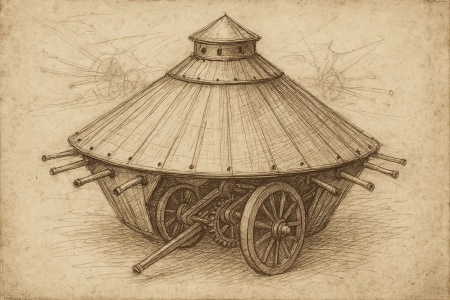
- Armored vehicle: a covered mobile platform equipped with guns, often compared loosely to a modern tank.
- Bridges: portable and military bridge concepts designed for rapid movement.
Some designs were plausible, others impractical, and many were never constructed. Leonardo’s importance as an engineer should therefore not be measured by counting modern machines he supposedly “invented.” His notebooks instead show the extraordinary breadth of problems he tried to solve.
The Dream of Flight
Leonardo studied birds in detail and tried to understand how wing shape, air, weight, and motion made flight possible. His sketches include flapping-wing machines, gliding ideas, a parachute-like device, and the famous aerial screw.
The aerial screw is often described as a “helicopter.” It resembles the principle of a rotating lifting surface, but Leonardo did not build a working helicopter, and human muscle could not have powered the machine as drawn. Its importance lies in the attempt to reason mechanically about vertical flight rather than in a direct technological line to modern aircraft.
The same is true of his so-called “tank.” The drawing demonstrates an imaginative concept for protected mobile firepower, but it should not be presented as the direct invention of the modern armored fighting vehicle.
Why Leonardo da Vinci Was Important to the Renaissance
Leonardo’s importance to the Renaissance comes from more than the fame of individual paintings. His career embodied several of the period’s central intellectual tendencies: fascination with nature, recovery of classical ideas, confidence in human observation, interest in mathematical proportion, experimentation with new artistic techniques, and the belief that knowledge from different fields could reinforce one another.
| Field | Leonardo’s contribution | Historical impact |
|---|---|---|
| Painting | Sfumato, atmospheric depth, expressive gestures, psychological portraiture | Immediate and substantial influence on Renaissance artists. |
| Drawing | Used images for artistic preparation, scientific explanation, mapping, and design | Helped demonstrate the intellectual power of drawing as an investigative tool. |
| Anatomy | Detailed dissections and visual analysis of muscles, organs, brain, and heart | Extraordinarily advanced, but little direct contemporary influence because it was unpublished. |
| Engineering | Military, hydraulic, architectural, mechanical, and transportation designs | Important to his work for patrons; many famous notebook designs remained conceptual. |
| Natural science | Observations of water, geology, fossils, plants, optics, and motion | Shows sophisticated empirical reasoning, but most results circulated only much later. |
| Renaissance ideal | Connected art, mathematics, nature, mechanics, and the human body | Became the enduring model of the interdisciplinary “Renaissance man.” |
How Did Leonardo Change the World?
Leonardo did not single-handedly create modern science or engineering. His most direct historical impact was artistic: his paintings, drawings, pupils, and followers altered the development of Renaissance art.
His broader modern significance comes from the survival of his notebooks. Once they became widely studied, they revealed an unusually systematic attempt to unite observation, drawing, experiment, and mechanical reasoning. That is why Leonardo now occupies a place not only in art history but in the histories of anatomy, engineering, scientific illustration, cartography, and technology.
Why Is Leonardo da Vinci Considered a Genius?
Calling a historical figure a “genius” can easily become empty praise. In Leonardo’s case, the label survives because of several identifiable qualities visible in his surviving work.
- Relentless curiosity: he investigated subjects ranging from smiles and muscles to clouds, rivers, gears, fossils, and bird wings.
- Observation before assumption: although he inherited many ancient ideas, he repeatedly compared them against bodies, landscapes, experiments, and direct visual evidence.
- Visual reasoning: drawings were not decoration but tools for dissection, measurement, explanation, comparison, and invention.
- Cross-disciplinary thinking: problems in one field often became solutions in another. Anatomy improved art; hydraulics informed landscape; mechanics shaped stage and military designs.
- Technical refinement: he could pursue a problem repeatedly over years, producing layers of revisions rather than accepting easy answers.
- Imagination grounded in mechanisms: even his most speculative machines were usually attempts to reason about force, motion, structure, or natural processes.
These qualities also explain why Leonardo became the archetypal Renaissance man. The phrase does not simply mean someone with many hobbies. It describes the Renaissance aspiration that human beings could investigate and cultivate multiple forms of knowledge rather than remain confined to a single intellectual specialty.
Leonardo da Vinci in the Changing 15th-Century World
Leonardo’s career unfolded during one of the most dynamic periods in late medieval and Renaissance history. The world around him was being transformed politically, technologically, and intellectually.
-
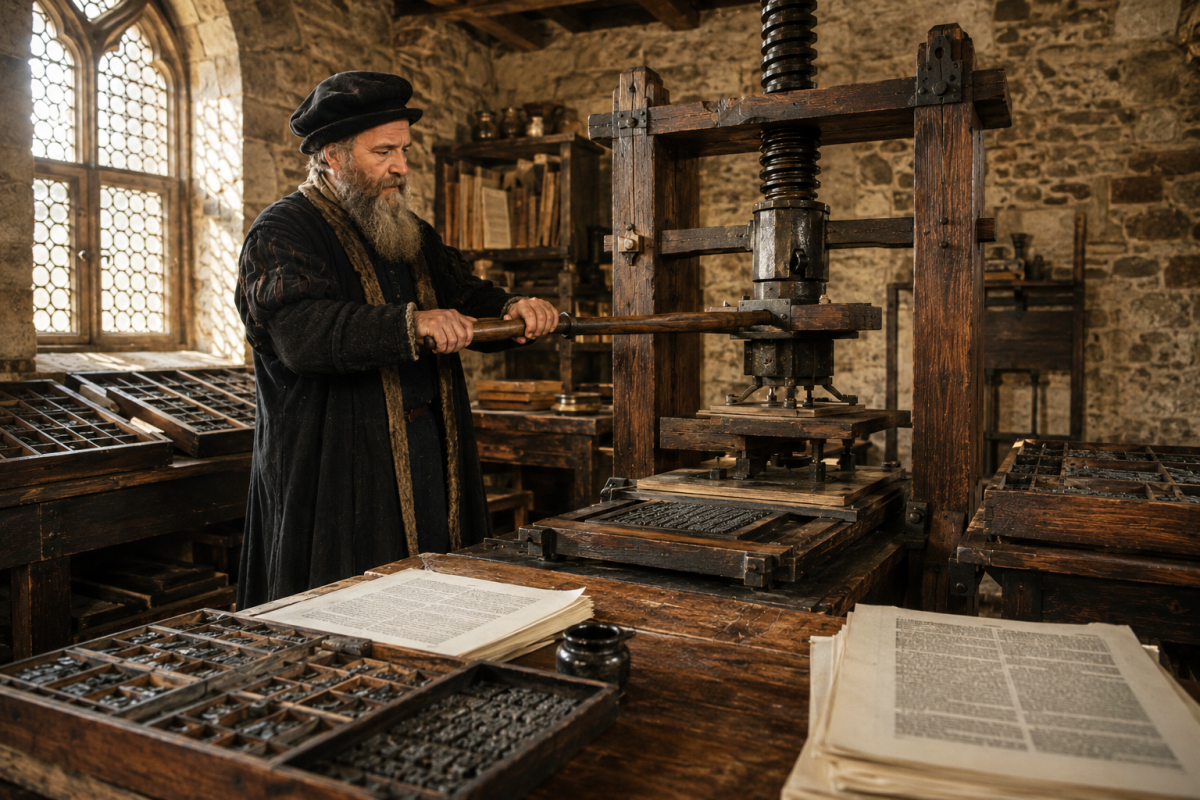
Printing multiplied information.
The printing press accelerated the reproduction of texts, images, maps, religious arguments, and technical knowledge.
-
Gunpowder reshaped warfare.
Cannon and firearms forced rulers and engineers to rethink armies and fortifications, the same military environment in which Leonardo marketed himself as an engineer.
-
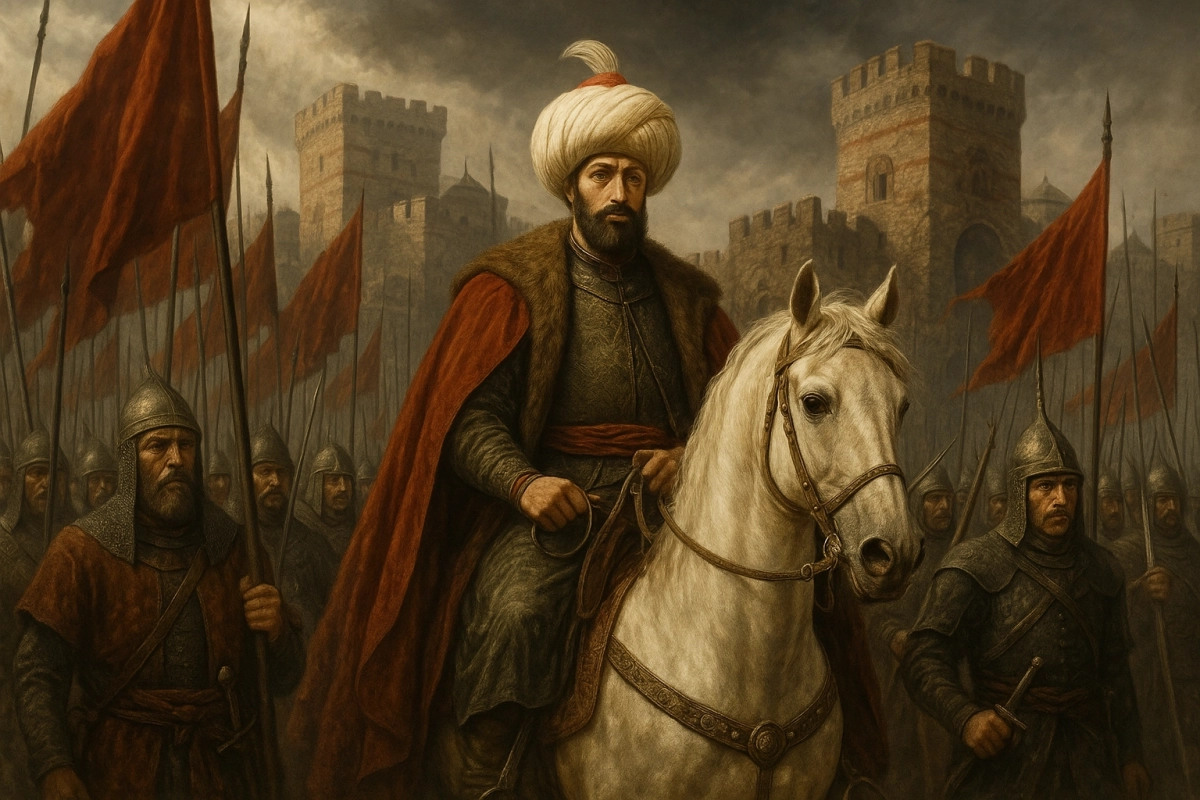
Ottoman power expanded.
Mehmed II captured Constantinople in 1453, only a year after Leonardo’s birth, dramatically altering the political world of the eastern Mediterranean.
-
Atlantic voyages widened European horizons.
During Leonardo’s adulthood, Christopher Columbus’s 1492 voyage initiated sustained European contact with the Americas.
-
The culture of war and courts changed.
Leonardo served patrons who expected artists to design festivals, weapons, buildings, portraits, monuments, maps, and machines — a much broader role than the modern idea of a studio painter.
-
Older medieval traditions remained visible.
Leonardo’s Renaissance world still stood beside the churches, fortified cities, and engineering traditions discussed in Gothic Cathedrals: Engineering the Medieval Sky.
Leonardo was therefore not a man mysteriously born “ahead of his time.” He was deeply rooted in his own time — in Renaissance workshops, Italian court politics, military rivalry, classical revival, artistic competition, and increasingly technical forms of patronage. His originality emerged from that world rather than outside it.
Leonardo da Vinci: Myths and Historical Reality
| Popular claim | Historical reality |
|---|---|
| Leonardo invented the modern helicopter. | He drew an aerial screw exploring vertical lift, but it was never a working helicopter. |
| Leonardo invented the tank. | He designed a concept for an armored mobile gun platform, not a functional modern armored vehicle. |
| Mirror writing was a secret code. | Leonardo habitually wrote backward with his left hand and used ordinary writing when preparing material for others. |
| The Church prohibited Leonardo from studying anatomy. | Human dissection was practiced in Renaissance medical settings; access and social position were greater limitations than a blanket Church ban. |
| Leonardo discovered blood circulation. | His heart studies were remarkably advanced, but he did not establish the complete circulatory system later associated with William Harvey. |
| His inventions transformed Renaissance technology. | Many designs remained private or unbuilt. His immediate artistic influence was far greater than the direct technological impact of his notebooks. |
Final Years in France
After periods in Florence, Milan, and Rome, Leonardo entered the patronage of King Francis I of France. By 1516–1517 he had moved to the manor of Clos Lucé near Amboise, where he spent the final years of his life.
His position gave him security and status, but his health was declining. A visitor in 1517 reported paralysis affecting Leonardo’s right arm, possibly the result of a stroke. Because Leonardo was left-handed, he remained capable of drawing and writing to some extent, although assistants likely carried out increasing amounts of physical work.
Leonardo died at Amboise on 2 May 1519, aged 67. He left his drawings and manuscripts principally to his pupil and close associate Francesco Melzi, who attempted to preserve them.
The collection did not remain intact. After Melzi’s death, manuscripts and individual sheets were dispersed among collectors. Hundreds survived, but many were not systematically published or understood until the 19th century. As scholars reconstructed this enormous paper archive, the familiar image of Leonardo expanded from famous painter to universal investigator.
Conclusion: Why Leonardo da Vinci Still Matters
Leonardo da Vinci’s importance to the Renaissance begins with his art. His treatment of expression, atmosphere, light, composition, landscape, and the human figure influenced other painters almost immediately and helped shape the visual language of the High Renaissance.
His notebooks reveal something different but equally compelling: a mind unwilling to accept the boundaries between painter, engineer, anatomist, and observer of nature. His scientific studies did not launch a Renaissance scientific revolution because most remained unpublished, yet they demonstrate an extraordinary commitment to seeing, measuring, drawing, questioning, and testing.
That distinction makes Leonardo more interesting than the simplified legend of a man who “invented everything.” He did not build helicopters, tanks, or modern laboratories. He did something more historically grounded: he treated the visible world as a system that could be investigated from many directions at once.
That is why Leonardo da Vinci is still considered a Renaissance genius. His greatest legacy is not a checklist of inventions but a method of curiosity — the belief that art, nature, mechanics, mathematics, and the human body become more understandable when they are studied together.
Leonardo da Vinci — Frequently Asked Questions
What is Leonardo da Vinci most famous for?
Leonardo is most famous for paintings including the Mona Lisa and The Last Supper, but he was also an extraordinary draftsman who investigated anatomy, engineering, mechanics, nature, flight, optics, and water in thousands of notebook pages.
Why was Leonardo da Vinci important to the Renaissance?
Leonardo helped transform Renaissance painting through naturalism, psychological expression, atmospheric effects, anatomy, and composition. More broadly, his work became the classic example of the Renaissance ideal that art, mathematics, nature, and human knowledge were interconnected.
How did Leonardo da Vinci influence Renaissance art?
His use of sfumato, subtle facial expression, dynamic gestures, atmospheric landscapes, and unified compositions strongly influenced painters in Milan and elsewhere. Artists associated with his Milanese circle are often called the Leonardeschi.
Why is Leonardo da Vinci considered a genius?
His reputation comes from the combination of exceptional artistic skill, precise observation, visual reasoning, mechanical imagination, and the ability to connect ideas across anatomy, engineering, optics, geometry, painting, and natural science.
Why was Leonardo da Vinci considered a Renaissance man?
Leonardo pursued expertise across numerous fields and constantly connected them. Anatomy informed painting, geometry informed perspective, mechanics informed engineering, and observation of nature shaped both his science and art. He became the best-known example of the interdisciplinary Renaissance ideal.
What did Leonardo da Vinci discover?
Leonardo made sophisticated observations about anatomy, heart valves, blood movement, fluid turbulence, fossils, geology, optics, and mechanics. Some anticipated much later scientific findings, but most remained unpublished and therefore had little direct influence on science during his lifetime.
What did Leonardo da Vinci contribute besides painting?
He worked in anatomy, engineering, architecture, military design, cartography, hydraulics, mechanics, optics, geology, botany, theatrical design, and studies of flight. His drawings are particularly important because they record how he investigated these subjects.
Did Leonardo da Vinci invent the helicopter?
No. Leonardo drew an aerial screw that explored the idea of generating lift through rotation, but it was never a working helicopter and could not have flown using the human power envisioned in the design.
Did Leonardo da Vinci invent the tank?
He drew a protected, mobile platform armed with guns that is often nicknamed Leonardo’s “tank.” It was a conceptual military design rather than a functioning ancestor of the modern tank.
Why did Leonardo write backwards?
Leonardo was left-handed and habitually wrote his personal notes from right to left. The mirror writing was not necessarily intended as secrecy; when producing maps or material for other readers he could write in the ordinary direction.
What century was Leonardo da Vinci from?
Leonardo was born in 1452, during the 15th century, and died in 1519. His career therefore bridges the later 15th century and the early 16th-century High Renaissance.
How did Leonardo da Vinci change the world?
His clearest immediate impact was on art, where his paintings and drawings influenced Renaissance artists and later European painting. His scientific notebooks became far more influential after their later rediscovery and publication, helping establish his modern reputation as a symbol of interdisciplinary curiosity.
Sources & References
- Martin Kemp, Leonardo da Vinci: The Marvellous Works of Nature and Man (Oxford University Press, 2006).
- Carmen C. Bambach, Leonardo da Vinci Rediscovered (Yale University Press, 2019).
- Charles Nicholl, Leonardo da Vinci: The Flights of the Mind (Penguin, 2005).
- Walter Isaacson, Leonardo da Vinci (Simon & Schuster, 2017).
- Luke Syson, ed., Leonardo da Vinci: Painter at the Court of Milan (National Gallery, London, 2011).
- Royal Collection Trust, Leonardo’s Study of Anatomy and Leonardo in the Royal Collection.
- National Gallery, London, biographical and exhibition resources on Leonardo da Vinci and the Leonardeschi.
- Metropolitan Museum of Art, Leonardo da Vinci (1452–1519) and Leonardo da Vinci, Master Draftsman.
- National Gallery of Art, Washington, resources on Ginevra de’ Benci.
- Gallerie dell’Accademia, Venice, research and collection information on the Vitruvian Man.
- UNESCO World Heritage Centre, Santa Maria delle Grazie and Leonardo’s Last Supper.
More Articles